

- Excursions in Egypt
- Egypt Tour Packages
- Cairo Tours and Excursions
- Hurghada Tours and Excursions
- Soma Bay Tours and Excursions
- Makadi Bay Tours and Excursions
- Sahl Hasheesh Tours and Excursions
- El Gouna Tours and Excursions
- Marsa Alam Tours and Excursions
- Port Ghalib Tours and Excursions
- El Quseir Tours and Excursions
- Dendera and Abydos Day Tours
- Aswan Tours and Excursions
- Luxor Tours and Excursions
- Sharm El Sheikh Tours and Excursions
- Top Rated Egypt Tours in 2026
- Optional Excursions in Egypt
- Private Transfer
- Blogs About egypt
- Ancient Egypt
- Historical Sites in Egypt
- Cairo
- Alexandria
- Luxor
- Aswan
- The Red Sea
- Dendera Temple
- El Fayoum Oasis
- Bahariya Oasis
- Siwa Oasis
- Al Alamein
- Marsa Matruh
- Why Egypt Is One of the Safest Countries to Visit in the Middle East
- What You Need To know Before Your First Trip To Egypt
- Egypt Travel Costs in 2026 Full Budget Guide
- Top 10 Tourist Activities in Egypt
- Top 50 Activities You Can’t Miss in Egypt in 2026
- The Guide to Guided Tours in Egypt
- Egypt’s Ancient and Modern History
- The Nile River
- The Deserts of Egypt
- Ancient Egyptian gods
- famous Egyptian dishes
- UNESCO World Heritage sites
- About Us
- Egypt Hotels and Resorts
- Excursions in Egypt
- Egypt Tour Packages
- Cairo Tours and Excursions
- Hurghada Tours and Excursions
- Soma Bay Tours and Excursions
- Makadi Bay Tours and Excursions
- Sahl Hasheesh Tours and Excursions
- El Gouna Tours and Excursions
- Marsa Alam Tours and Excursions
- Port Ghalib Tours and Excursions
- El Quseir Tours and Excursions
- Dendera and Abydos Day Tours
- Aswan Tours and Excursions
- Luxor Tours and Excursions
- Sharm El Sheikh Tours and Excursions
- Top Rated Egypt Tours in 2026
- Optional Excursions in Egypt
- Private Transfer
- Blogs About egypt
- Ancient Egypt
- Historical Sites in Egypt
- Cairo
- Alexandria
- Luxor
- Aswan
- The Red Sea
- Dendera Temple
- El Fayoum Oasis
- Bahariya Oasis
- Siwa Oasis
- Al Alamein
- Marsa Matruh
- Why Egypt Is One of the Safest Countries to Visit in the Middle East
- What You Need To know Before Your First Trip To Egypt
- Egypt Travel Costs in 2026 Full Budget Guide
- Top 10 Tourist Activities in Egypt
- Top 50 Activities You Can’t Miss in Egypt in 2026
- The Guide to Guided Tours in Egypt
- Egypt’s Ancient and Modern History
- The Nile River
- The Deserts of Egypt
- Ancient Egyptian gods
- famous Egyptian dishes
- UNESCO World Heritage sites
- About Us
- Egypt Hotels and Resorts
Welcome to
Tomb of Mentuherkhepshef (KV19): Complete Guide to the Royal Prince's Tomb in the Valley of the Kings
The Tomb of Mentuherkhepshef (KV19) is one of the most remarkable princely tombs in the Valley of the Kings, located on the west bank of Luxor, Egypt. Unlike the magnificent royal tombs built for reigning pharaohs, KV19 was created for a member of Egypt’s royal family and offers a fascinating glimpse into the burial traditions reserved for royal princes during the late New Kingdom. Originally excavated for Prince Ramesses Sethherkhepshef, who later became Pharaoh Ramesses VIII, the tomb was abandoned when the prince ascended the throne. It was later completed and reused for Prince Mentuherkhepshef, a son of Pharaoh Ramesses IX. This unusual history makes KV19 one of the few tombs in the Valley of the Kings with two significant royal associations, providing valuable evidence for the political, religious, and funerary practices of the Twentieth Dynasty.
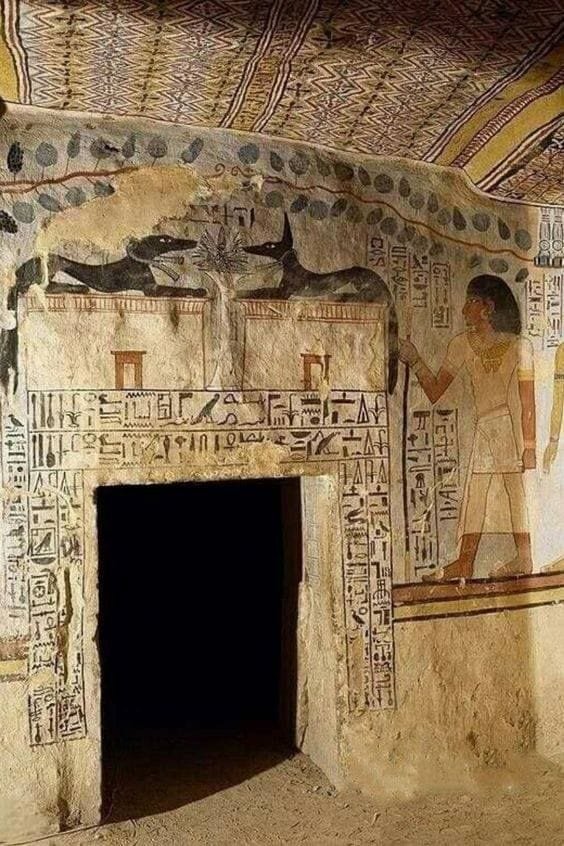
Although KV19 is smaller than famous monuments such as KV17 (Seti I), KV11 (Ramesses III), or KV62 (Tutankhamun), it is celebrated for its exceptional artistic quality and remarkably well-preserved decoration. The tomb contains beautifully carved reliefs and vividly painted scenes depicting Prince Mentuherkhepshef presenting offerings to major Egyptian deities, including Osiris, Anubis, Ptah, Ra-Horakhty, Horus, and Thoth. Hieroglyphic inscriptions, religious prayers, and sacred funerary texts cover the walls, reflecting the ancient Egyptian belief that members of the royal family required divine protection and magical guidance to achieve eternal life in the afterlife. These colorful scenes make KV19 one of the finest examples of a royal prince’s burial monument from ancient Egypt.
Today, the Tomb of Mentuherkhepshef remains an important archaeological site within the Theban Necropolis, attracting Egyptologists, historians, photographers, and travelers interested in exploring lesser-known treasures of the Valley of the Kings. While it may not contain the spectacular treasures of Tutankhamun’s tomb, KV19 offers something equally valuable: an intimate look at the lives, status, and religious beliefs of Egypt’s royal princes during the final years of the New Kingdom. This comprehensive guide explores the history of Prince Mentuherkhepshef, the original owner of the tomb, its architecture, religious decoration, archaeological discoveries, conservation efforts, visitor experience, and lasting significance, explaining why KV19 remains one of the most fascinating monuments in ancient Egyptian archaeology.
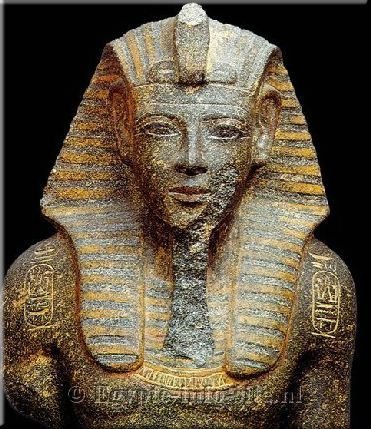
1. Who Was Prince Mentuherkhepshef?
Prince Mentuherkhepshef was a prominent member of Egypt's royal family during the Twentieth Dynasty and is generally identified as a son of Pharaoh Ramesses IX, one of the later rulers of the New Kingdom. Although he never ruled Egypt as pharaoh, his royal birth granted him exceptional status within the Egyptian court and entitled him to receive an elaborate burial in the prestigious Valley of the Kings. His name, which may be translated as "Montu is with his strong arm", honored the powerful war god Montu, reflecting the importance of divine protection and military strength within the royal family. Like many princes of the Ramesside Period, Mentuherkhepshef likely held important ceremonial, religious, or administrative responsibilities while serving the Egyptian state and supporting his father's reign. Historical information about Prince Mentuherkhepshef remains limited, largely because the surviving written records from the late Twentieth Dynasty are incomplete. However, his beautifully decorated tomb provides valuable clues about his rank and importance. The elaborate religious scenes, high-quality artwork, and carefully planned architecture of KV19 demonstrate that he occupied a privileged position within the royal household. Throughout the tomb, the prince is shown wearing elegant royal garments, ceremonial wigs, and traditional insignia while making offerings to the gods. These depictions emphasize his close relationship with the divine world and his expectation of joining the gods in the afterlife, much like the reigning pharaoh himself. The burial of Prince Mentuherkhepshef also highlights the important role played by royal princes in ancient Egyptian society. While only the pharaoh ruled the kingdom, members of the royal family often served as military commanders, priests, administrators, diplomats, or heirs to the throne. Their tombs reflected their elevated social status and ensured that they would receive eternal protection through elaborate religious rituals and sacred texts. In the case of KV19, the prince's burial demonstrates that even non-ruling members of the royal family could receive magnificent funerary monuments decorated by the highly skilled artisans of Deir el-Medina. Today, Prince Mentuherkhepshef remains one of the best-known royal princes of the late New Kingdom, largely because of the remarkable preservation of his tomb.
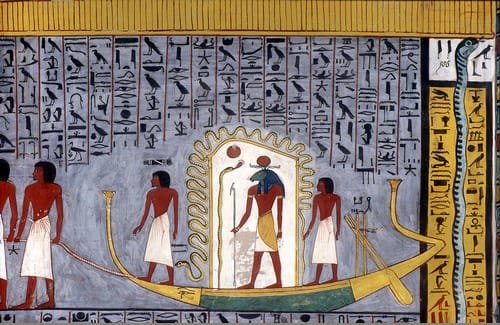
2. The Original Owner of KV19 – Prince Ramesses Sethherkhepshef (Later Ramesses VIII)
One of the most fascinating aspects of KV19 is that it was not originally intended for Prince Mentuherkhepshef. Archaeological evidence shows that the tomb was first excavated for Prince Ramesses Sethherkhepshef, a royal prince who would later become Pharaoh Ramesses VIII, one of the shortest-reigning kings of the Twentieth Dynasty. Before ascending the throne, Egyptian princes commonly began preparing their burial places in anticipation of their future deaths. As a result, work on KV19 likely commenced while Ramesses Sethherkhepshef was still a prince. However, after unexpectedly becoming pharaoh, he abandoned the unfinished monument in favor of constructing or selecting a more suitable royal tomb befitting Egypt's king. The decision to abandon KV19 provides valuable insight into the customs of royal burial during the New Kingdom. Egyptian tradition required reigning pharaohs to possess tombs that reflected their divine status and supreme authority. A monument originally designed for a prince would no longer be considered appropriate after accession to the throne. Consequently, the partially excavated KV19 remained unused until it was later adapted for Prince Mentuherkhepshef. Archaeologists have identified architectural features and inscriptions supporting this sequence of events, making KV19 one of the clearest examples of a tomb whose ownership changed during construction. The reuse of KV19 demonstrates the practical approach sometimes adopted by ancient Egyptian royal builders. Rather than abandoning the monument entirely, craftsmen modified and completed the existing structure for another high-ranking member of the royal family. This adaptation included replacing planned inscriptions, completing decorative programs, and tailoring religious scenes to suit the new owner. Such reuse was relatively uncommon within the Valley of the Kings, making KV19 particularly significant for understanding royal funerary practices, construction management, and political succession during the late Ramesside Period. Today, the dual history of KV19 greatly enhances its archaeological importance, as it preserves evidence connected to both Ramesses VIII and Prince Mentuherkhepshef, two important figures from the closing years of Egypt's New Kingdom.
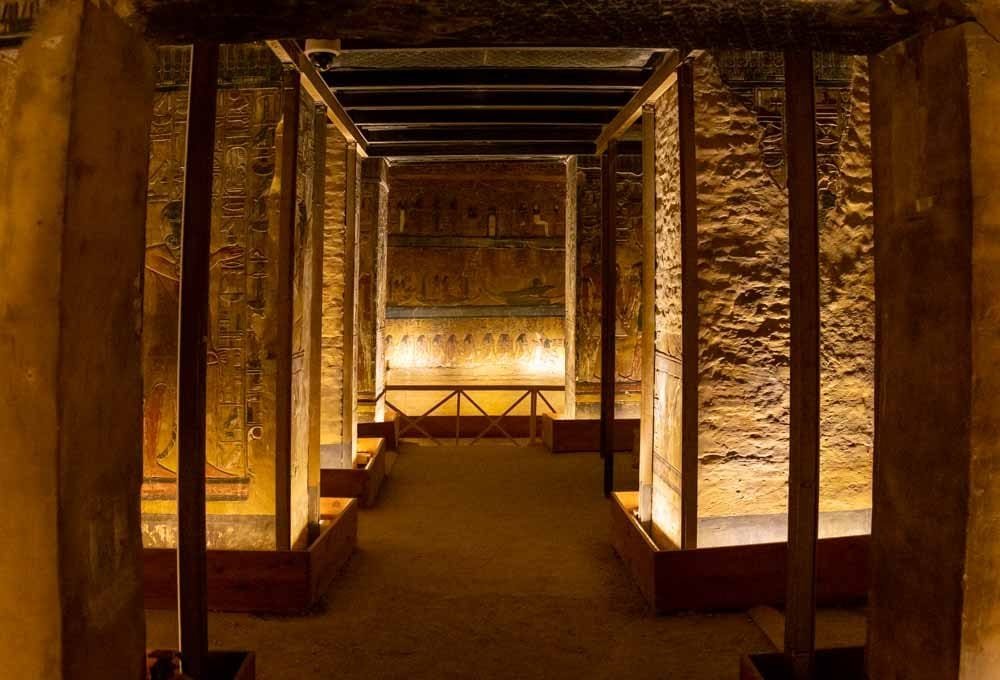
3. Architecture and Layout of KV19
The Tomb of Mentuherkhepshef (KV19) is one of the most distinctive princely tombs in the Valley of the Kings, combining elegant architecture with exceptional decorative craftsmanship. Although considerably smaller than the vast royal tombs of Seti I (KV17), Ramesses II (KV7), and Ramesses III (KV11), KV19 follows many of the architectural traditions established for elite burials during the New Kingdom. The tomb was initially excavated for Prince Ramesses Sethherkhepshef, the future Ramesses VIII, before being adapted for Prince Mentuherkhepshef. Its carefully planned layout reflects both the prestige of the royal family and the practical modifications made when ownership changed. Despite its relatively modest size, KV19 demonstrates the high standards of engineering and artistic planning achieved by the craftsmen of Deir el-Medina, whose expertise shaped many of the finest monuments in the Theban Necropolis. The tomb begins with a descending entrance corridor carved into the limestone cliffs of western Luxor, leading visitors gradually into the sacred underground space. Unlike the long and complex royal tombs built for reigning pharaohs, KV19 has a more compact plan consisting of a series of corridors and chambers that ultimately lead to the burial chamber. Every architectural element was designed according to ancient Egyptian religious beliefs, symbolizing the prince's journey from the world of the living into the eternal realm of Osiris. The walls and ceilings were carefully prepared for decoration, with smooth plaster surfaces providing the ideal foundation for painted reliefs and hieroglyphic inscriptions. Although the monument was originally intended for another owner, the modifications carried out during its completion resulted in a harmonious architectural design that successfully accommodated Prince Mentuherkhepshef's burial. One of the most remarkable features of KV19 is the close integration between its architecture and decoration. Rather than treating the walls as simple structural elements, ancient artists transformed every corridor into a sacred religious environment filled with colorful images, divine figures, and magical texts. The relatively intimate scale of the tomb allows visitors to appreciate these details from close range, making KV19 one of the most visually engaging monuments in the Valley of the Kings. Today, its elegant proportions, excellent preservation, and unusual history make the Tomb of Mentuherkhepshef one of the finest surviving examples of a royal prince's burial monument from the late Twentieth Dynasty.

4. Religious Decoration and Funerary Texts of KV19
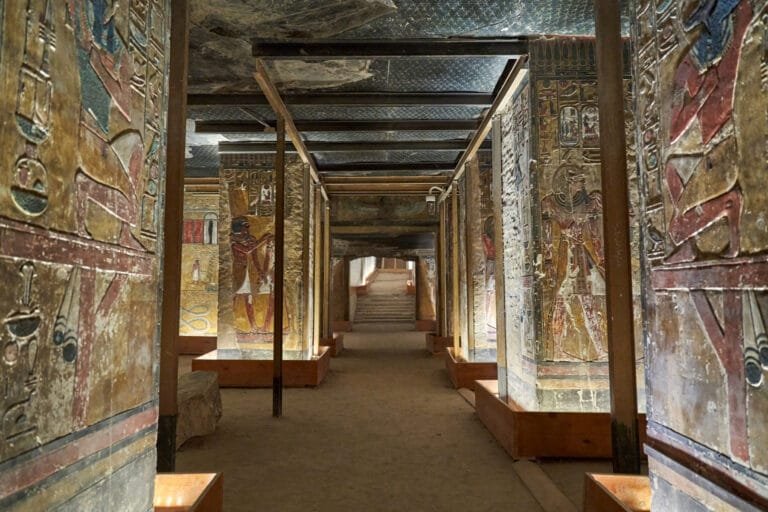
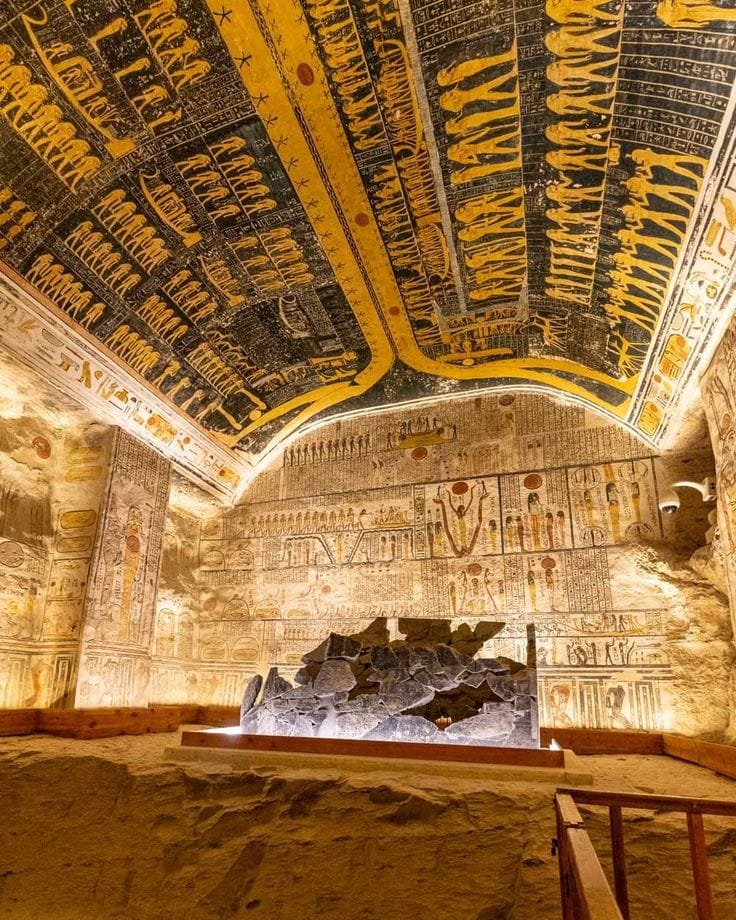
One of the greatest treasures of KV19 is its magnificent religious decoration, which ranks among the finest examples of funerary art created for a royal prince during the New Kingdom. Nearly every wall is covered with beautifully carved reliefs and brilliantly painted scenes depicting Prince Mentuherkhepshef interacting with the major gods of ancient Egypt. Although the tomb is smaller than those of the reigning pharaohs, the artistic quality rivals many royal monuments, reflecting the importance of the prince within the royal family. The vivid colors, elegant hieroglyphs, and carefully balanced compositions demonstrate the extraordinary skill of the artists from Deir el-Medina, whose workshops produced some of the most celebrated masterpieces of Egyptian art. Throughout the tomb, Prince Mentuherkhepshef is shown presenting offerings and prayers to powerful deities including Osiris, ruler of the underworld; Anubis, the jackal-headed protector of mummies; Ra-Horakhty, the solar creator; Ptah, the god of craftsmen; Horus, the divine protector of kingship; Thoth, the god of wisdom and writing; and Hathor, the goddess of love and rebirth. Each scene carries profound religious meaning, illustrating the prince's transformation from a mortal member of the royal family into an eternal blessed spirit. The hieroglyphic inscriptions accompanying these scenes include prayers, protective formulas, hymns, and invocations intended to guide the prince safely through the dangers of the underworld and ensure his acceptance among the gods. Although KV19 does not contain the complete versions of major funerary compositions found in large royal tombs such as the Book of Gates or the Amduat, its decoration reflects many of the same theological ideas. Themes of resurrection, divine judgment, purification, rebirth, and eternal life appear repeatedly throughout the monument. The colorful artwork also provides valuable information about royal clothing, ceremonial jewelry, religious rituals, and artistic conventions during the Twentieth Dynasty. Today, the decoration of KV19 remains one of the tomb's greatest attractions and an invaluable source for understanding the religious beliefs surrounding royal princes in ancient Egypt.
5. Archaeological Discoveries Inside KV19
The Tomb of Mentuherkhepshef (KV19) has provided archaeologists with valuable evidence about the burial customs of Egypt's royal family during the late New Kingdom. Although the tomb was robbed in antiquity, as were many monuments in the Valley of the Kings, numerous architectural features, painted reliefs, and inscriptions survived remarkably well. Unlike the spectacular treasure-filled discovery of Tutankhamun's Tomb (KV62), KV19's greatest archaeological value lies in its exceptionally preserved decoration and the historical evidence it provides concerning the reuse of royal tombs. Every chamber contributes to a better understanding of the lives of royal princes, the evolution of funerary traditions, and the changing political circumstances of the Twentieth Dynasty. Excavations inside KV19 have revealed evidence confirming that the tomb originally belonged to Prince Ramesses Sethherkhepshef, who later became Pharaoh Ramesses VIII, before being adapted for Prince Mentuherkhepshef. Architectural details, unfinished elements, and inscriptions indicate that the monument underwent modifications during construction to accommodate its new owner. This makes KV19 one of the clearest examples in the Valley of the Kings of a tomb whose intended occupant changed before completion. Archaeologists have carefully documented these alterations, providing important insight into how ancient Egyptian builders adjusted royal monuments to meet changing political and dynastic circumstances. Although most of the prince's original funerary equipment disappeared long ago, fragments of plaster, pigment, pottery, and architectural details continue to offer valuable archaeological information. Modern research using laser scanning, digital photography, three-dimensional modeling, and epigraphic recording has allowed scholars to preserve every relief and hieroglyph with exceptional accuracy. These projects have revealed subtle artistic techniques, corrected earlier interpretations of damaged inscriptions, and enhanced understanding of the religious program decorating the tomb. Today, KV19 remains one of the most important archaeological monuments for studying royal princes, tomb reuse, and funerary art in the Valley of the Kings, making it an essential site for both researchers and visitors interested in the history of ancient Egypt.
6. Historical Importance of KV19
The Tomb of Mentuherkhepshef (KV19) occupies a unique position in the history of the Valley of the Kings because it reflects both the changing political landscape of the Twentieth Dynasty and the important role played by Egypt's royal princes. Unlike most tombs in the Valley, which were built exclusively for reigning pharaohs, KV19 demonstrates that members of the royal family could also receive elaborate burial monuments decorated with magnificent religious artwork and sacred inscriptions. The tomb is particularly significant because it preserves evidence of two royal figures: it was originally excavated for Prince Ramesses Sethherkhepshef, who later became Pharaoh Ramesses VIII, before being completed for Prince Mentuherkhepshef, a son of Ramesses IX. This unusual sequence provides historians with valuable insight into royal succession, changing burial plans, and the practical management of construction projects during the final decades of the New Kingdom. KV19 also illustrates the continued strength of ancient Egyptian religious traditions despite the political and economic challenges facing Egypt during the late Ramesside Period. Even though the empire was experiencing declining international influence and increasing internal difficulties, the craftsmen of Deir el-Medina continued producing artwork of exceptional quality. The beautifully preserved reliefs inside the tomb demonstrate that royal workshops still maintained remarkably high artistic standards. Scenes showing Prince Mentuherkhepshef before Osiris, Anubis, Horus, Ptah, Ra-Horakhty, and other deities reveal that beliefs concerning resurrection, divine judgment, and eternal life remained central to Egyptian royal ideology until the very end of the New Kingdom. For modern Egyptology, KV19 provides a rare opportunity to study the burial traditions of a royal prince rather than a pharaoh. Because comparatively few princely tombs survive in such excellent condition, the monument fills an important gap in archaeological knowledge. It reveals how status, religious beliefs, artistic conventions, and funerary practices extended beyond the king himself to include members of the royal household. Today, the Tomb of Mentuherkhepshef is recognized as one of the most significant non-pharaonic monuments in the Valley of the Kings, offering invaluable evidence about royal family life, dynastic succession, and funerary traditions during one of ancient Egypt's most fascinating historical periods.
7. Conservation and Preservation of KV19
The preservation of the Tomb of Mentuherkhepshef (KV19) is an important priority for archaeologists and conservation specialists working in the Valley of the Kings. Although the tomb escaped some of the severe damage suffered by other monuments, its painted reliefs and carved limestone surfaces remain vulnerable to natural weathering, humidity, salt crystallization, dust accumulation, and the effects of tourism. Because KV19 contains some of the finest surviving decoration created for a royal prince during the Twentieth Dynasty, protecting its artwork is essential for preserving an important chapter of ancient Egyptian cultural heritage. Conservation efforts aim not only to stabilize the monument but also to ensure that future generations can continue studying and appreciating its remarkable artistic achievements. One of the greatest conservation challenges involves preserving the vivid pigments and delicate plaster layers covering the walls. The colorful scenes depicting Prince Mentuherkhepshef before the gods remain remarkably well preserved, but fluctuations in temperature and humidity can gradually weaken the limestone beneath the painted surfaces. Conservation teams regularly inspect the tomb for cracks, salt deposits, loose plaster, and areas of pigment loss. Using carefully controlled scientific techniques, specialists stabilize fragile surfaces while avoiding any intervention that might alter the original appearance of the ancient artwork. Their work ensures that the hieroglyphic inscriptions and religious scenes remain as authentic as possible. Modern technology has become an indispensable tool in protecting KV19. High-resolution photography, laser scanning, photogrammetry, multispectral imaging, and three-dimensional digital mapping have created detailed records of every corridor, chamber, inscription, and painted relief. These digital archives allow scholars to conduct detailed research without excessive physical contact with the monument while providing a permanent record should future deterioration occur. Visitor management also plays an essential role in preservation through controlled access, designated walkways, improved ventilation, and educational interpretation. Together, these conservation measures ensure that the Tomb of Mentuherkhepshef remains one of the best-preserved and most informative monuments in the Theban Necropolis.
8. Visiting KV19 Today – What to Expect
A visit to the Tomb of Mentuherkhepshef (KV19) offers one of the most rewarding experiences in the Valley of the Kings for travelers interested in ancient Egyptian art, religion, and royal history. Although the tomb is smaller than many of the famous royal monuments, its exceptional preservation and intimate atmosphere allow visitors to appreciate details that are often overlooked in larger tombs. As you descend through the entrance corridor, you are immediately surrounded by brilliantly colored reliefs, elegant hieroglyphic inscriptions, and beautifully carved figures that have survived for more than three thousand years. The vivid decoration creates an immersive experience, allowing visitors to feel remarkably close to the artistic world of the late New Kingdom. The highlight of KV19 is undoubtedly its magnificent wall decoration. Throughout the corridors and chambers, Prince Mentuherkhepshef is shown making offerings to gods such as Osiris, Anubis, Horus, Ptah, Ra-Horakhty, and Thoth, illustrating his spiritual journey toward eternal life. Unlike many royal tombs where decoration was left unfinished or later damaged, much of KV19's artwork remains exceptionally clear. Visitors can admire the precision of the carved reliefs, the richness of the pigments, and the remarkable skill of the artisans from Deir el-Medina. Egyptologist guides often explain the symbolism behind each scene, helping visitors understand the complex religious beliefs that shaped royal burials in ancient Egypt. Because KV19 is relatively compact, visitors can explore the monument at a comfortable pace while closely examining its artistic details. The tomb is especially popular with photographers, historians, and travelers seeking monuments beyond the Valley's most famous attractions. Combined with visits to nearby tombs such as KV17 (Seti I), KV11 (Ramesses III), or KV62 (Tutankhamun), KV19 provides a deeper appreciation of the diversity of burial traditions within the royal necropolis. Its outstanding preservation, fascinating history, and beautiful decoration make the Tomb of Mentuherkhepshef one of the hidden gems of the Valley of the Kings and an essential stop for anyone exploring Luxor's extraordinary archaeological heritage.
9. Fascinating Facts About KV19
The Tomb of Mentuherkhepshef (KV19) is filled with fascinating historical details that make it one of the most unusual monuments in the Valley of the Kings. One of its most remarkable features is that it had two intended owners. Archaeological evidence indicates that the tomb was originally excavated for Prince Ramesses Sethherkhepshef, who later ascended the throne as Pharaoh Ramesses VIII. After becoming king, he abandoned the tomb because Egyptian tradition required a reigning pharaoh to have a more prestigious royal burial. The unfinished monument was later completed for Prince Mentuherkhepshef, making KV19 one of the few tombs in the Valley whose ownership changed before completion. Another fascinating aspect of KV19 is the exceptional quality of its decoration. Despite belonging to a prince rather than a pharaoh, the tomb contains artwork comparable to that found in many royal tombs. The brightly colored reliefs have survived remarkably well, allowing modern visitors to appreciate the original brilliance of Twentieth Dynasty painting. Scenes of Prince Mentuherkhepshef standing before Osiris, Anubis, Horus, Ptah, Ra-Horakhty, Thoth, and Hathor demonstrate the extraordinary skill of the artists from Deir el-Medina, whose work remains among the finest achievements of ancient Egyptian art. One particularly interesting feature is the prince's royal attire. Throughout the tomb, Mentuherkhepshef is portrayed wearing elaborate ceremonial garments, finely crafted jewelry, decorative wigs, and symbols of high rank usually associated with members of the royal family. These depictions provide valuable evidence for the clothing, ceremonial customs, and artistic conventions of Egypt's royal court during the late New Kingdom. Unlike many monuments that focus almost entirely on the king, KV19 offers a rare visual record of how royal princes were represented in Egyptian religious art. Today, KV19 continues to attract archaeologists because it bridges two important periods of Egyptian history. It preserves evidence relating both to the future Ramesses VIII and to Prince Mentuherkhepshef, while also demonstrating how unfinished monuments could be successfully adapted for new owners. Its unique history, remarkable preservation, and artistic excellence make KV19 one of the most intriguing tombs in the Theban Necropolis.
10. KV19 Compared with Other Tombs in the Valley of the Kings
Among the more than sixty tombs discovered in the Valley of the Kings, KV19 occupies a distinctive position because it was built for a royal prince rather than a reigning pharaoh. While famous monuments such as KV17 (Seti I), KV62 (Tutankhamun), KV11 (Ramesses III), and KV9 (Ramesses V and VI) were designed to glorify kings, KV19 demonstrates how members of the royal family also received carefully planned burials reflecting their elevated social status. This distinction makes the tomb especially valuable for understanding the broader structure of Egypt's royal court and the privileges enjoyed by princes during the Twentieth Dynasty. Architecturally, KV19 is smaller and simpler than the great royal tombs, yet its artistic quality is equally impressive. The compact design allows visitors to appreciate the painted reliefs and hieroglyphic inscriptions from close range, creating a more intimate experience than that offered by many larger monuments. Although KV19 does not contain the vast corridors or multiple pillared halls found in tombs such as KV17 or KV7 (Ramesses II), its decoration is exceptionally refined and remarkably well preserved. The vivid colors, elegant compositions, and carefully carved figures rank among the finest examples of funerary art produced during the late New Kingdom. Another feature that distinguishes KV19 is its unusual construction history. Few tombs in the Valley of the Kings were begun for one royal individual and completed for another. This dual ownership provides historians with rare evidence about changes in royal succession, tomb planning, and construction management during the Ramesside Period. It also demonstrates the flexibility of ancient Egyptian builders, who successfully modified an existing monument to meet the needs of a different member of the royal family. For visitors seeking to explore beyond Egypt's most famous tombs, KV19 offers an exceptional combination of historical significance, artistic beauty, and archaeological interest. Its outstanding preservation and unique story ensure that it remains one of the most rewarding monuments to visit in the Valley of the Kings.
11. Frequently Asked Questions About KV19
Who was buried in KV19?
KV19 served as the burial place of Prince Mentuherkhepshef, who is widely believed to have been a son of Pharaoh Ramesses IX during the Twentieth Dynasty. Although originally excavated for another royal prince, the monument was later completed and adapted for Mentuherkhepshef.
Who originally owned KV19?
The tomb was originally begun for Prince Ramesses Sethherkhepshef, who later became Pharaoh Ramesses VIII. After ascending the throne, he abandoned the monument, allowing it to be reused for Prince Mentuherkhepshef.
Why is KV19 important?
KV19 is important because it preserves one of the best-decorated tombs belonging to a royal prince rather than a pharaoh. It also provides rare evidence of tomb reuse within the Valley of the Kings and offers valuable insight into royal funerary traditions during the late New Kingdom.
What gods appear inside KV19?
The tomb contains beautifully preserved scenes showing Prince Mentuherkhepshef before major Egyptian deities, including Osiris, Anubis, Horus, Ptah, Ra-Horakhty, Thoth, and Hathor, each playing an important role in the prince’s journey to the afterlife.
Can visitors enter KV19 today?
Access to KV19 depends on the current opening schedule established by the Egyptian authorities. Because tomb availability sometimes changes for conservation purposes, visitors should confirm whether KV19 is open before visiting the Valley of the Kings.
What makes KV19 different from other tombs?
Unlike most tombs in the Valley of the Kings, KV19 was designed for a royal prince rather than a ruling king. Its combination of dual ownership, exceptional artwork, and outstanding preservation makes it one of the most unique monuments in the royal necropolis.
12. Conclusion and Legacy of the Tomb of Mentuherkhepshef (KV19)
The Tomb of Mentuherkhepshef (KV19) stands as one of the finest surviving examples of a royal prince's burial monument in the Valley of the Kings. Although it does not possess the enormous scale of the great pharaonic tombs, it offers something equally valuable—a detailed and beautifully preserved record of the religious beliefs, artistic traditions, and royal customs surrounding members of Egypt's royal family during the late New Kingdom. From its remarkable history of dual ownership to its magnificent painted reliefs, KV19 provides an extraordinary window into a lesser-known aspect of ancient Egyptian civilization. The tomb also illustrates the resilience of Egyptian artistic traditions during a period of political uncertainty. Even as the Twentieth Dynasty faced economic pressures and declining royal authority, the craftsmen of Deir el-Medina continued producing masterpieces of exceptional quality. The vibrant images of Prince Mentuherkhepshef before the gods, the elegant hieroglyphic inscriptions, and the carefully planned architectural layout demonstrate that religious devotion and artistic excellence remained central to Egyptian royal culture until the very end of the New Kingdom. For archaeologists, historians, and Egyptologists, KV19 continues to provide invaluable evidence concerning royal succession, tomb reuse, funerary practices, and princely burials. Ongoing conservation projects and modern digital documentation ensure that its remarkable artwork will be preserved for future generations. As one of the hidden treasures of the Theban Necropolis, the Tomb of Mentuherkhepshef remains an essential destination for anyone seeking a deeper understanding of the Valley of the Kings, Luxor, and the enduring legacy of ancient Egypt. Its unique history and exceptional preservation guarantee its place among the most significant monuments of Egypt's royal necropolis.