- Excursions in Egypt
- Egypt Tour Packages
- Cairo Tours and Excursions
- Hurghada Tours and Excursions
- Soma Bay Tours and Excursions
- Makadi Bay Tours and Excursions
- Sahl Hasheesh Tours and Excursions
- El Gouna Tours and Excursions
- Marsa Alam Tours and Excursions
- Port Ghalib Tours and Excursions
- El Quseir Tours and Excursions
- Dendera and Abydos Day Tours
- Aswan Tours and Excursions
- Luxor Tours and Excursions
- Sharm El Sheikh Tours and Excursions
- Top Rated Egypt Tours in 2026
- Optional Excursions in Egypt
- Private Transfer
- Blogs About egypt
- Ancient Egypt
- Historical Sites in Egypt
- Cairo
- Alexandria
- Luxor
- Aswan
- The Red Sea
- Dendera Temple
- El Fayoum Oasis
- Bahariya Oasis
- Siwa Oasis
- Al Alamein
- Marsa Matruh
- Why Egypt Is One of the Safest Countries to Visit in the Middle East
- What You Need To know Before Your First Trip To Egypt
- Egypt Travel Costs in 2026 Full Budget Guide
- Top 10 Tourist Activities in Egypt
- Top 50 Activities You Can’t Miss in Egypt in 2026
- The Guide to Guided Tours in Egypt
- Egypt’s Ancient and Modern History
- The Nile River
- The Deserts of Egypt
- Ancient Egyptian gods
- famous Egyptian dishes
- UNESCO World Heritage sites
- About Us
- Egypt Hotels and Resorts
- Excursions in Egypt
- Egypt Tour Packages
- Cairo Tours and Excursions
- Hurghada Tours and Excursions
- Soma Bay Tours and Excursions
- Makadi Bay Tours and Excursions
- Sahl Hasheesh Tours and Excursions
- El Gouna Tours and Excursions
- Marsa Alam Tours and Excursions
- Port Ghalib Tours and Excursions
- El Quseir Tours and Excursions
- Dendera and Abydos Day Tours
- Aswan Tours and Excursions
- Luxor Tours and Excursions
- Sharm El Sheikh Tours and Excursions
- Top Rated Egypt Tours in 2026
- Optional Excursions in Egypt
- Private Transfer
- Blogs About egypt
- Ancient Egypt
- Historical Sites in Egypt
- Cairo
- Alexandria
- Luxor
- Aswan
- The Red Sea
- Dendera Temple
- El Fayoum Oasis
- Bahariya Oasis
- Siwa Oasis
- Al Alamein
- Marsa Matruh
- Why Egypt Is One of the Safest Countries to Visit in the Middle East
- What You Need To know Before Your First Trip To Egypt
- Egypt Travel Costs in 2026 Full Budget Guide
- Top 10 Tourist Activities in Egypt
- Top 50 Activities You Can’t Miss in Egypt in 2026
- The Guide to Guided Tours in Egypt
- Egypt’s Ancient and Modern History
- The Nile River
- The Deserts of Egypt
- Ancient Egyptian gods
- famous Egyptian dishes
- UNESCO World Heritage sites
- About Us
- Egypt Hotels and Resorts
Welcome to
The Eternal Radiance of Hathor: A Masterpiece of Ancient Cosmic Design
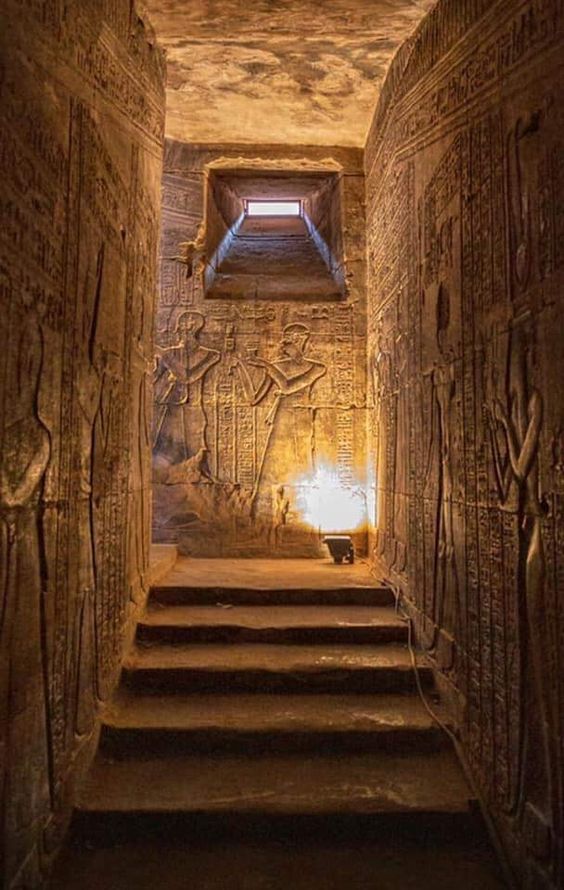
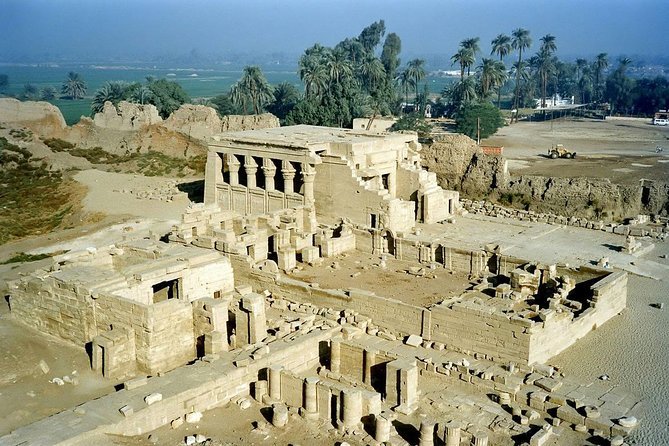
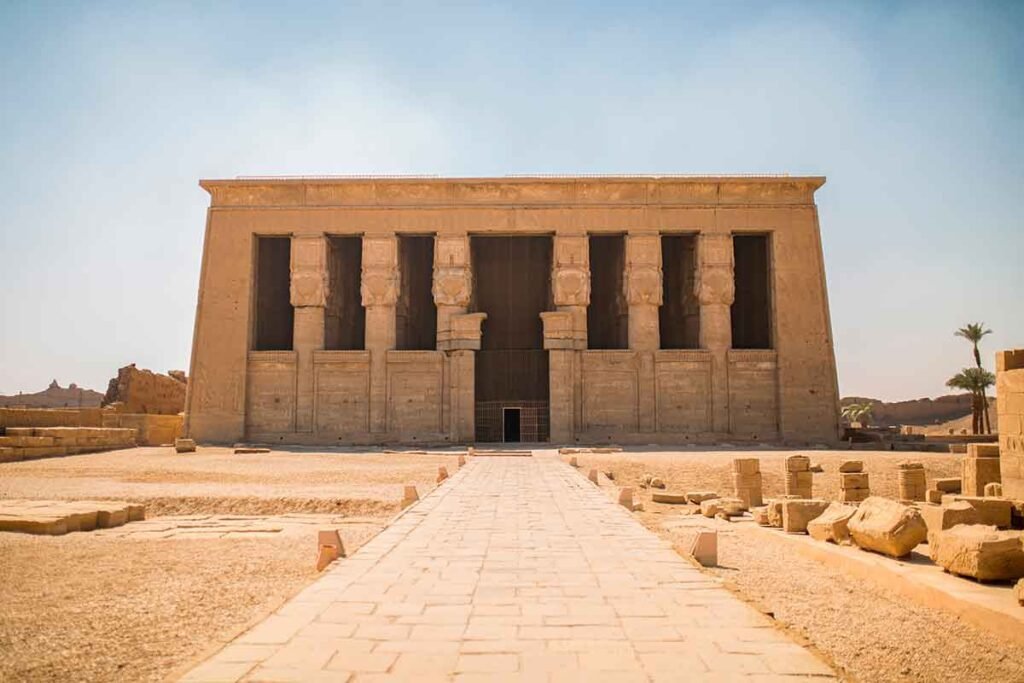
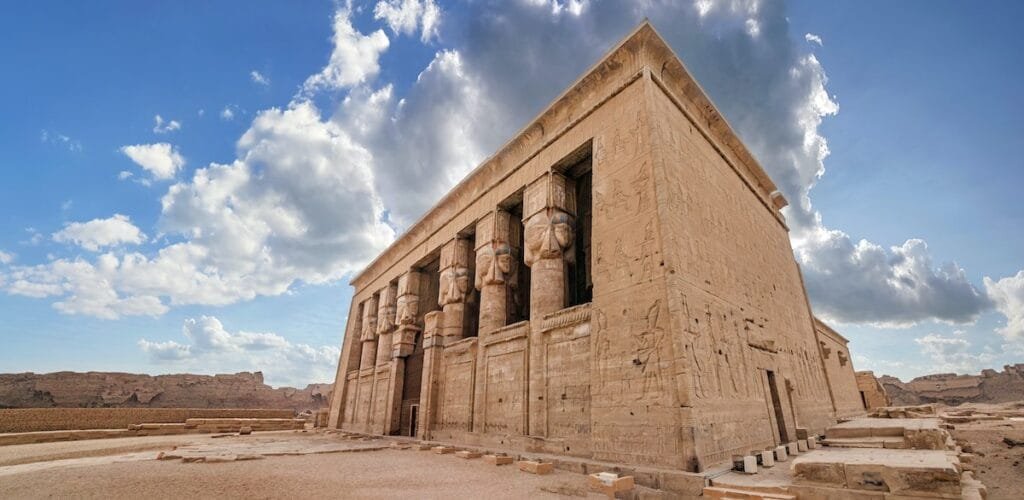
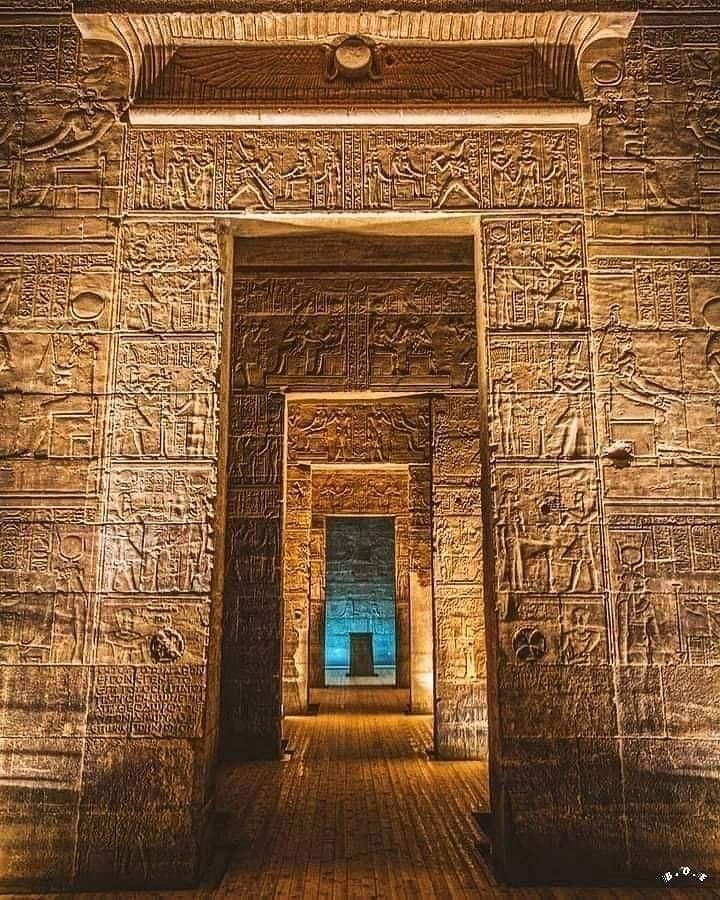
The Dendera Temple Complex stands as an unparalleled jewel of Egyptian antiquity, representing the most remarkably preserved architectural achievement of the late Pharaonic and Greco-Roman eras. Located on the west bank of the Nile, this sprawling 40,000-square-meter precinct is anchored by the majestic Temple of Hathor, a structure that defies the typical decay of history. Unlike many of its contemporaries, Dendera retains its massive stone roof, vibrant original pigments, and a labyrinthine network of hidden crypts, offering an immersive experience into what scholars call the “Living Theology” of the ancients.
The site is not merely a collection of ruins but a sophisticated cosmic engine designed to synchronize the earthly realm with the celestial movements of the stars. Dedicated to Hathor—the multi-faceted goddess of love, music, maternal care, and the sky—the temple served as a center for high science, astronomical observation, and complex spiritual healing. Every square inch of its walls is inscribed with high-relief carvings and cryptic hieroglyphics that explain the Egyptian pursuit of Ma’at (universal balance). From the famous Dendera Zodiac to the enigmatic “lightbulb” reliefs in its subterranean chambers, the complex remains a bridge between the physical world and the divine mysteries of the universe.
For the modern traveler, researcher, or history enthusiast, entering Dendera is akin to stepping through a portal into a world where architecture and astronomy were one and the same. It is a site where the legendary Cleopatra VII is still immortalized in stone and where the blue-painted ceilings still reflect the constellations as they were viewed two millennia ago. In the following exploration, we will navigate the 18 essential facets of this magnificent complex, uncovering the secrets held within its stone halls and the enduring legacy of the “Mistress of the Stars.”
1. The Gateway to Cosmic Harmony: An Introduction to Dendera
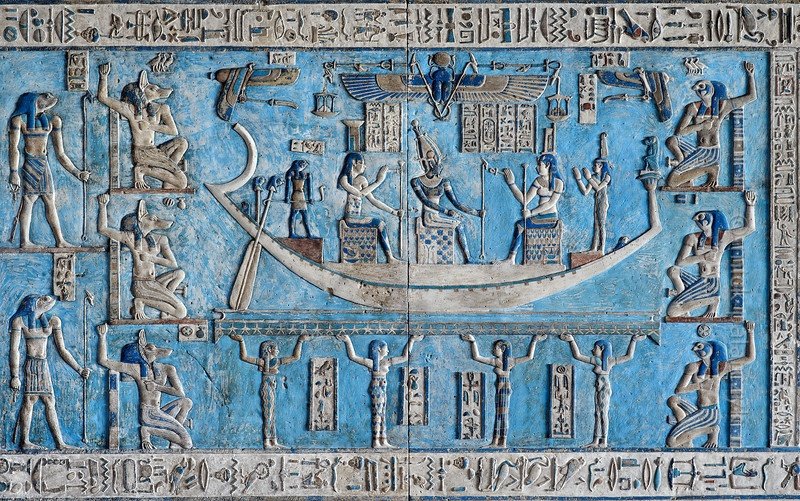
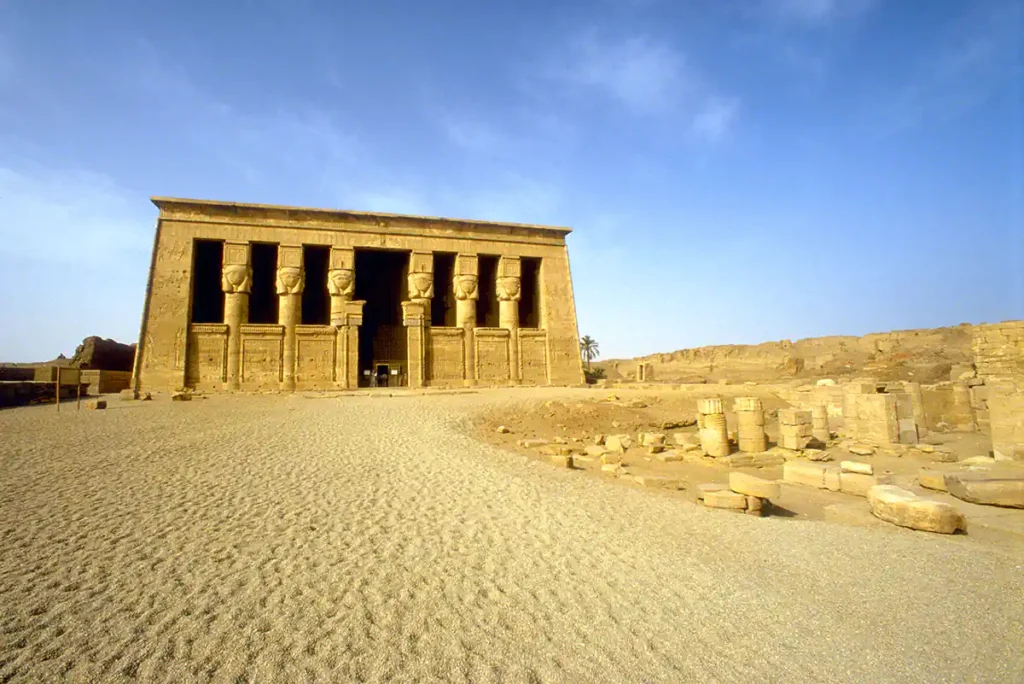
The Dendera Temple Complex stands as one of the most remarkably preserved archaeological sites in Upper Egypt, serving as a profound testament to the architectural ingenuity and spiritual depth of the late Pharaonic and Greco-Roman periods. Located approximately 60 kilometers north of Luxor on the west bank of the Nile, this sprawling complex is dominated by the majestic Temple of Hathor, the goddess of love, joy, music, and maternal care. Unlike many other Egyptian ruins that have succumbed to the ravages of time and iconoclasm, Dendera retains its roof, much of its vibrant original pigment, and an intricate subterranean network of crypts. For the modern traveler and the seasoned Egyptologist alike, Dendera offers a rare, immersive window into the "Living Theology" of ancient Egypt, where every relief and astronomical ceiling serves as a sophisticated map of the cosmos and the divine.
2. Foundations of the Divine: Historical Continuity and Sacred Lineage
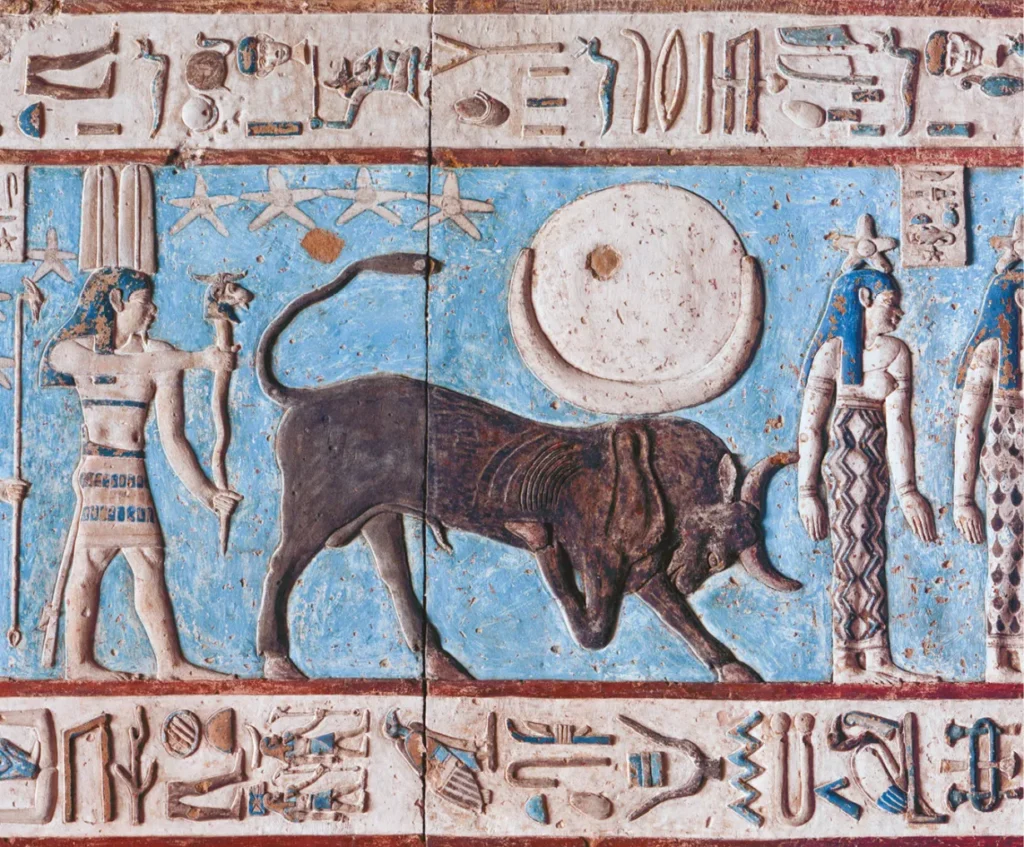
The historical lineage of the site stretches back far beyond its current stone structures, with evidence suggesting that the precinct was considered sacred as early as the Old Kingdom. While the majority of the standing architecture dates to the Ptolemaic Dynasty and was completed under the Roman Emperor Tiberius, the foundations rest upon layers of history that include the reigns of Khufu and Pepi I. This continuity of sanctity illustrates the enduring importance of the "Mistress of Dendera" in the Egyptian pantheon. The complex functioned not merely as a site for ritual worship but as a sophisticated center for healing, astronomical observation, and the celebration of the Beautiful Feast of the Reunion, where Hathor would journey by river to Edfu to visit her consort, Horus.
3. The Forest of Stone: The Grandeur of the Great Hypostyle Hall
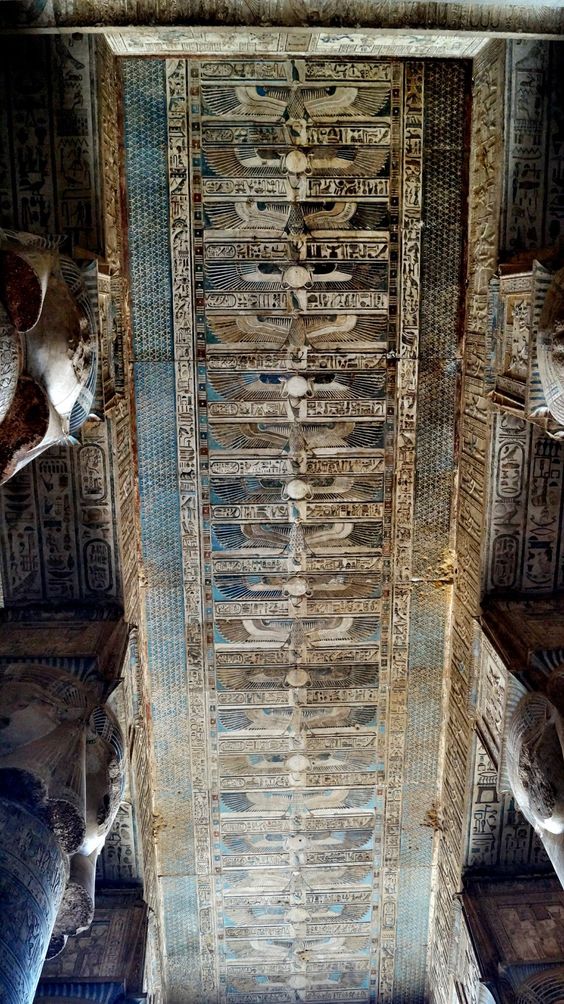
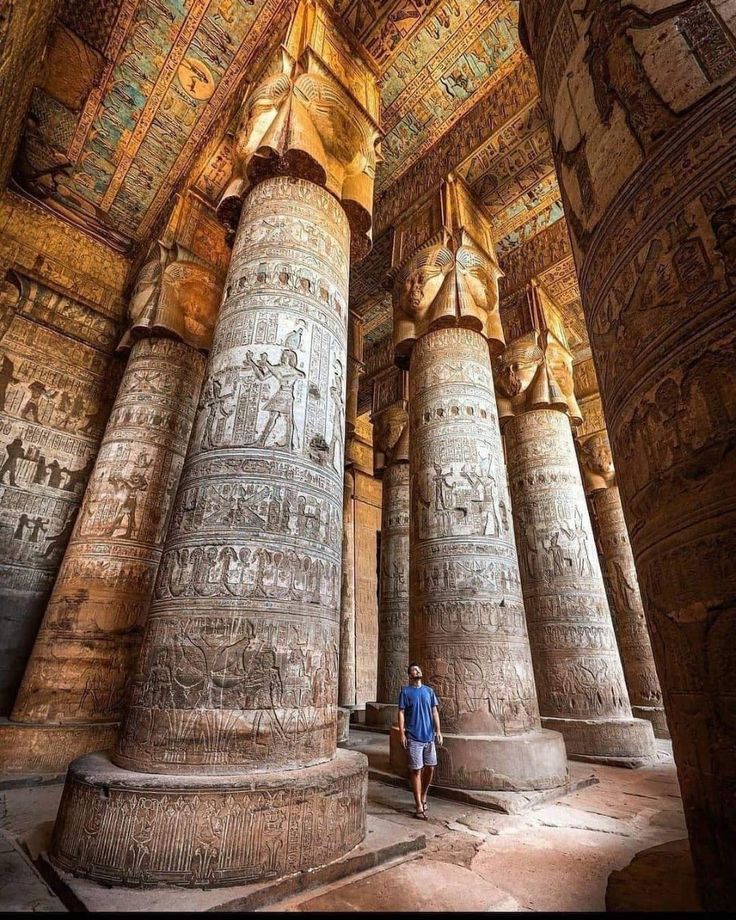
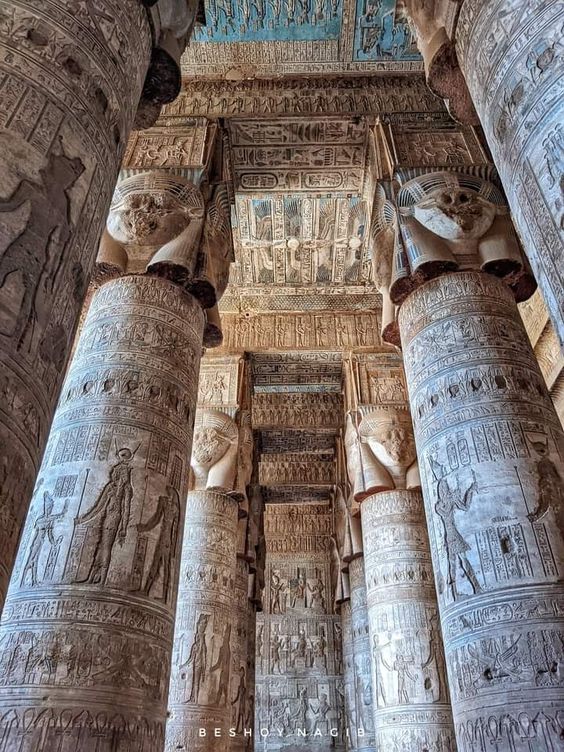
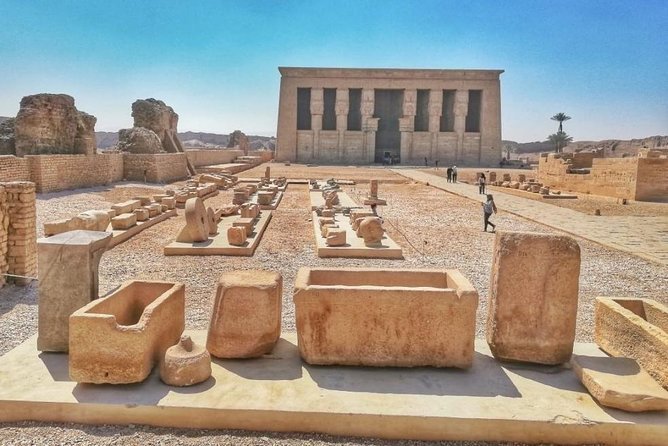
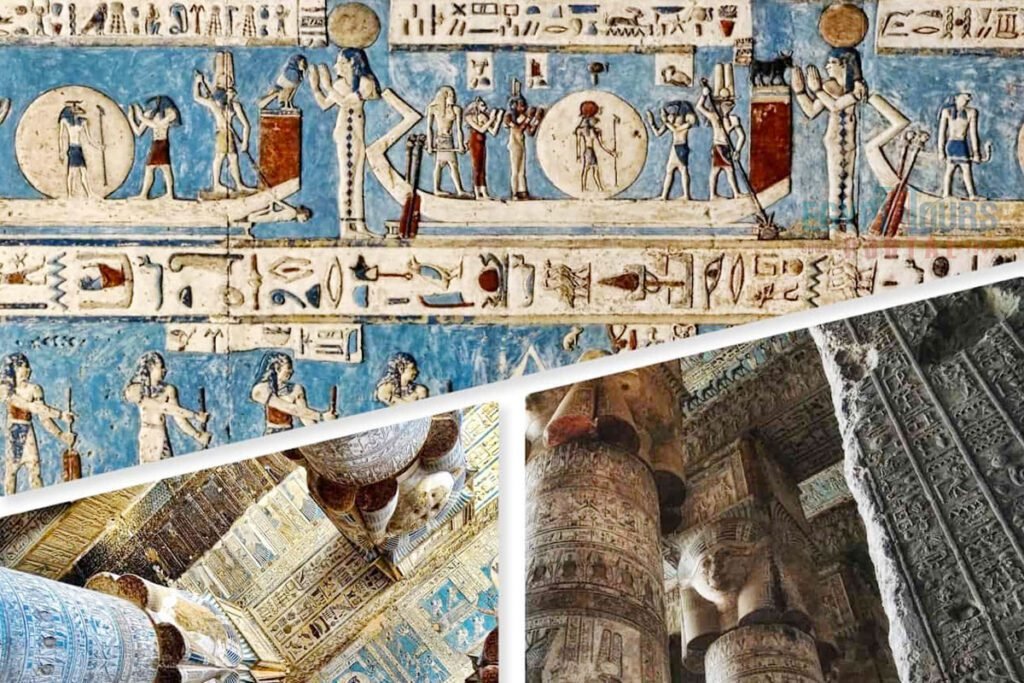
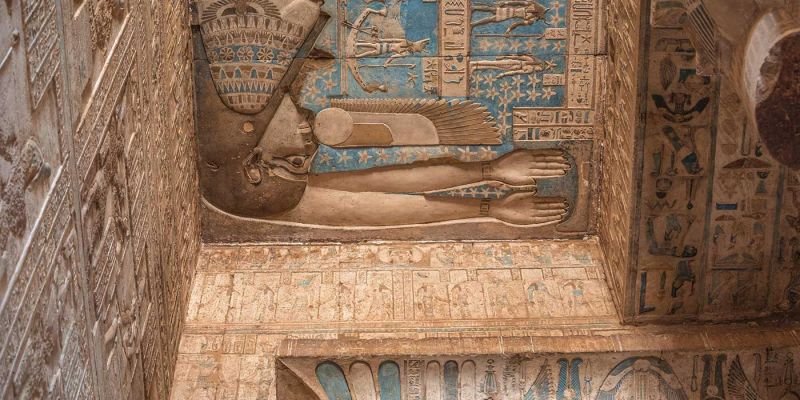
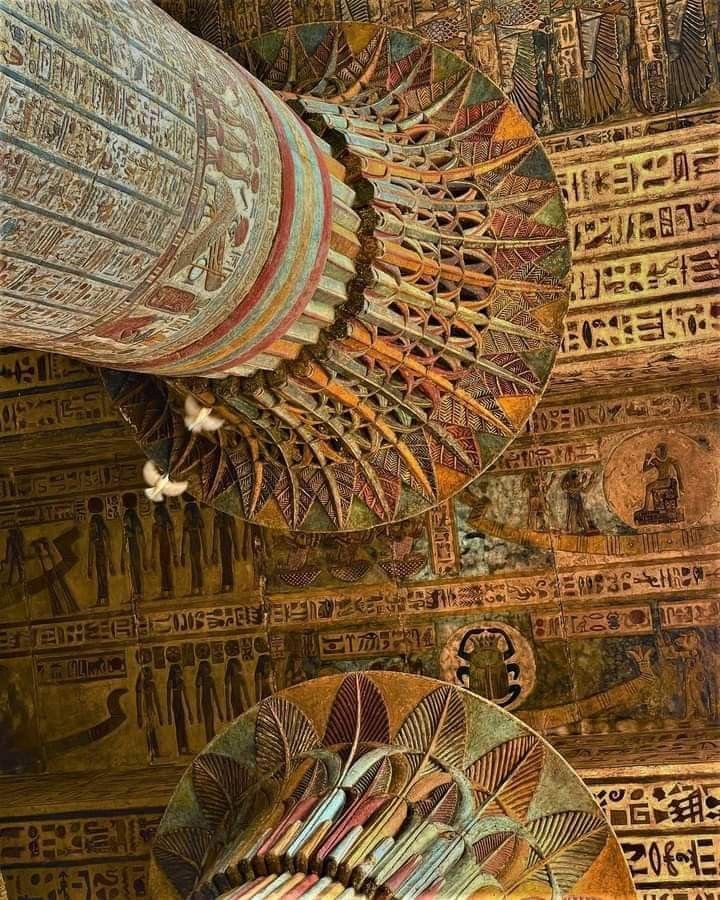
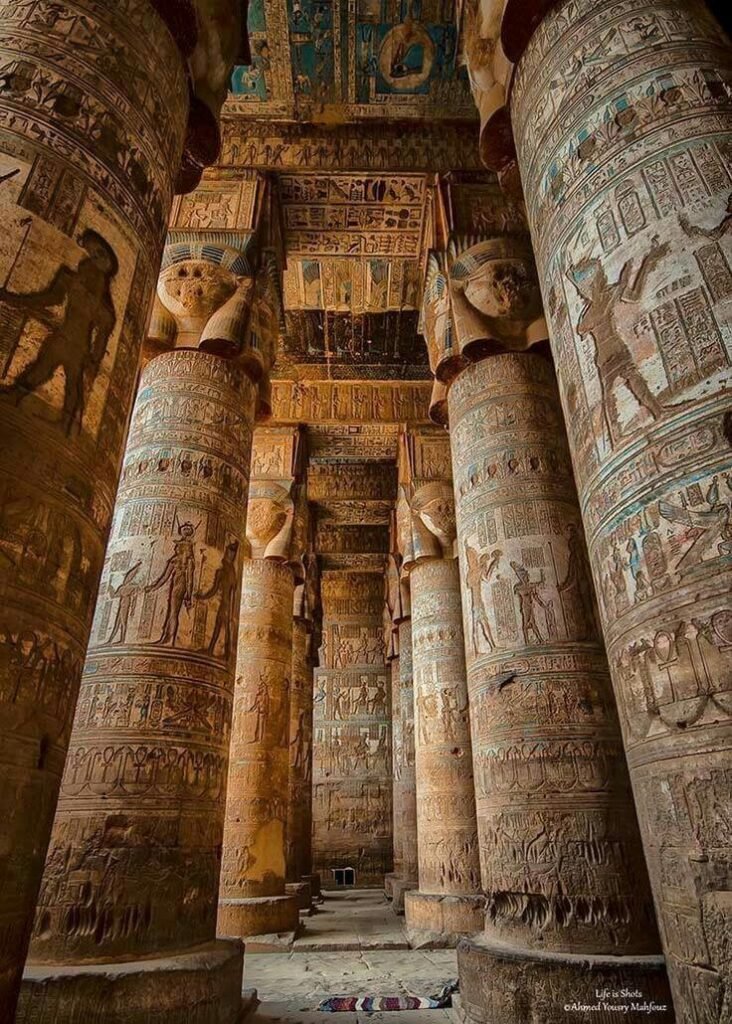
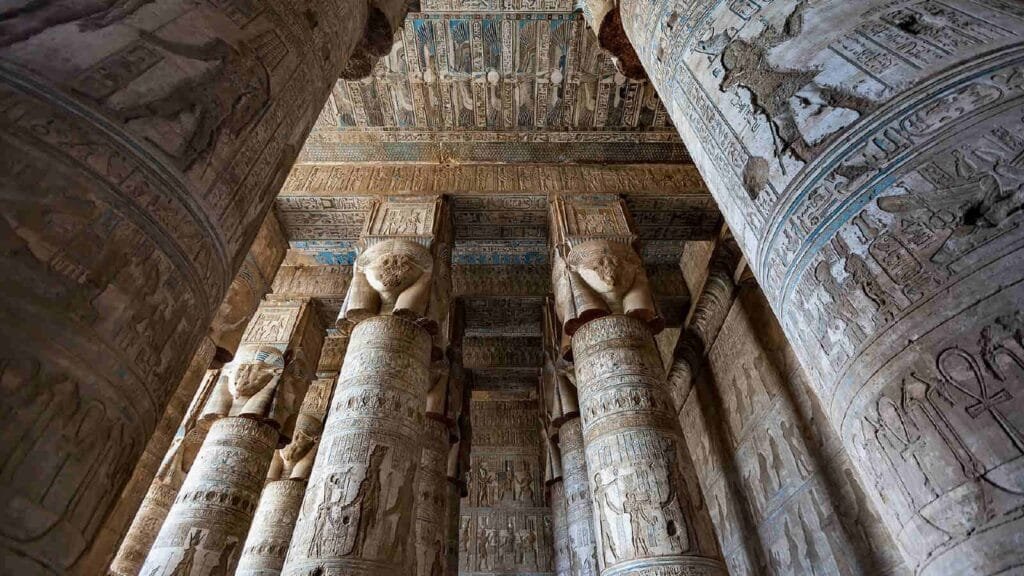
Entering the precinct through the massive mud-brick enclosure walls, visitors are immediately confronted by the awe-inspiring Great Hypostyle Hall. This architectural marvel features 24 massive columns topped with Hathoric capitals, depicting the goddess with bovine ears and a serene, maternal face. The ceiling of this hall is perhaps the most famous feature of the entire complex; following a meticulous cleaning process in recent decades, it reveals a breathtaking astronomical landscape of zodiac signs, sky deities, and the arched body of the goddess Nut swallowing the sun at night to give birth to it at dawn. The vivid blues and ochres preserved here provide a sensory bridge to the past, allowing us to perceive the temple not as a cold monument of stone, but as a vibrant, "breathing" cosmic engine designed to maintain Ma'at—the universal balance of order and truth.
4. The Celestial Ceiling and the Dendera Zodiac
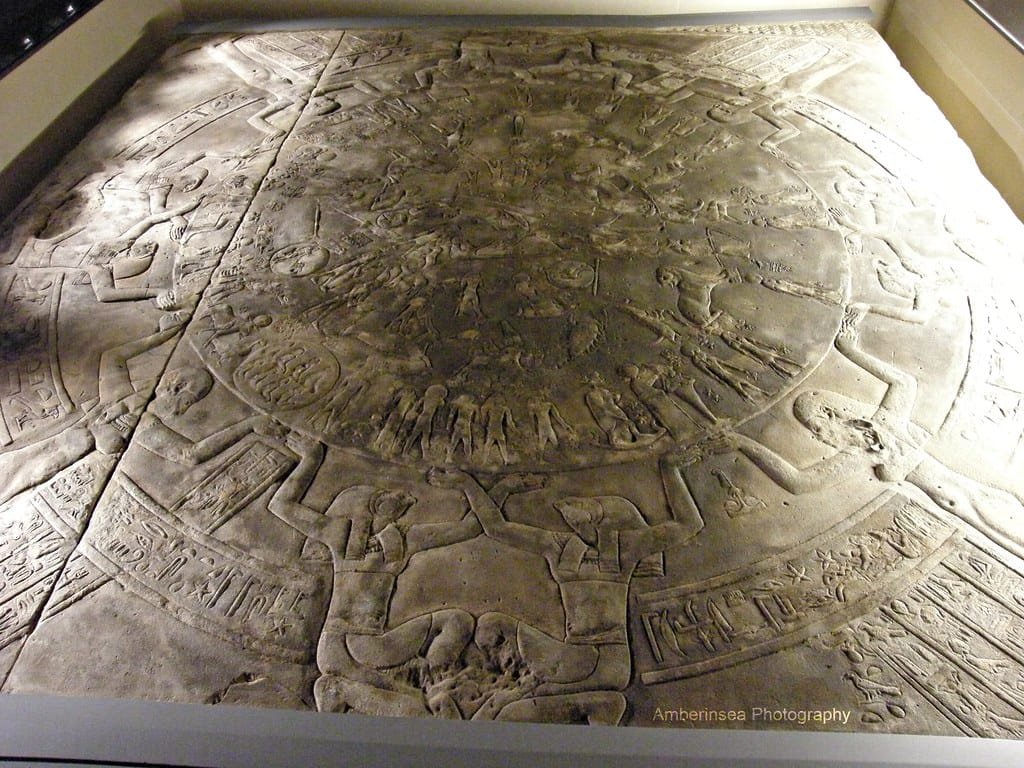
Moving deeper into the celestial theology of the temple, the roof chapels house what was once the most celebrated astronomical artifact of the ancient world: the Dendera Zodiac. While the original sandstone bas-relief was removed in the 19th century and is currently displayed in the Louvre Museum in Paris, a faithful plaster cast remains in the Chapel of Osiris at Dendera to guide visitors. This circular map of the heavens represents a masterful synthesis of Babylonian, Greek, and Egyptian astronomical traditions, depicting the constellations of the zodiac—such as Aries, Taurus, and Leo—interspersed with Egyptian decans and planetary alignments. It served as a sophisticated calendar, allowing the priesthood to calculate the cycles of the moon and the rising of Sirius, which heralded the life-giving Nile flood. The presence of this zodiac reinforces Dendera’s reputation as a center of high science, where the boundary between religious mysticism and mathematical observation was virtually nonexistent.
5. The Enigma of the Crypts and the "Lightbulbs"
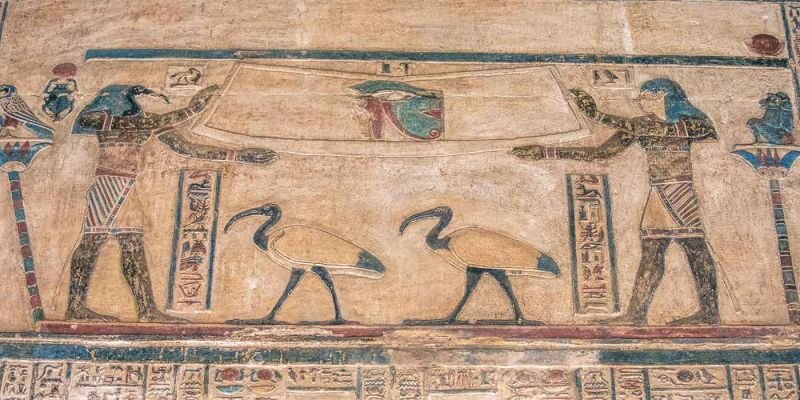
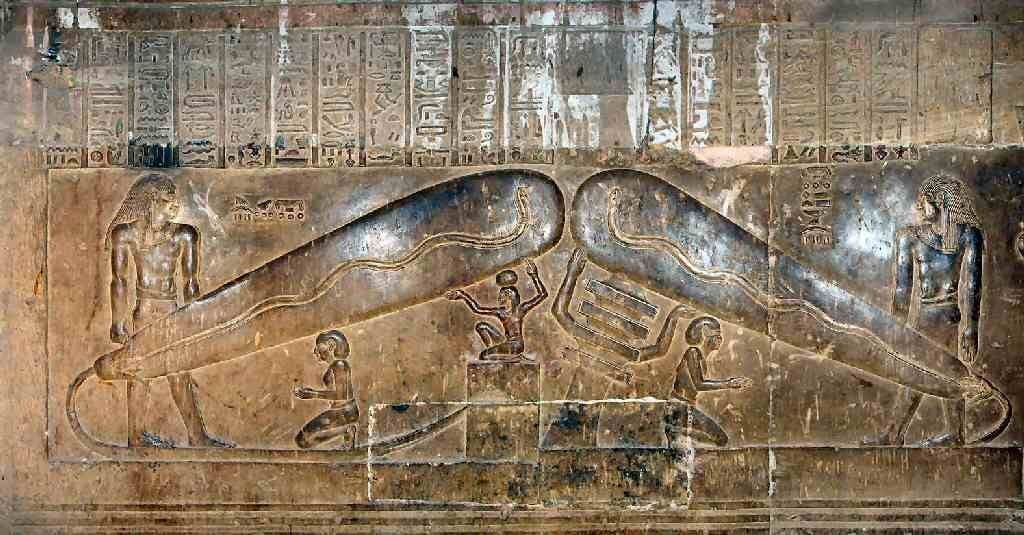
Beneath the floor of the sanctuary lies a hidden world of underground crypts, which served as secure storage for the temple’s most sacred ritual objects and precious divine statues. These narrow, beautifully carved passages are famous for containing the controversial "Dendera Lightbulb" reliefs. While fringe theorists often cite these images as evidence of ancient electrical technology, mainstream Egyptologists interpret them through the rich lens of Egyptian mythology as the birth of the god Harsomtus from a sacred lotus flower. The "bulb" is actually a protective bubble or womb of the sky, and the "cable" represents the stem of the lotus. Regardless of the interpretation, the craftsmanship in these cramped, airless spaces is staggering, featuring some of the most delicate high-relief carvings in the entire complex, originally intended to be seen only by the highest-ranking priests and the gods themselves.
6. The Sanatorium and the Healing Waters
To the west of the main temple stands the Sanatorium, a unique structure that highlights the complex's role as a major center for pilgrimage and holistic medicine. This building was a center for "divine incubation," where the sick and infirm would sleep in small, dark cells, hoping for a dream-revelation or a visitation from the goddess Hathor to cure their ailments. The Sanatorium also featured a complex system of water basins; water was poured over sacred statues inscribed with magical "healing" spells, collecting the "charged" liquid for the afflicted to drink or bathe in. This integration of medical practice and spiritual intervention showcases the ancient Egyptian worldview, where the physical body and the Ka (spirit) were treated as an inseparable unit, and divine grace was considered the ultimate catalyst for recovery.
7. The Mammisi: Celebrating the Divine Birth and Royal Legitimacy
The complex features two distinct Birth Houses (Mammisi), which were essential components of the temple's theological landscape. The older structure was initiated by Nectanebo I of the 30th Dynasty, while the more prominent Roman Mammisi was built during the reigns of Emperors Augustus and Trajan. These specialized buildings were dedicated to the mystery of the divine birth of the child-god Ihy, the son of Hathor and Horus. The walls of the Roman Mammisi are exceptionally well-preserved, featuring columns adorned with the protective figure of the dwarf-god Bes, who presided over the safety of women during childbirth. By sponsoring these buildings, foreign rulers—from the Ptolemies to the Roman Caesars—linked themselves to the divine lineage of the gods, effectively using the temple as a stage for political propaganda to prove they were the chosen "Divine Children" of Egypt.
8. The Sacred Lake and the Primeval Waters of Nun
Every major Egyptian temple required a source of pure water for the daily purification of the priesthood and the performance of sacred rituals, and Dendera’s Sacred Lake is one of the most intact examples in existence. Today, the rectangular stone-lined pool stands empty of water, surrounded by desert palms, yet its four corner staircases still lead down to where the water level once fluctuated with the Nile. Adjacent to the lake is a deep stone well that provided a constant supply of water for the temple's inner sanctum. In the Egyptian mind, these waters were symbolic of the "Primeval Waters of Nun" from which all life emerged at the beginning of time. During the great festivals, the lake became a ceremonial theater where the gilded barques of the gods were rowed across the surface in a rhythmic reenactment of the sun god's journey through the sky.
9. The Roman Gate and the Mud-Brick Enclosure Walls
The physical boundary of the precinct is marked by a massive Roman Gate, which features inscriptions and carvings of the Emperors Domitian and Trajan. This gateway serves as a profound transition point, separating the secular world from the sanctified "House of the Goddess." The entire complex is protected by a towering temenos wall constructed from mud-bricks, built in a distinctive wavy or "pulsating" pattern. This architectural choice was not merely aesthetic; it was symbolic, representing the undulating waves of the primordial ocean that surrounded the world at the moment of creation. The wall functioned as a spiritual fortress, designed to repel the chaotic forces of Isfet and preserve the sacred order within, ensuring that the rituals performed by the priests remained untainted by the outside world.
10. The Wabet and the Rites of the New Year
Located at the rear of the temple, the Wabet (meaning "The Pure Place") is a specialized open-air courtyard used for the final preparation and purification of the goddess’s statue before major festivals. On the eve of the Egyptian New Year—the arrival of the star Sirius—the gilded statue of Hathor was carried from the dark, hidden sanctuary up to the roof in a magnificent procession. This ritual was known as the "Union with the Sun Disc." In the Wabet, the goddess was dressed in fine linens and anointed with sacred oils. This space served as a transitional zone where the terrestrial statue was prepared to receive the celestial energy of her father, Ra, ensuring that the divine essence of the temple was refreshed for the year to come.
11. The Stairs of the Sun: The Architectural Path of Ascension
The movement of the clergy within the temple was choreographed through two distinct, beautifully decorated staircases: a circular one for the ascent and a straight one for the descent. These staircases are lined with detailed, low-relief carvings depicting the New Year’s Procession, showing the Pharaoh, the high priests, and various local deities carrying banners, incense burners, and the sacred barque. The wear on the stone steps, smoothed by the feet of thousands of priests over several centuries, offers a poignant physical connection to the lived reality of temple life. The walls here act as a storyboard, capturing the rhythmic, ritualized motion that defined the temple's existence, ensuring that even when the priests were absent, the "procession" continued eternally in the medium of stone.
12. The Cult of Isis and the Synthesis of Divine Power
While Hathor is the undisputed "Mistress of Dendera," the complex also honors the goddess Isis with a dedicated temple located directly behind the main sanctuary of Hathor. This Temple of Isis is unique because of its orientation—it faces East toward the rising sun, whereas the main temple faces North toward the Nile. It was specifically designed to celebrate the birth of Isis during the "intercalary days" of the Egyptian calendar. The presence of this smaller temple emphasizes the multifaceted nature of the feminine divine in late Egyptian religion, where Hathor and Isis were often seen as complementary forces. Additionally, the precinct houses a 5th-century Coptic Basilica, illustrating how this site of ancient power was later repurposed by the early Christian community, layering a new faith over the ancient foundations.
13. The Sanctuary: The Holy of Holies and the Divine Dwelling
At the absolute core of the complex lies the Sanctuary, the most restricted and spiritually charged area of the temple. In ancient times, this chamber was plunged into near-total darkness, accessible only to the Pharaoh or the High Priest who had undergone rigorous purification rites. This "Holy of Holies" was believed to be the physical dwelling place of Hathor's Ba (soul) on earth. The walls of the sanctuary and its surrounding chapels are densely packed with "Daily Ritual" scenes, depicting the god being fed, clothed, and anointed with seven types of sacred oils. These reliefs were not merely decorative; they were functional magic, intended to ensure that the goddess would continue to reside within the temple and provide her blessings to the land of Egypt even if the human priests were unable to perform their duties.
14. Architecture of the Ptolemaic Period: A Baroque Evolution
Architecturally, Dendera represents the sophisticated pinnacle of Ptolemaic design, a style that flourished under the Greek successors of Alexander the Great. This era is characterized by a "baroque" sensibility—figures in the reliefs are more rounded and fleshy, and the hieroglyphic texts become incredibly dense and cryptic, often using "phonetic puns" that only the most learned scribes could decipher. A key feature of this period seen at Dendera is the use of intercolumnar screens. These are half-height walls built between the massive columns of the facade, which allowed a controlled amount of light to filter into the hall while still shielding the sacred interior from the gaze of the uninitiated. This masterful play of light and shadow was designed to guide the initiate from the bright, chaotic external world into the silent, mysterious womb of the goddess.
15. The Resurrection of Color: Restoration and the Blue of Egypt
One of the most breathtaking aspects of a modern visit to Dendera is the stunning preservation of its original pigment. For nearly two thousand years, the ceilings and walls were obscured by a thick layer of black soot, the result of centuries of cooking fires and oil lamps used by squatters who sought shelter within the temple. In recent decades, a massive restoration project by the Egyptian Ministry of Antiquities utilized specialized dry-cleaning techniques to painstakingly remove the grime without damaging the ancient stone. The results have been revolutionary: the "Dendera Blue" (Egyptian Blue), brilliant yellows, and deep ochres have emerged with such intensity that they look as if they were applied yesterday. Seeing these colors allows us to understand that ancient Egyptian temples were not the monochromatic ruins we often imagine, but vibrant, kaleidoscopic palaces designed to reflect the colorful brilliance of the Egyptian sky.
16. Cleopatra VII and the Rear Exterior Wall
The exterior rear wall of the Temple of Hathor holds a significant historical relief that serves as a bridge between the Pharaonic age and the Roman era: a massive depiction of the legendary Cleopatra VII. This carving is one of the few contemporary representations of the famous queen and depicts her alongside her son, Caesarion (Ptolemy XV), whose father was Julius Caesar. In this scene, Cleopatra is shown in the traditional regalia of a Pharaoh, offering incense and sacrifices to the gods. This was a powerful piece of political propaganda designed to reinforce the legitimacy of her dynasty and her son’s right to rule. The sheer scale of the relief, overlooking the desert sands, serves as a poignant reminder of the temple’s political importance during the twilight of the Ptolemaic period.
17. The Theological Significance of the Sistrum
Throughout the complex, the motif of the Sistrum—a sacred musical rattle—appears with striking frequency. Hathor was known as the "Mistress of the Sistrum," and the instrument was believed to possess the magical power to appease the "Dangerous Goddess" and transform her potential wrath into joy and maternal protection. The columns of the Great Hypostyle Hall are themselves shaped like giant sistrums, making the entire building a literal instrument of the divine. Music, dance, and rhythm were not merely entertainment at Dendera; they were fundamental liturgical tools used to maintain the harmony of the universe (Ma'at). The rhythmic shaking of the sistrum in these echoing halls would have created a sonic environment that mirrored the pulsing life-force of the goddess herself.
18. Legacy and Modern Significance: An Eternal Monument
Today, the Dendera Temple Complex remains a cornerstone of World Heritage and a primary destination for those seeking to understand the spiritual and scientific sophistication of the ancients. It survives as a magnificent bridge between the Pharaonic past and the Greco-Roman world, a place where the stars were mapped and the divine was given form in stone. As modern technology and restoration efforts continue to uncover more of the site’s secrets—from hidden passages to microscopic analysis of pigments—Dendera continues to teach us about the Egyptian pursuit of immortality and their profound connection to the cosmos. It stands not as a silent tomb of a dead religion, but as an eternal monument to the enduring human search for meaning, beauty, and the divine radiance of the stars.