- Excursions in Egypt
- Egypt Tour Packages
- Cairo Tours and Excursions
- Hurghada Tours and Excursions
- Soma Bay Tours and Excursions
- Makadi Bay Tours and Excursions
- Sahl Hasheesh Tours and Excursions
- El Gouna Tours and Excursions
- Marsa Alam Tours and Excursions
- Port Ghalib Tours and Excursions
- El Quseir Tours and Excursions
- Dendera and Abydos Day Tours
- Aswan Tours and Excursions
- Luxor Tours and Excursions
- Sharm El Sheikh Tours and Excursions
- Top Rated Egypt Tours in 2026
- Optional Excursions in Egypt
- Private Transfer
- Blogs About egypt
- Ancient Egypt
- Historical Sites in Egypt
- Cairo
- Alexandria
- Luxor
- Aswan
- The Red Sea
- Dendera Temple
- El Fayoum Oasis
- Bahariya Oasis
- Siwa Oasis
- Al Alamein
- Marsa Matruh
- Why Egypt Is One of the Safest Countries to Visit in the Middle East
- What You Need To know Before Your First Trip To Egypt
- Egypt Travel Costs in 2026 Full Budget Guide
- Top 10 Tourist Activities in Egypt
- Top 50 Activities You Can’t Miss in Egypt in 2026
- The Guide to Guided Tours in Egypt
- Egypt’s Ancient and Modern History
- The Nile River
- The Deserts of Egypt
- Ancient Egyptian gods
- famous Egyptian dishes
- UNESCO World Heritage sites
- About Us
- Egypt Hotels and Resorts
- Excursions in Egypt
- Egypt Tour Packages
- Cairo Tours and Excursions
- Hurghada Tours and Excursions
- Soma Bay Tours and Excursions
- Makadi Bay Tours and Excursions
- Sahl Hasheesh Tours and Excursions
- El Gouna Tours and Excursions
- Marsa Alam Tours and Excursions
- Port Ghalib Tours and Excursions
- El Quseir Tours and Excursions
- Dendera and Abydos Day Tours
- Aswan Tours and Excursions
- Luxor Tours and Excursions
- Sharm El Sheikh Tours and Excursions
- Top Rated Egypt Tours in 2026
- Optional Excursions in Egypt
- Private Transfer
- Blogs About egypt
- Ancient Egypt
- Historical Sites in Egypt
- Cairo
- Alexandria
- Luxor
- Aswan
- The Red Sea
- Dendera Temple
- El Fayoum Oasis
- Bahariya Oasis
- Siwa Oasis
- Al Alamein
- Marsa Matruh
- Why Egypt Is One of the Safest Countries to Visit in the Middle East
- What You Need To know Before Your First Trip To Egypt
- Egypt Travel Costs in 2026 Full Budget Guide
- Top 10 Tourist Activities in Egypt
- Top 50 Activities You Can’t Miss in Egypt in 2026
- The Guide to Guided Tours in Egypt
- Egypt’s Ancient and Modern History
- The Nile River
- The Deserts of Egypt
- Ancient Egyptian gods
- famous Egyptian dishes
- UNESCO World Heritage sites
- About Us
- Egypt Hotels and Resorts
Welcome to
The Hanging Church: The Celestial Jewel of Old Cairo
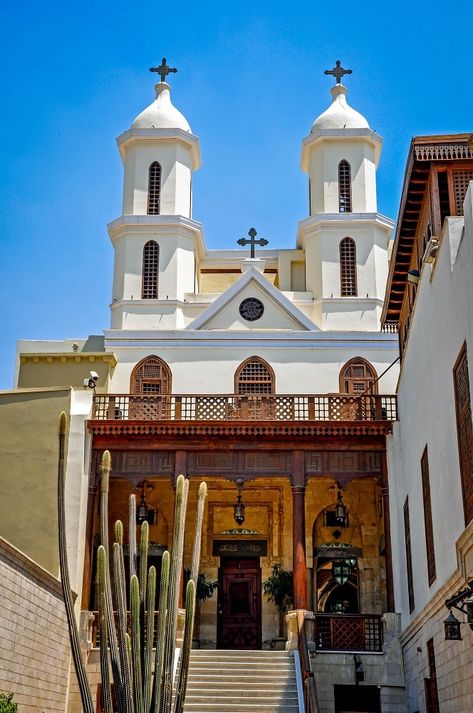
In the heart of Coptic Cairo, amidst the narrow, cobblestone alleys that have whispered stories of faith for nearly two millennia, sits the Saint Virgin Mary’s Coptic Orthodox Church, famously known as the Hanging Church (Al-Muallaqa). This architectural marvel is not merely a place of worship; it is a symbol of endurance, a stone-and-timber testament to the deep roots of Christianity in Egypt. Perched uniquely above the gatehouse of the Roman Fortress of Babylon, the church appears to be suspended in mid-air, earning its poetic name. For centuries, it has served as the spiritual seat of the Coptic Pope and a sanctuary for those seeking peace. Its walls, adorned with rare icons and intricate wood carvings, tell the story of a civilization that blended Pharaonic, Roman, and Islamic influences into a unique Christian identity. To visit the Hanging Church is to ascend into a realm where time slows down, and the echoes of ancient hymns resonate through a forest of marble columns.
1. The Legend of the "Suspended" Sanctuary: A Feat of Ancient Engineering
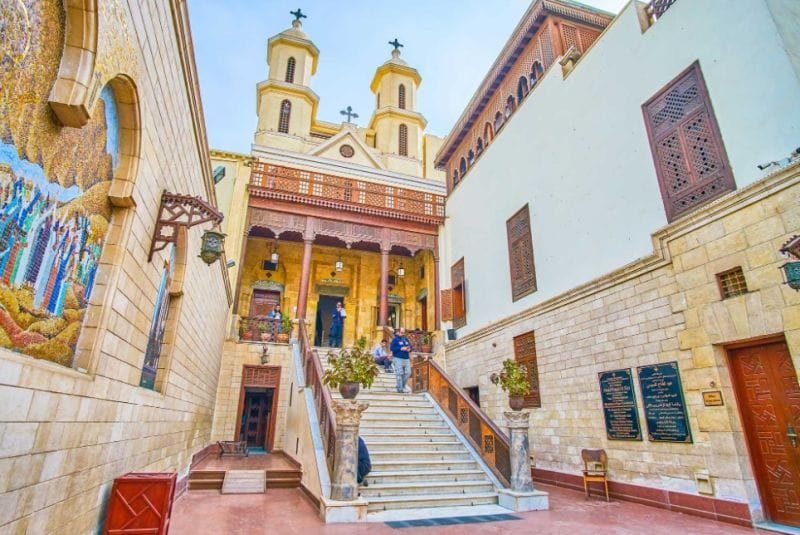
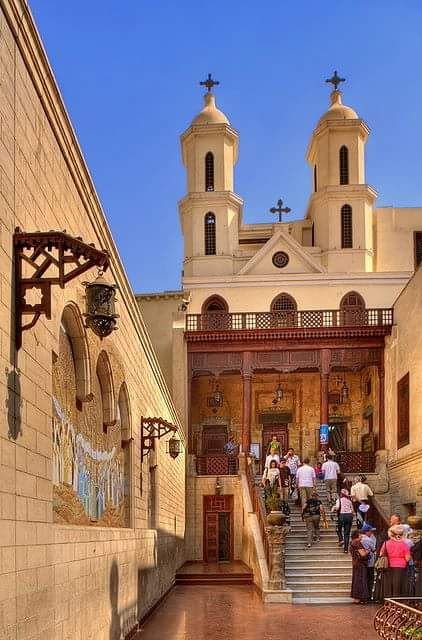
The most striking feature of the Hanging Church, and the source of its fame, is its unique structural position. Unlike any other religious building in Egypt, it does not rest on the ground. Instead, it was built atop the southern gatehouse of the Roman Fortress of Babylon, specifically over the two circular towers of the gate. By the time the church was being expanded in the 7th and 9th centuries, the architects decided to use the existing Roman fortifications as a foundation, suspending the nave of the church over the passage between the towers. This creates a dramatic visual effect for visitors: as you look down through the glass panels in the church floor today, you can see the sheer drop to the Roman gatehouse far below. This engineering choice was not just about aesthetics; it was a matter of survival and symbolism. During the turbulent centuries of Roman and early Islamic rule, building high above the ground provided a degree of natural fortification. Over time, as the ground level of Cairo rose due to the accumulation of silt and debris, the "hanging" nature of the church became even more pronounced. Today, the church is reached by a grand staircase of 29 steps, leading the faithful away from the earthly noise of the streets into a celestial space. This elevated position has made the church a literal "bridge" between the Roman past and the Coptic present, proving that the early Egyptian Christians were master engineers who could transform military structures into monuments of divine peace.
2. The Façade and the Grand Entrance: A Portal of Modern Grace
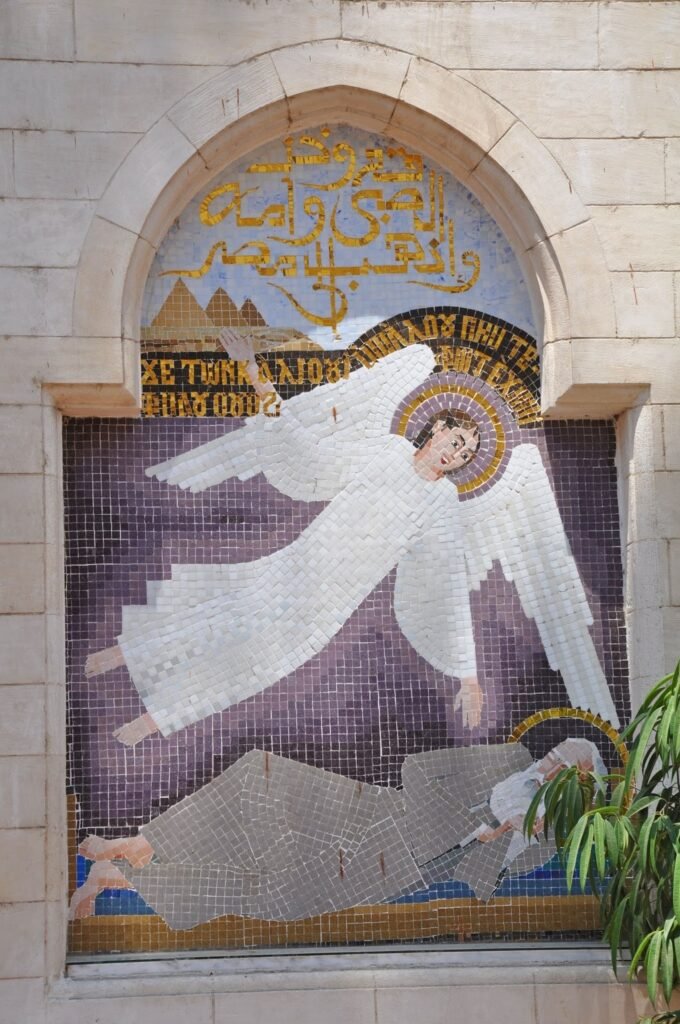
The journey into the Hanging Church begins at its iconic façade, which is a relatively modern addition compared to the ancient interior, yet it perfectly captures the spirit of Coptic art. Rebuilt in the 19th century, the entrance features twin bell towers and a beautiful porch adorned with intricate geometric patterns and biblical inscriptions. The courtyard leading to the church is a narrow, sun-drenched corridor lined with mosaics that depict the history of the Holy Family’s journey in Egypt. These mosaics are vibrant and detailed, serving as a visual "prelude" to the spiritual experience inside. The entrance is designed to be a gradual transition; as you ascend the stairs and pass through the outer gates, the architecture shifts from the broad, open style of modern Cairo to the intimate, sacred geometry of the medieval world. The façade itself is a masterpiece of symmetry and symbolism. The white limestone glows under the Egyptian sun, and the delicate carvings around the windows hint at the luxury found within. For the traveler, this entrance is one of the most photographed spots in Cairo. It represents the resilience of the Coptic community, which has maintained this site with immense pride through centuries of change. The grand staircase is often crowded with pilgrims from around the world—from Ethiopia to Europe—all seeking to cross this threshold. Passing through the main wooden doors, which are themselves works of art, is like entering a time capsule where the 21st century fades away, replaced by the scent of ancient incense and the sight of dim, candle-lit corridors that have welcomed the faithful for over 1,600 years.
3. The Timber Roof: A Noah’s Ark in the Sky
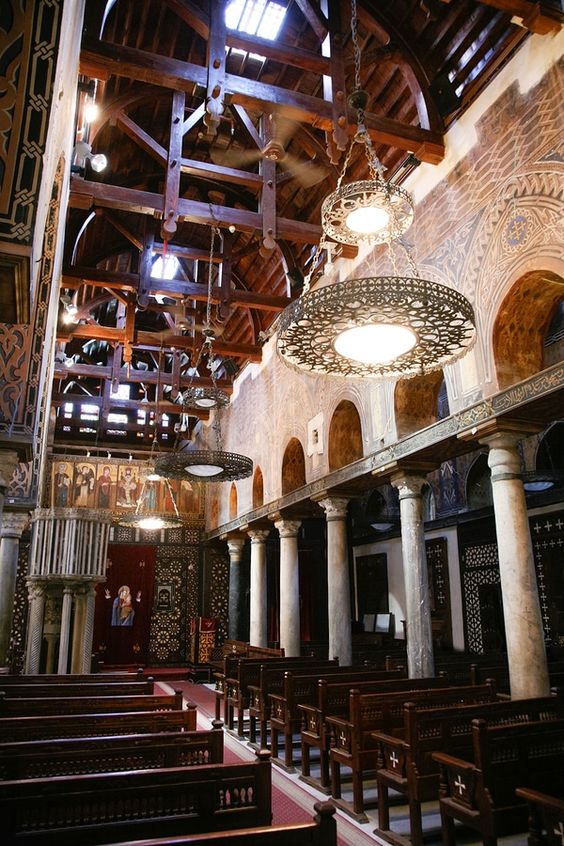
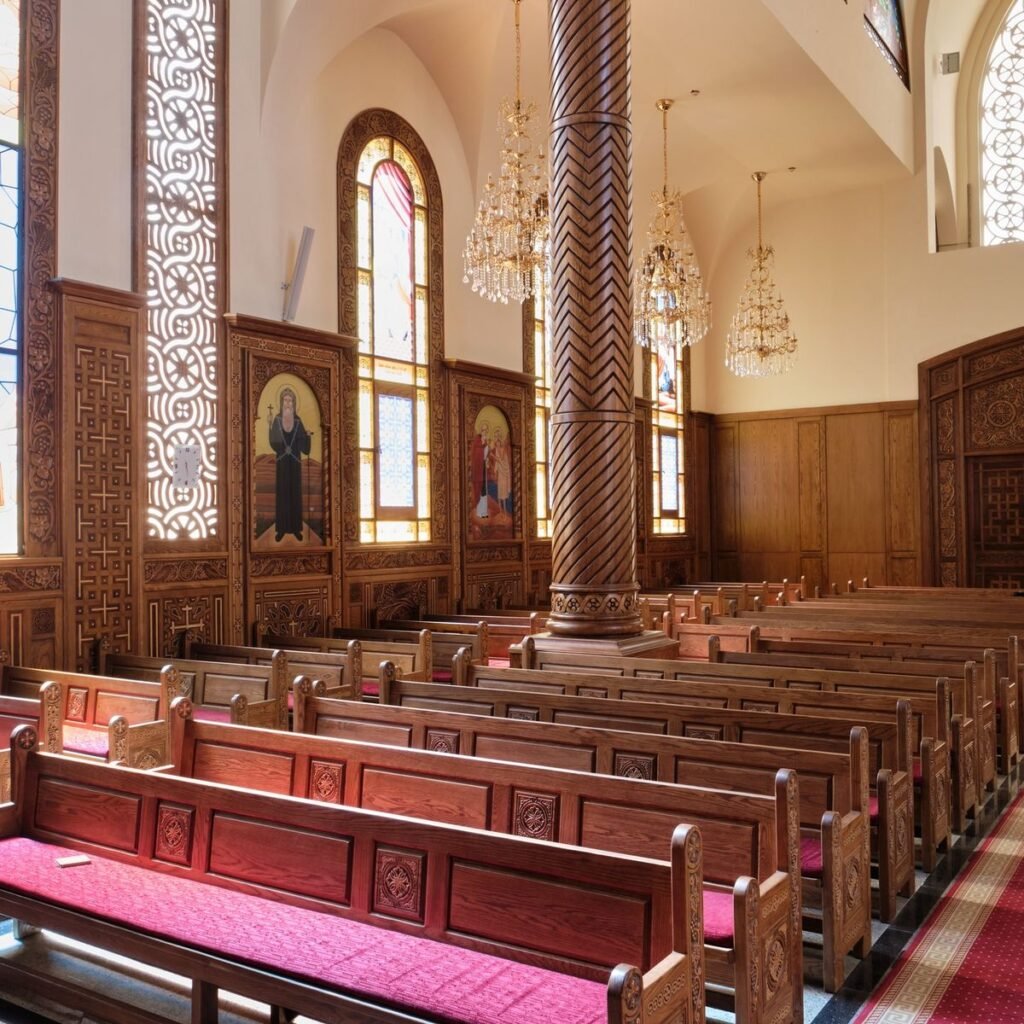
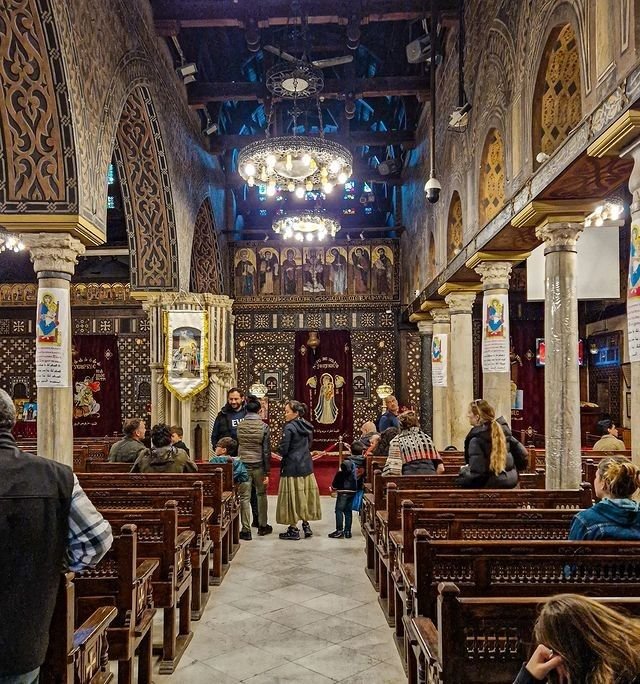
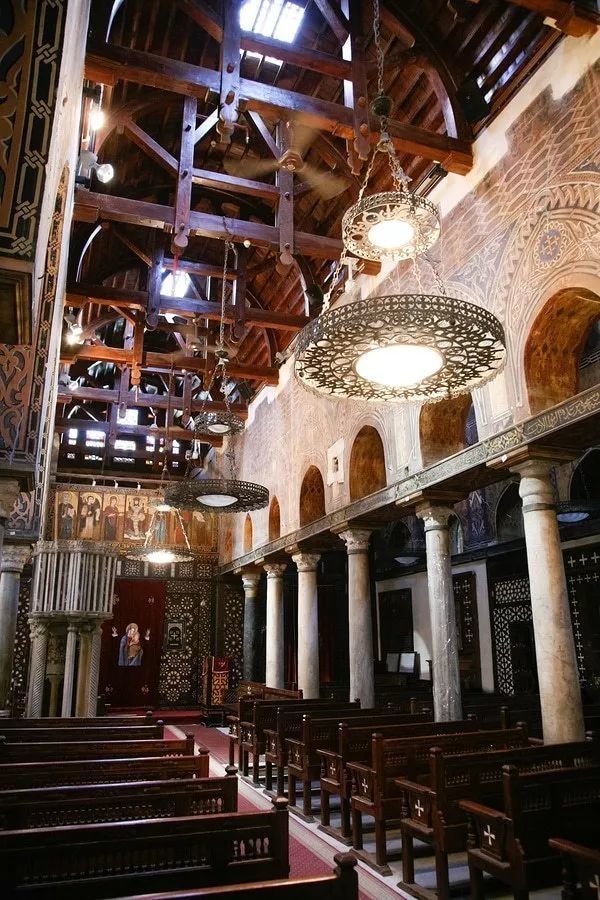
Once inside the main nave, the most breathtaking sight is often found by looking upward. The roof of the Hanging Church is a rare architectural gem, constructed entirely of dark, heavy timber in the shape of an inverted ship’s hull. This design is deeply symbolic in Christian tradition, representing Noah’s Ark, the vessel that carried humanity through the floods to safety. It also serves as a metaphor for the Church itself, navigating the "stormy seas" of the world to bring the faithful to the harbor of salvation. The craftsmanship required to bend and join these massive beams without the use of modern machinery is a testament to the skill of medieval Coptic carpenters, who were renowned throughout the Mediterranean for their woodwork. The ceiling does more than just provide shelter; it creates a unique acoustic environment. The wooden "hull" captures the sound of the Coptic chants—which are still performed in the ancient language of the Pharaohs—and allows them to resonate with a deep, warm tone. The lack of a heavy stone vault makes the interior feel light and airy, despite the massive weight of the history it holds. For the art historian, this roof is a fascinating example of how maritime technology influenced sacred architecture. The dark wood, aged by centuries of candle smoke and incense, provides a somber and reverent contrast to the white marble columns below. It is a constant reminder to those standing in the nave that they are "on board" a spiritual vessel, protected by a roof that has stood firm through a millennium of trials.
4. The Marble Pulpit: A Masterpiece of Fifteen Pillars
Standing at the center of the nave is one of the church’s most prized treasures: the marble pulpit (Ambon). Dating back to the 11th century, this pulpit is a stunning example of the transition between the Fatimid and Mamluk artistic influences on Coptic design. It is carved from white marble and supported by fifteen slender pillars, each representing a key figure in the Christian narrative. According to tradition, the central pillar represents Jesus Christ, while the others represent the twelve Apostles and the two Evangelists, Mark and Luke. The columns are arranged in pairs, symbolizing the disciples being sent out two by two to spread the word. Interestingly, one of the columns is carved in black marble, traditionally said to represent Judas Iscariot, the betrayer. The pulpit is decorated with intricate carvings of crosses and floral motifs, and it stands as a symbol of the authority of the Word. In the medieval era, this was the spot from which the Coptic Pope or a high-ranking bishop would deliver sermons to the congregation. The elevation of the pulpit ensured that the speaker could be heard throughout the long nave. For the visitor, the pulpit is a masterclass in symbolic geometry. Every curve of the marble and every placement of a pillar has a theological meaning. It remains one of the most intact and beautiful pulpits in any ancient church in the Middle East, serving as a focal point that draws the eye and anchors the spiritual layout of the sanctuary.
5. The Iconostasis: A Wall of Faith and Ebony
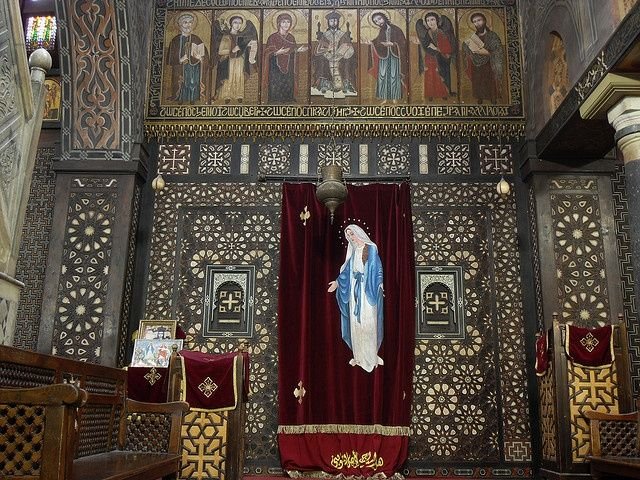
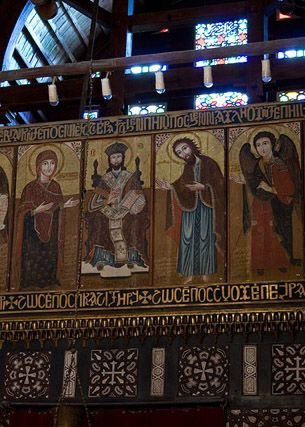
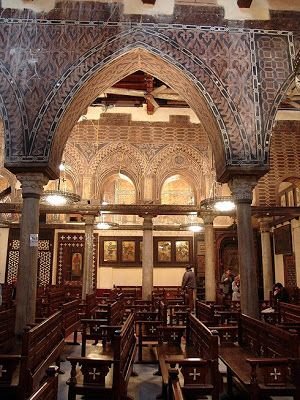
The Iconostasis of the Hanging Church is widely considered one of the most exquisite and sophisticated examples of Coptic woodcraft in existence. Serving as the symbolic and physical barrier between the nave (the world of the faithful) and the sanctuary or Haikal (the Holy of Holies), this screen dates back primarily to the 12th and 13th centuries. It is crafted from heavy, luxurious ebony wood, intricately inlaid with thousands of tiny, hand-carved pieces of ivory. What makes this screen a masterpiece of medieval engineering is the "interlocking" technique; the thousands of ivory crosses and geometric stars are fitted together so precisely that not a single nail or drop of glue was required to hold the massive structure together. This reflects the "Arabesque" influence of the Fatimid and Mamluk eras, showing how Coptic artisans absorbed the artistic language of their neighbors to create a unique Christian aesthetic. Every inch of the Iconostasis is saturated with theological meaning. The dark ebony represents the steadfastness and suffering of the earthly church, while the white ivory symbolizes the purity, light, and resurrection of the divine realm. At the top of the screen, a row of icons depicts the twelve Apostles, with the Virgin Mary at the center, acting as mediators between the congregation and the altar. For the visitor, standing before this screen is a dizzying experience of detail; the repeating patterns of the Coptic cross create a sense of infinity, designed to lead the mind away from material distractions and into a state of meditation. It is a testament to the era when Old Cairo was a global center for elite craftsmanship, proving that the Hanging Church was not just a house of prayer, but a sanctuary where the finest materials on earth were dedicated to the glorification of the heavens.
6. The Coptic Mona Lisa: Rare Icons of Ancient Grace
The Hanging Church houses a world-renowned collection of approximately 110 icons, but none is more captivating or mysterious than the one famously dubbed the "Coptic Mona Lisa." Dating back to the 8th century, this icon depicts the Virgin Mary holding the Christ Child with a striking level of emotional depth and artistic sophistication. Similar to Leonardo da Vinci’s famous portrait, the eyes of the Virgin in this icon are painted with a unique technique that makes them appear to follow the viewer regardless of where they stand in the chapel. This effect was achieved using the "Encaustic" method—an ancient technique involving pigments mixed with hot wax—which has allowed the colors to remain vibrant and the gaze to remain piercingly life-like for over 1,200 years. Beyond this single masterpiece, the walls of the church are lined with icons that serve as a visual "Who’s Who" of Christian history, from St. George the Prince of Martyrs to St. Mark the Evangelist. These icons are characterized by the distinct Coptic style: large, soulful eyes, rounded faces, and a flattened perspective that emphasizes spiritual presence over physical realism. This style is a direct evolutionary descendant of the ancient "Fayum Mummy Portraits" of the Pharaonic-Roman era, linking the church to Egypt’s deepest artistic roots. To the Coptic believer, these icons are not merely paintings but "windows to heaven," through which the saint depicted is spiritually present with the community. For the art historian, the collection represents a vital link in the development of Christian art, showing how Egyptian Christians preserved ancient Mediterranean painting techniques and adapted them to tell the story of their faith through the centuries.
7. The Seat of the Pope: A Thousand Years of Authority
For a significant portion of its history, the Hanging Church was much more than a local parish; it was the official Supreme Seat of the Coptic Orthodox Pope. Originally, the patriarchal seat was located in Alexandria, the city of St. Mark. However, following the Arab conquest and the shift of Egypt’s political capital to Fustat and later Cairo, the need arose for the church leadership to be closer to the center of government. In the 11th century, during the reign of Pope Christodolos, the decision was made to officially transfer the Papal Seat to the Hanging Church. This transition transformed the building into the "Vatican of the East," making it the heart of Christian administration and diplomacy in the region for centuries. It was within these walls that major theological decrees were drafted, bishops were consecrated, and the Coptic community’s relationship with the ruling Caliphs was navigated. Inside the church, visitors can still see the ancient Patriarchal Throne, a majestic marble chair that served as the physical symbol of this authority. Although the official seat was eventually moved to the Church of Saint Mercury (Abu Seifein) and later to the modern Cathedral in Abbassia, the Hanging Church retains a "primacy of honor." It is considered the "Mother Church" of Cairo. The fact that the Pope chose to reside within a fortress—literally perched atop Roman ruins—sent a powerful message of resilience and stability to the faithful during turbulent times. For historians, this era marks the church's golden age, as it became a sanctuary where political power and spiritual devotion intersected. Standing near the throne today, one can almost feel the weight of the difficult decisions made by the Popes of old, who guided their flock through shifts in empires while ensuring the survival of the Coptic identity.
8. The Miracle of the Mokattam Mountain: A Legend in Stone
Perhaps no story is more deeply entwined with the spiritual identity of the Hanging Church than the Miracle of Moving the Mokattam Mountain. According to Coptic tradition, in the 10th century, during the caliphate of Al-Mu'izz, a high-ranking Jewish minister challenged the Coptic Pope, Abraham the Syrian, to prove the truth of the Gospel. Referring to the biblical verse stating that faith as small as a mustard seed could move mountains, the Caliph demanded that the Christians move the Mokattam Mountain to prove their God’s power, or face persecution. Pope Abraham ordered a three-day fast, and it is said that the Virgin Mary appeared to him in a vision within the Hanging Church, directing him to a one-eyed tanner named Simon (Samaan). Following their prayers, a massive earthquake shook the city, and the mountain was seen to rise and move, striking fear and awe into the hearts of the onlookers. This miracle is more than just a legend; it is a foundational narrative of "divine protection" for the Coptic community. To this day, the three-day fast is still observed by the Church as the "Fast of the Virgin." For the visitor, this story adds a layer of mystical gravity to the building. The Hanging Church is viewed by pilgrims as a site of answered prayers and supernatural intervention. Even for the secular traveler, the legend highlights the intense religious tensions and the dramatic social stakes of 10th-century Egypt. The memory of the miracle is kept alive through icons and oral tradition passed down in the church's corridors, reminding every visitor that these stones are not just architectural achievements, but symbols of a faith that the people believe can move the very foundations of the earth.
9. The Roman Fortress Foundation: Secrets of Babylon
The physical "magic" of the Hanging Church lies beneath its floorboards, where it rests upon the massive ruins of the Fortress of Babylon. Built by the Romans around 300 AD, this fortress was once the strategic key to Egypt, guarding the head of the Nile Delta. The church was cleverly constructed between the two circular bastions of the fortress’s southern gatehouse. In recent years, glass panels have been installed in the church floor, allowing visitors to peer down into the dark abyss and see the sheer vertical drop to the Roman foundations far below. This unique positioning makes the church a "suspended" structure in the most literal sense; the nave is bridged across the gap between the two towers, supported by massive palm trunks and layers of stone that have held firm for over 1,600 years. This layer of history provides a fascinating architectural contrast. While the church above is filled with the soft curves of Coptic woodcraft and the warmth of flickering candles, the foundations below are made of cold, hard Roman limestone and sun-dried bricks. This represents a literal "triumph over the empire," where a site of military oppression was repurposed into a sanctuary of peace. Exploring the base of the church reveals the strategic genius of the Roman engineers—the thickness of the walls, the defensive slits, and the sheer scale of the towers. For the archaeology enthusiast, the Hanging Church is a vertical timeline of Cairo. It proves that the city was not built on a blank canvas, but was a constant process of recycling and reimagining. To stand in the church is to stand on the shoulders of the Romans, witnessing how the Coptic spirit rose from the ruins of an empire to create something entirely new and enduring.
10. The Baptistery and the Sacred Well: Waters of New Life
Hidden within the complex of the Hanging Church are the spaces dedicated to the first and most vital sacrament of the faith: the Baptistery. In the Coptic tradition, baptism is not merely a ritual but a spiritual rebirth, and the architectural setting for this act reflects its solemnity. The baptistery at the Hanging Church features a deep, circular basin carved from a single block of pink granite, often decorated with simple yet profound Coptic crosses. Its location within the church is strategically chosen to be near the entrance or in a side chapel, symbolizing the "gateway" through which one enters the family of God. For centuries, infants and converts have been immersed in these waters, following a liturgy that has remained largely unchanged since the early centuries of the Christian era. Adjacent to these ritual spaces is the ancient sacred well, a feature common to many of the oldest churches in Coptic Cairo. This well was not just a source of water for the clergy and the congregation; it holds a deep symbolic connection to the Holy Family’s journey through Egypt. Tradition suggests that many of these wells were blessed by the presence of the Virgin Mary and the infant Jesus during their flight from King Herod. For the modern pilgrim, the well represents a physical link to the biblical narrative. Even today, the water from such ancient sites is regarded with immense reverence, believed by many to carry "Baraka" or divine blessing. Standing by the cool, stone rim of the well, the visitor is reminded that the Hanging Church is built not just upon Roman stone, but upon a landscape of sacred springs and hidden sanctuaries that provided refuge to the holy long before the first marble column was ever raised.
11. The Intricate Woodwork: A Masterclass in Coptic Geometry
While the Hanging Church is famous for its marble pulpit and Roman foundations, the true "warmth" of its interior comes from its extraordinary woodwork. Coptic artisans were world-renowned for their ability to turn humble timber into complex theological puzzles. The screens, doors, and ceilings of the church are covered in a style of carving known as "interlocking joinery." This technique involves fitting together hundreds of small pieces of wood—usually cedar, ebony, or walnut—to create intricate star patterns and crosses without the use of nails. This was a practical necessity as much as an aesthetic choice; in the shifting temperatures and humidity of Cairo, non-glued wood could expand and contract without cracking, allowing these masterpieces to survive for over a millennium. The three main sanctuaries (Haikals) are separated from the nave by these magnificent wooden screens, each dedicated to a different saint: the Virgin Mary, St. John the Baptist, and St. George. The central screen, dedicated to the Virgin, is the most ornate, featuring ivory inlays that depict delicate floral motifs and Coptic crosses that seem to glow against the dark wood. For the art historian, this woodwork represents a fascinating bridge between the "Arabesque" patterns found in Islamic mosques and the sacred symbols of Christianity. It proves that the craftsmen of Cairo lived in a shared world of geometric beauty, where a pattern used in a Caliph’s palace could be reimagined to guard the altar of a church. Touching the smooth, aged surface of these screens, one feels the human hand of the medieval artist, whose devotion was expressed through the patient, rhythmic chipping of the chisel into the wood.
12. The Coptic Language: Echoes of the Pharaohs in Ancient Hymns
Inside the Hanging Church, the air is often filled with a sound that exists nowhere else on earth: the chanting of the Coptic Liturgy. This music is the acoustic soul of the building, and it is performed in the Coptic language, which is the final direct descendant of the language of the Ancient Egyptians. When the priests and deacons chant within the vaulted nave, they are using the same linguistic roots used by the builders of the Pyramids and the scribes of Luxor, albeit written in a modified Greek alphabet. This makes the Hanging Church a living laboratory of linguistics. For the visitor, listening to these hymns—accompanied by the rhythmic clashing of small brass cymbals and triangles—is a powerful sensory bridge to a lost world. The preservation of this language within the church is a feat of cultural resilience. While Arabic became the daily language of Egyptians centuries ago, the Coptic Church maintained its ancient tongue for its most sacred mysteries. The hymns themselves are believed to carry echoes of ancient Pharaonic temple music, characterized by long, melismatic vocal lines that evoke a sense of eternal mourning and eventual triumph. For the linguistics enthusiast, seeing the bilingual prayer books (Arabic and Coptic) and hearing the priest’s intonation is like hearing a "living ghost" of the Pharaonic era. The language is not merely a museum piece; it is the medium through which the community expresses its deepest identity. Within the Hanging Church, the Coptic language ensures that the past is never truly past, but remains a vibrant, breathing presence that continues to sanctify the "suspended" halls of Old Cairo.

13. The Hidden Passages: Survival and Sanctuary
Beyond the public halls and the ornate altars, the Hanging Church holds a deep history of refuge, marked by a series of hidden passages and secret chambers that have long served as a sanctuary during times of persecution. Throughout the medieval period, Coptic Cairo was a hub of activity but also a place of immense vulnerability. When political tides turned or civil unrest erupted, the church—with its fortress-like foundation and elevated position—acted as a natural shelter for the clergy and the local Christian community. Oral histories and structural surveys suggest that there were once concealed tunnels connecting the church to other parts of the Roman fortress, allowing for the discrete movement of people and the protection of precious liturgical vessels and relics when threats were imminent. These hidden spaces were not just for escape; they were centers of quiet survival. In the dim, subterranean chambers beneath the church, monks and scholars often sequestered themselves to transcribe manuscripts, ensuring that Coptic theology, history, and linguistic knowledge were not lost to fire or censorship. For the visitor, these secret corners add a layer of intrigue to the church’s architecture. They reveal that the Hanging Church was never merely a place of grand display, but a functional fortress designed for the preservation of a culture under pressure. This aspect of the church speaks to the "hidden" strength of the Coptic identity—the ability to persist, adapt, and protect what is sacred even when the world outside is in upheaval. It turns the church into a symbol of a faith that survives not through strength of arms, but through the quiet, persistent wisdom of the underground.

14. The Coptic Museum Connection: A Treasure House Next Door
The Hanging Church is not an isolated monument; it sits at the epicenter of a historic cluster that includes the world’s most significant repository of Coptic art: the Coptic Museum. Just a short walk from the church’s grand staircase, this museum houses thousands of years of Egyptian history, from the early transition of the Pharaonic era into the Christian period to the flowering of Islamic-influenced Coptic art. For the cultural traveler, visiting the museum after the church is essential, as the artifacts inside provide the historical context for the icons, woodwork, and textiles found within the Hanging Church itself. The museum contains the actual documents, ancient scrolls, and funerary stelae that explain the evolution of the very symbols the visitor sees on the church’s walls. This proximity creates a unique "cultural precinct." The museum’s collection includes early Christian tapestries that mirror the patterns found in the church’s vestments, as well as limestone carvings that share the same aesthetic DNA as the church’s pulpit. Walking from the church into the museum is a transition from "worship" to "academic study," where one can see the broader narrative of how the Copts integrated themselves into the fabric of Egyptian society. The museum serves as the intellectual complement to the church’s spiritual heartbeat. For the enthusiast of history, this connection is what makes Old Cairo a globally significant heritage site; here, the "living" church and the "cataloged" history exist side-by-side, allowing visitors to see the continuity of a civilization that has refused to fade away for two millennia.
15. The Modern Restoration: Preserving a Floating Wonder
Preserving a structure that is literally "hanging" above ancient Roman ruins is an engineering nightmare that the Egyptian government, in cooperation with international partners, has navigated with heroic effort. In the early 2000s, the church underwent a massive, state-of-the-art restoration project that addressed the structural threats posed by ground subsidence and the vibration of the modern city. The most significant challenge was the stabilization of the foundation—the Roman towers that have supported the church for over a millennium. Engineers had to carefully reinforce the walls and install advanced monitoring systems to ensure that the "suspended" nave would not shift. The restoration was not just about safety; it was about scientific conservation, using specialized cleaning techniques to remove centuries of candle soot from the frescoes and the delicate wooden ceilings without damaging the original pigments. For the modern traveler, this restoration is a triumph of heritage management. The work was done with such extreme sensitivity that the church feels as if it has been frozen in time rather than "repaired." The subtle installation of modern lighting and climate control allows the ancient wood and stone to breathe, while the glass panels in the floor provide a view of the Roman gate that is both safe and awe-inspiring. This project has ensured that the Hanging Church remains a functioning place of worship while serving as a global monument to human ingenuity. It highlights the importance of Cairo’s commitment to preserving its layered history, proving that even as the city races toward the future, it values the delicate, floating wonders of its past. The restoration is a promise kept to the generations to come, ensuring that the church continues to "hang" suspended between heaven and earth for another thousand years.
16. The Spiritual Atmosphere: A Haven of Old Cairo
Beyond the architectural feats and the historical weight, the Hanging Church possesses an atmospheric quality that is difficult to put into words—a palpable sense of "Ruhiya" (spirituality) that transcends religious boundaries. For many Cairenes and travelers alike, the church is a vital escape from the sensory overload of modern Cairo. The moment you ascend the 29 steps and leave the street-level noise behind, the temperature seems to drop, and the air grows thick with the scent of ancient incense and beeswax. The dim lighting, often filtered through small stained-glass windows or the warm glow of flickering candles, creates an intimate, womb-like environment that invites quiet reflection and prayer. This spiritual sanctuary is characterized by a "living" silence. Even when crowded with pilgrims, the reverent hushed tones and the rhythmic, low-frequency chanting of the Coptic hymns create a meditative pulse. It is a place where many claim to feel the presence of the "Cloud of Witnesses"—the generations of saints and common folk who have knelt on these same marble floors. For the non-religious visitor, the church offers a rare psychological reset; it is a space where the frantic pace of the 21st century is paused, replaced by the slow, cyclical time of ancient tradition. Whether you are admiring the icons or simply sitting in a darkened corner, the Hanging Church offers a profound "spiritual pause," reminding every visitor that beneath the layer of stone and wood lies a sanctuary for the human soul.
17. A Practical Guide for Visitors: Navigating Coptic Cairo
Visiting the Hanging Church is a seamless experience if one follows a few cultural and logistical guidelines. Located within the Mar Girgis (St. George) area of Old Cairo, the church is easily accessible via the Cairo Metro (Mar Girgis Station). It is generally open daily for visitors from 9:00 AM to 5:00 PM, though it is important to check for specific feast days or long liturgical services when tourist access might be limited. As it is an active place of worship, modest dress is essential: both men and women should ensure their shoulders and knees are covered. While headscarves are not strictly required for visitors, a quiet and respectful demeanor is expected, especially near the sanctuaries where people are praying. The area surrounding the church is a pedestrian-friendly complex that includes the Coptic Museum, the Church of St. Sergius (Abu Serga)—where the Holy Family is said to have rested—and the Ben Ezra Synagogue. A practical tip for visitors is to arrive early in the morning to enjoy the site before the large tour buses arrive. There is no entrance fee for the church, but donations for the upkeep of the site are welcomed. Photography is permitted in most areas, but flash is often discouraged to protect the ancient icons. After your visit, exploring the nearby craft stalls for traditional Coptic crosses or hand-painted papyrus provides a tactile memory of your journey into the heart of one of the world’s oldest Christian communities.
18. Conclusion: The Enduring Legacy of the Hanging Church
The Hanging Church stands as a magnificent paradox: it is "suspended" in air, yet firmly rooted in the very bedrock of Egyptian identity. It is a building that has seen the Roman Empire fade into the sands, the Arab conquest reshape the language of the land, and the modern state rise around its ancient towers. Through all these shifts, it has remained a constant—a stone-and-timber witness to the resilience of the Coptic people and the inclusive nature of Egyptian history. It is not merely a museum of the past; it is a vibrant, breathing institution that continues to baptize new generations and offer a home to those seeking the divine. As the "Celestial Jewel of Old Cairo," the Hanging Church proves that true beauty is found in layers. It is the Roman fortress, the Coptic icon, the Fatimid woodwork, and the modern restoration all working in harmony. It serves as a reminder that Egypt’s heritage is a mosaic, where every piece—Pharaonic, Christian, and Islamic—is essential to the whole. To walk through its nave is to understand that the spirit of a nation cannot be contained in a single era. The Hanging Church will continue to hang between the earth and the heavens, a bridge across time, inviting every traveler to look up, look down, and realize that they are standing in the presence of an eternal, resplendent history.