- Excursions in Egypt
- Egypt Tour Packages
- Cairo Tours and Excursions
- Hurghada Tours and Excursions
- Soma Bay Tours and Excursions
- Makadi Bay Tours and Excursions
- Sahl Hasheesh Tours and Excursions
- El Gouna Tours and Excursions
- Marsa Alam Tours and Excursions
- Port Ghalib Tours and Excursions
- El Quseir Tours and Excursions
- Dendera and Abydos Day Tours
- Aswan Tours and Excursions
- Luxor Tours and Excursions
- Sharm El Sheikh Tours and Excursions
- Top Rated Egypt Tours in 2026
- Optional Excursions in Egypt
- Private Transfer
- Blogs About egypt
- Ancient Egypt
- Historical Sites in Egypt
- Cairo
- Alexandria
- Luxor
- Aswan
- The Red Sea
- Dendera Temple
- El Fayoum Oasis
- Bahariya Oasis
- Siwa Oasis
- Al Alamein
- Marsa Matruh
- Why Egypt Is One of the Safest Countries to Visit in the Middle East
- What You Need To know Before Your First Trip To Egypt
- Egypt Travel Costs in 2026 Full Budget Guide
- Top 10 Tourist Activities in Egypt
- Top 50 Activities You Can’t Miss in Egypt in 2026
- The Guide to Guided Tours in Egypt
- Egypt’s Ancient and Modern History
- The Nile River
- The Deserts of Egypt
- Ancient Egyptian gods
- famous Egyptian dishes
- UNESCO World Heritage sites
- About Us
- Egypt Hotels and Resorts
- Excursions in Egypt
- Egypt Tour Packages
- Cairo Tours and Excursions
- Hurghada Tours and Excursions
- Soma Bay Tours and Excursions
- Makadi Bay Tours and Excursions
- Sahl Hasheesh Tours and Excursions
- El Gouna Tours and Excursions
- Marsa Alam Tours and Excursions
- Port Ghalib Tours and Excursions
- El Quseir Tours and Excursions
- Dendera and Abydos Day Tours
- Aswan Tours and Excursions
- Luxor Tours and Excursions
- Sharm El Sheikh Tours and Excursions
- Top Rated Egypt Tours in 2026
- Optional Excursions in Egypt
- Private Transfer
- Blogs About egypt
- Ancient Egypt
- Historical Sites in Egypt
- Cairo
- Alexandria
- Luxor
- Aswan
- The Red Sea
- Dendera Temple
- El Fayoum Oasis
- Bahariya Oasis
- Siwa Oasis
- Al Alamein
- Marsa Matruh
- Why Egypt Is One of the Safest Countries to Visit in the Middle East
- What You Need To know Before Your First Trip To Egypt
- Egypt Travel Costs in 2026 Full Budget Guide
- Top 10 Tourist Activities in Egypt
- Top 50 Activities You Can’t Miss in Egypt in 2026
- The Guide to Guided Tours in Egypt
- Egypt’s Ancient and Modern History
- The Nile River
- The Deserts of Egypt
- Ancient Egyptian gods
- famous Egyptian dishes
- UNESCO World Heritage sites
- About Us
- Egypt Hotels and Resorts
Welcome to
The Sultan Hassan Mosque-Madrasa: The "Pyramid" of Islamic Architecture
In the heart of Historic Cairo, where the echoes of centuries past still resonate through narrow alleyways and towering minarets, stands a monument so vast and so architecturally perfect that it has been hailed for generations as the “Pyramid of Islamic Architecture.” The Mosque-Madrasa of Sultan Hassan is not merely a place of worship; it is a profound statement of Mamluk power, intellectual ambition, and artistic defiance. Commissioned in 1356 AD by the young and embattled Sultan An-Nasir Hassan, this colossal structure was designed to dwarf every other building in the medieval world, serving as a fortress of faith and a global sanctuary for scholarship. Its soaring limestone walls, which rise like cliffs from the desert floor at the foot of the Citadel, represent a pinnacle of engineering that pushed the limits of what was thought possible in the 14th century. For the traveler and the historian alike, the mosque serves as a gateway into an era where Egypt stood as the undisputed cultural and intellectual center of the Islamic world, a time when the “Mountain of Stone” was carved to reflect the divine geometry of the heavens.
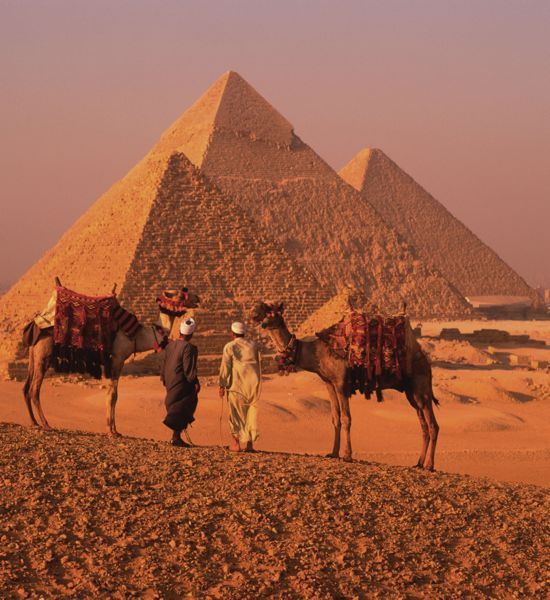
The Sultan Hassan complex is a rare architectural hybrid, functioning simultaneously as a congregational mosque, a royal mausoleum, and a prestigious university housing four separate schools of Islamic law. Its construction was an undertaking of such immense scale and cost that it famously nearly bankrupted the Egyptian treasury, requiring the labor of thousands of craftsmen and the extraction of massive stone blocks, some of which were reportedly repurposed from the ancient casing of the Giza Pyramids. This physical and symbolic link between the Pharaonic past and the Islamic present creates a sense of continuity that is unique to Cairo. In this exhaustive 18-paragraph exploration, we will delve into the secrets of its “sewn” masonry, the tragic story of the Sultan who never rested in his own tomb, the acoustic mysteries of its vaulted halls, and its enduring role as an eternal sentinel watching over the shifting tides of Egyptian history.
1. The Vision of An-Nasir Hassan: A Legacy Forged in Turmoil
The genesis of the Mosque-Madrasa of Sultan Hassan is a story of personal tragedy and immense political ambition. Sultan An-Nasir Hassan, the son of the great Sultan Al-Nasir Muhammad, ascended the throne during a period of extreme instability within the Mamluk Empire. His reign was interrupted by deposition and exile, yet upon his return to power in 1354, he was determined to leave an indelible mark on the city of Cairo that surpassed the legacies of his predecessors. He envisioned a monument so grand that it would embody the absolute authority of the Sultanate, choosing a strategic site at the foot of the Saladin Citadel, the seat of government. This location was highly symbolic; the mosque would be the first thing the Sultan saw from his palace and the last thing he viewed before entering his fortress. The construction of the complex was not merely a religious endeavor but a massive public works project that sustained the city's economy. Thousands of workers, ranging from humble laborers to elite master-craftsmen brought from across the Islamic world, toiled day and night. The Sultan’s vision was so uncompromising that he demanded the finest materials—marble from the Mediterranean, timber from the Levant, and stone from the Giza Plateau. This paragraph in history highlights the paradox of Sultan Hassan’s reign: while he struggled to maintain his grip on the throne, he succeeded in building a structure that has outlasted every dynasty that followed. For the modern visitor, understanding this backdrop of political struggle adds a layer of human poignancy to the cold stone, revealing the mosque as a desperate and beautiful reach for immortality by a man whose life was often filled with uncertainty.
2. The "Pyramid" Construction: Engineering the Impossible
Historians and architects have long referred to the Mosque of Sultan Hassan as the "Pyramid of Islamic Architecture" because of its staggering physical scale and the sophisticated engineering required to erect its massive walls. The building covers a total area of nearly 8,000 square meters, a footprint that was unprecedented for a religious complex in the 14th century. The sheer volume of limestone required for its construction was so immense that contemporary chroniclers claimed the builders turned to the Giza Pyramids as a convenient quarry, stripping away the smooth white casing stones to provide the raw materials for this medieval giant. This "theft" of antiquity was not seen as an act of destruction but as a cycle of rebirth, where the greatness of the Pharaohs was physically integrated into the greatness of Islam. The engineering feats found within these walls are staggering. The walls themselves rise to over 36 meters (about 118 feet), and the precision with which the massive blocks were laid is a testament to the advanced mathematical knowledge of the Mamluk architects. Unlike other mosques of the period that relied on lighter materials like brick, Sultan Hassan was built almost entirely of solid stone, giving it the appearance and durability of a fortress. This architectural weightiness serves a dual purpose: it creates a sense of divine permanence and also provides a natural insulation against the sweltering Cairo heat. As you walk alongside its exterior, the verticality of the design forces your eyes toward the heavens, a deliberate psychological effect intended to make the worshipper feel small in the presence of the Creator. This mastery of scale and stone is why the building remains the definitive landmark of Historic Cairo.
3. The Four Madrasas: A Global Sanctuary for Intellectual Pursuit
Beyond its identity as a mosque for congregational prayer, the Sultan Hassan complex was primarily designed as a "Madrasa," or a grand university for Islamic legal studies. What makes this institution unique is its "cruciform" layout, specifically engineered to house four separate schools of Sunni jurisprudence: the Hanafi, Shafi'i, Maliki, and Hanbali schools. In the 14th century, Cairo was the intellectual capital of the world, and Sultan Hassan intended his complex to be its crowning jewel. Each of the four schools was allocated its own autonomous wing within the building, complete with its own classrooms, private courtyard, and multi-story student dormitories. This allowed for a diversity of thought and legal interpretation to exist under one roof, reflecting the cosmopolitan and tolerant nature of Cairo at its peak. The life of a student within these walls was one of intense devotion and luxury compared to the standards of the time. The mosque provided stipends, food, and high-quality housing for hundreds of scholars and students who traveled from as far as West Africa, Persia, and the Levant to study here. This paragraph of the mosque's history emphasizes its role as a "City of Knowledge." The architectural separation of the four schools ensured that students could focus on their specific legal tradition while still coming together in the central courtyard for communal prayers. For the modern traveler, wandering through the quiet, shaded corridors of the Madrasa wings offers a stark contrast to the grandeur of the main prayer hall. It is in these intimate spaces that the true heartbeat of the complex is felt—not in the shouting of kings, but in the quiet whispers of students who have studied here for over six centuries, preserving the intellectual heritage of the Mamluk Golden Age.
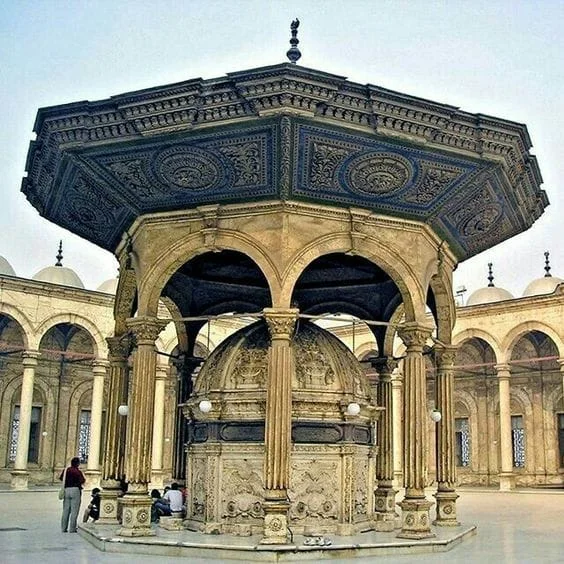
4. The Grand Entrance Portal: A Gateway to Divinity
The entrance portal of the Mosque-Madrasa of Sultan Hassan is widely regarded as one of the most spectacular architectural achievements in the Islamic world. Standing at a staggering height of 38 meters, it was designed to be an imposing gateway that immediately signaled the Sultan’s power to anyone approaching from the Citadel. The portal is not flush with the building's walls; instead, it is recessed and set at an angle, a clever architectural trick intended to make the entrance visible to the Sultan from his high seat in the palace above. Every inch of this massive stone entryway is adorned with the finest Mamluk ornamentation. From the intricate muqarnas (stalactite carvings) that cascade from the ceiling of the entrance bay to the delicate floral and geometric patterns carved directly into the limestone, the portal is a masterclass in the "horror vacui" style, where no space is left undecorated. Beyond its aesthetic beauty, the portal serves a profound psychological purpose. As the visitor approaches the massive bronze-plated doors, they are dwarfed by the sheer verticality of the stone. This creates a sense of awe and humility, preparing the soul for the transition from the mundane world of the marketplace into the sacred realm of prayer. The portal also features marble inlays in contrasting colors, known as ablaq, which add a rhythmic visual quality to the facade. For the architectural traveler, studying this portal is like reading a stone encyclopedia of Mamluk art. It reflects the influence of various regional styles, including elements that suggest craftsmen from Anatolia or North Africa were involved in its creation. This gateway is not just an entrance; it is a monumental prologue to the spiritual journey that awaits inside, a permanent testament to the era’s obsession with grandeur and divine order.
5. The Labyrinthine Corridor: Transitioning from Noise to Silence
One of the most deliberate and atmospheric features of the Sultan Hassan complex is the long, winding corridor that leads from the grand entrance to the main courtyard. This is not a direct path; rather, it is a narrow, dimly lit passage that forces the visitor to turn several times, effectively losing their sense of orientation to the busy city streets outside. This "dark corridor" is an architectural manifestation of a spiritual threshold. In the 14th century, the area outside the mosque was a bustling hub of commerce and military activity. By forcing the visitor through this compressed, shadowy space, the architects ensured that by the time one reached the light of the central courtyard, the noise and distractions of Cairo had been completely stripped away. The acoustics within this corridor are equally intentional. The thick stone walls absorb the sounds of the street, replacing them with a heavy, contemplative silence that is broken only by the echo of one's own footsteps. This sensory deprivation serves to heighten the impact of the eventual reveal. As you reach the end of the passage, the space suddenly explodes into the blinding sunlight and vast openness of the central Sahn. This dramatic contrast between the "compressed darkness" of the tunnel and the "infinite light" of the courtyard is a powerful metaphor for the journey of the soul seeking God. For modern visitors, this transition remains one of the most moving experiences in Islamic Cairo, offering a rare moment of meditative calm in a city that is otherwise famously energetic. It is a masterstroke of spatial design that proves the Mamluk architects were as much psychologists as they were engineers.
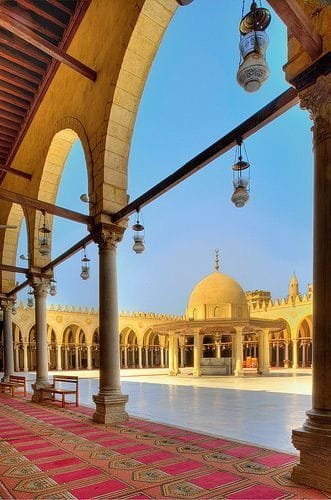
6. The Central Sahn: A Masterpiece of Symmetry and Openness
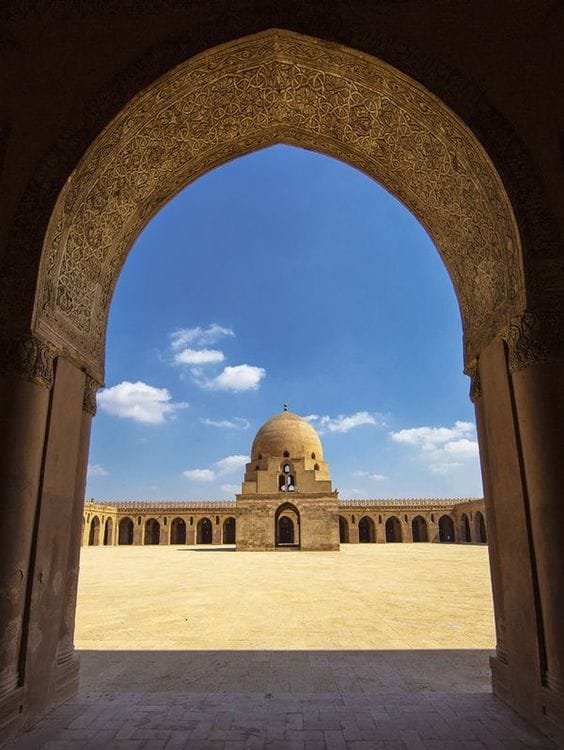
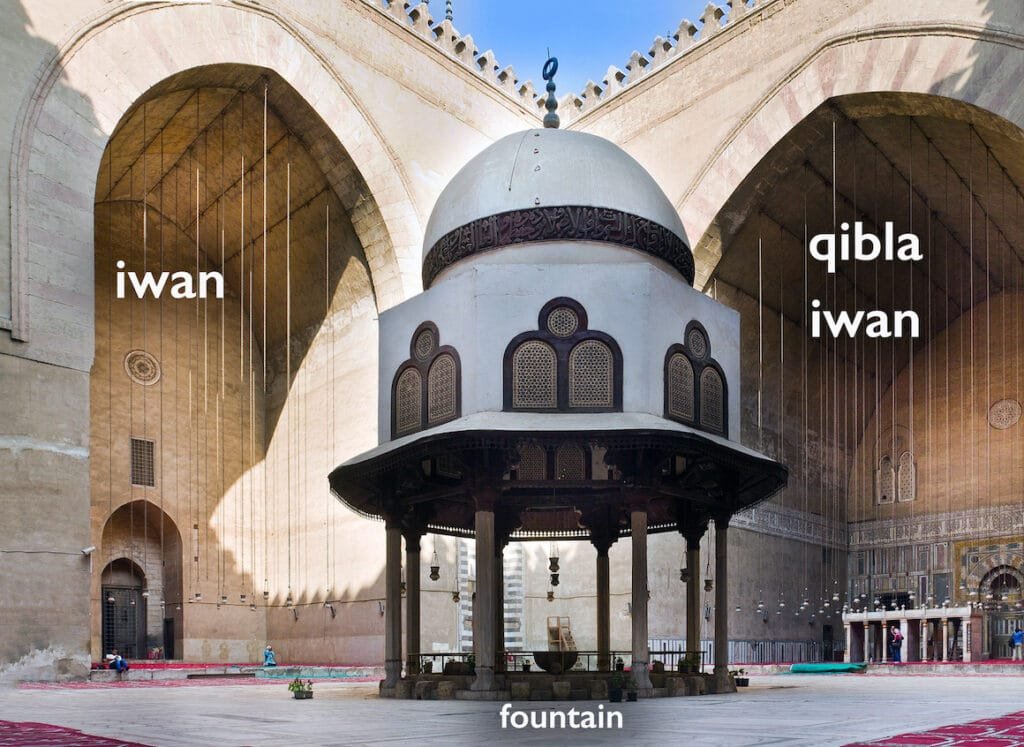
Emerging from the corridor, the visitor stands in the Central Sahn (Courtyard), the spiritual and architectural heart of the entire complex. This vast rectangular space, measuring approximately 32 by 34 meters, is open to the sky, allowing the brilliant Egyptian sun to illuminate the intricate marble floor patterns. The courtyard is a masterpiece of the "four-iwan" layout, where four massive vaulted halls open directly onto the center. This design creates a perfect sense of balance and symmetry, reflecting the medieval belief that architecture should mirror the harmony of the cosmos. In the center of the courtyard stands an elegant ablution fountain, topped by a bulbous wooden dome supported by marble columns. This fountain was the focal point of daily life, where worshippers would perform their ritual cleansing before prayer, the sound of trickling water adding a serene auditory layer to the environment. The floor of the Sahn is a work of art in itself, paved with a polychrome marble mosaic of geometric stars and floral motifs. These patterns were not merely decorative; they helped guide the worshippers' movements and provided a visual focus for meditation. Surrounding the courtyard, the towering walls of the four Iwans create a sense of being inside a "mountain of stone," yet the open roof ensures that the space never feels claustrophobic. Instead, the sky becomes a fifth wall, a celestial ceiling that connects the earth-bound worshippers to the divine. This interaction between light and shadow, stone and sky, makes the Sultan Hassan Sahn one of the most photogenic and emotionally resonant spaces in the world. It is here that the true scale of the mosque is most felt, as the visitor stands at the center of a perfectly ordered universe, protected by the massive walls from the chaos of the outside world.
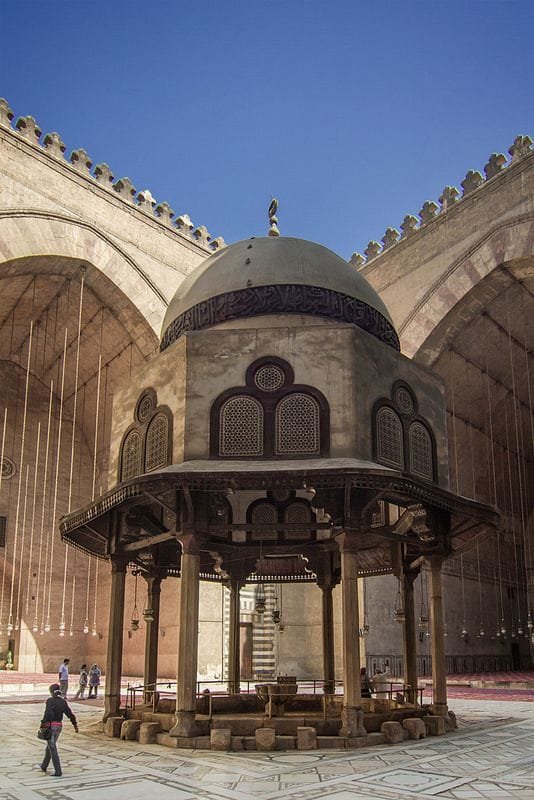
7. The Qibla Iwan: The Apex of Spiritual and Architectural Grandeur
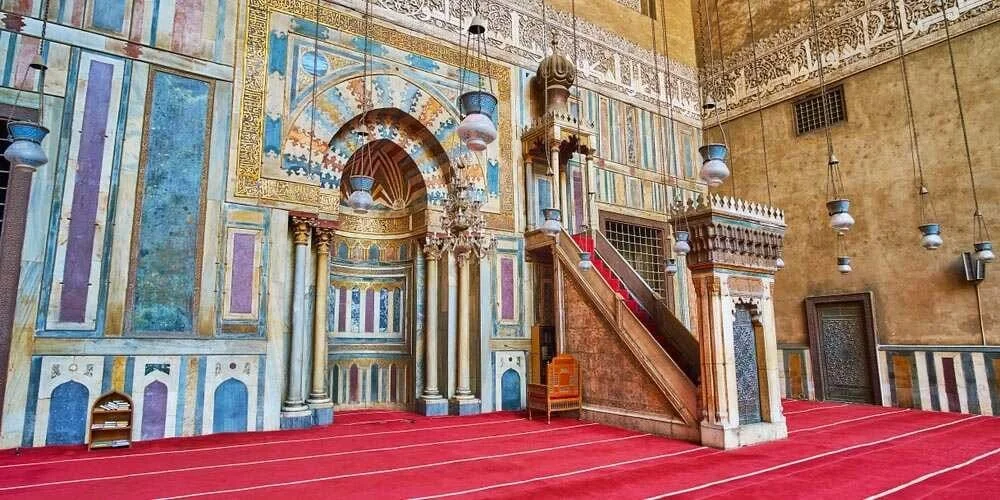
The Qibla Iwan of the Sultan Hassan Mosque is the largest and most magnificent of the four vaulted halls surrounding the central courtyard. Representing the spiritual and architectural climax of the entire complex, it is a space where engineering serves divinity. The Iwan is characterized by its colossal pointed arch and a massive barrel-vaulted ceiling that spans a vast area without a single supporting pillar—a breathtaking feat of 14th-century construction. The primary goal of this design was to create an uninterrupted visual field, allowing every worshipper, regardless of their position, a clear view of the Mihrab (prayer niche). This architectural openness fosters a profound sense of unity and humility. The sheer scale of the stone vault was engineered to amplify the Imam’s voice, creating a natural acoustic majesty that filled the hall with a reverberating, awe-inspiring sound during the five daily prayers. Aesthetically, the Qibla Iwan is a showcase of the finest Mamluk decorative arts, blending colored marble with intricate plasterwork. Encircling the walls is a monumental calligraphic frieze executed in Kufic script, carved into the plaster and set against a background of swirling floral motifs. This inscription features verses from Surat al-Fath (The Victory), widely considered one of the most beautiful examples of Arabic calligraphy in Islamic architecture. For the visitor, standing within this Iwan provides a sense of being dwarfed by the "Mountain of Stone." The mathematical precision in its proportions reflects a medieval obsession with cosmic harmony. It is not merely a hall for prayer; it is a stage where Mamluk power and religious devotion intersect, where natural light and architectural luxury combine to manifest the concept of "Divine Light" on earth.
8. The Marble Mihrab and Minbar: A Symphony of Stone Craftsmanship
At the center of the Qibla Iwan stand the Mihrab and the Minbar, representing the pinnacle of Mamluk ornamental arts. The Mihrab is a semi-circular niche indicating the direction of Mecca, and it is executed with unparalleled mastery using the Ablaq technique—the alternating of light and dark marble. It is further enriched with multicolored marble mosaics and mother-of-pearl inlays that create complex geometric patterns. These designs draw the worshipper’s eye toward the spiritual center of the mosque. Adjacent to it stands the marble Minbar (pulpit). In a period when most pulpits were crafted from wood, Sultan Hassan insisted on a Minbar made of solid white marble, adorned with delicate floral carvings and geometric star motifs. This choice of material was a deliberate statement of permanence, wealth, and royal prestige. These elements were not merely functional; they reflected the visual identity of a state that controlled global trade routes and employed the finest artisans from across the Levant, Persia, and North Africa. The precision of the carving on the marble Minbar is so fine that the stone appears to be woven rather than chiseled. For art historians and photographers, these features are the "icons" of Islamic art. In the medieval era, the light from hundreds of enamelled glass oil lamps would flicker against the polished marble surfaces, creating a shimmering halo of sanctity. The Mihrab and Minbar of Sultan Hassan remain as evidence that the medieval craftsman sought to reach "absolute beauty" as a form of worship, ensuring that every detail directed the mind away from the material world and toward the infinite.
9. The Sultan’s Mausoleum: A Royal Sanctuary of Eternal Silence
Directly behind the Qibla wall lies the Sultan’s mausoleum, a massive square chamber topped by a soaring dome that remains one of the most recognizable features of Cairo’s skyline. Entry to this sanctuary is gained through magnificent bronze doors plated with gold and silver, reflecting the immense wealth of the Mamluk court. Inside, a heavy, contemplative silence prevails. Sunlight filters through high-placed windows, illuminating the marble cenotaph at the center of the room. In a great historical irony, this grand tomb—built to be the final resting place of Sultan Hassan—is empty. The Sultan was assassinated in a political coup, and his body was never recovered. The mausoleum instead houses the remains of his sons, turning a royal monument into a symbol of human tragedy and the fleeting nature of political power. The internal architecture of the mausoleum is as breathtaking as it is somber. Massive wooden muqarnas (stalactite squinches) in the corners serve as the transitional elements that transform the square chamber into the circular base for the dome. The walls are clad in multi-colored marble dadoes that rise several meters high, topped by an elegantly carved wooden frieze. This space represents the Mamluk philosophy of death; the tomb is built as an extension of the mosque so that the deceased may benefit from the eternal recitation of the Quran in the adjacent hall. For the modern traveler, standing in the empty mausoleum is a moment of profound reflection. While the Sultan’s physical form vanished into history, his ambition was transformed into stone, leaving behind a monument that has successfully challenged the passage of time and remains a sanctuary of eternal silence.
10. The Twin Minarets: Skyscrapers of the Medieval World
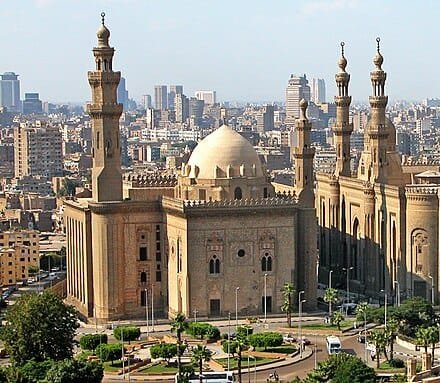
The minarets of Sultan Hassan are among the most defining features of Cairo's historical skyline, representing the sheer vertical ambition of Mamluk architects. Originally, the design called for four minarets, a rarity for the time, intended to crown each corner of the massive structure. However, only three were built, and today only two remain. The tallest of these reaches a staggering height of 68 meters (approximately 223 feet), making it the highest minaret of the Mamluk period. These structures were not just religious necessities for the Muezzin to call the faithful to prayer; they were "skyscrapers" of the 14th century, designed to project the Sultan's authority across the city. Their height ensured that the call to prayer could be heard even in the most distant quarters of Cairo, effectively weaving the mosque into the daily auditory fabric of the capital. From a design perspective, these minarets are masterpieces of stone engineering. They are built on massive square bases that transition into octagonal sections, adorned with delicate balconies supported by stone muqarnas. The intricate carvings on the upper tiers demonstrate a high level of craftsmanship, as artisans had to work at dangerous heights to complete the decorative details. For the cultural traveler, these minarets provide a sense of orientation within Old Cairo. They act as stone sentinels that have watched over the city for over 600 years. Standing at the base of the mosque and looking upward, the tapering forms of the minarets seem to pierce the sky, creating a visual link between the earthly city and the celestial realm—a core tenet of Islamic architectural philosophy.
11. The Tragedy of the Collapsed Minaret: A Dark Omen
The history of the Sultan Hassan Mosque is marred by a catastrophic event that many in the 14th century interpreted as a divine omen. In 1361, during the final stages of construction, one of the massive minarets—the one located above the main entrance—suddenly collapsed. The fall was devastating, as the heavy limestone blocks crashed into the mosque’s orphanage located below, resulting in the tragic deaths of approximately 300 children. The city of Cairo was plunged into mourning, and the event sent shockwaves through the Sultan's court. Rumors began to circulate among the populace that the collapse was a sign of the Sultan’s impending downfall. Indeed, Sultan Hassan was assassinated just thirty-three days after the disaster, leading many to believe that the mosque’s structural failure was a supernatural warning of the end of his reign. This tragedy had a lasting impact on the building’s final appearance. The collapsed minaret was never rebuilt in its original form, which is why the mosque today appears asymmetrical. For history enthusiasts, this incident highlights the immense risks involved in pushing the boundaries of medieval engineering. Building to such unprecedented heights in an era without modern structural analysis was a gamble. The collapse remains a somber chapter in the mosque's narrative, a reminder that the "Pyramid of Islamic Architecture" was built not just with stone and gold, but with human sweat and, ultimately, human sacrifice. Today, as you stand near the entrance portal, the absence of the third minaret serves as a silent memorial to those who perished in the pursuit of architectural perfection.
12. The Mosque as a Fortress: Military Strategy in Stone
One of the most fascinating aspects of the Sultan Hassan Mosque is its dual role as a religious sanctuary and a military fortress. Due to its massive, thick walls and its strategic location directly facing the Saladin Citadel, the mosque was frequently dragged into the violent power struggles of the Mamluk elite. During times of civil unrest or coups, rebel Emirs and soldiers would occupy the mosque, using its high roof and minarets as defensive platforms. From the top of Sultan Hassan, soldiers could launch projectiles, fire arrows, and even position trebuchets (medieval catapults) to fire upon the Sultan’s palace in the Citadel. Its fortress-like quality was so effective that the mosque became a "strategic thorn" in the side of many ruling Sultans. This military utility often led to the mosque being treated as a combat zone rather than a holy site. On several occasions, ruling Sultans ordered the destruction of the stairs leading to the minarets to prevent rebels from using them as sniper nests. Some even went as far as walling up the main entrance or attempting to demolish parts of the building to neutralize its tactical advantage. For the history buff, walking through the mosque today reveals "scars" of these battles—small chips in the stone or reinforced sections that hint at its turbulent past. This paragraph of its history reminds us that in medieval Cairo, the lines between religion, education, and warfare were often blurred. The Sultan Hassan Mosque was not just a place of peace; it was a silent participant in the bloody politics that shaped the Middle East for centuries.
13. The Light of the Mosque: Enamelled Glass Lamps and Divine Radiance
In the centuries following its completion, the interior of the Sultan Hassan Mosque was famously illuminated by a "sea of light," provided by hundreds of magnificent enamelled glass lamps. These lamps were not merely functional objects; they were among the most exquisite examples of Islamic decorative art ever produced. Suspended by long, delicate brass chains from the soaring vaulted ceilings, the lamps were decorated with the Sultan’s royal blazon, intricate floral motifs, and the famous "Light Verse" from the Quran: "God is the Light of the heavens and the earth." When lit with oil at night, the flickering flames would reflect off the polished marble walls and gilded inscriptions, creating an ethereal, golden atmosphere that made the massive stone halls feel weightless and divine. The production of these lamps represented a peak in medieval glassmaking technology. Craftsmen used a complex process of enameling and gilding to ensure the colors remained vibrant even when subjected to heat. Today, most of the original lamps have been removed for their protection and are housed in the Museum of Islamic Art in Cairo, the British Museum, and the Metropolitan Museum of Art, where they are regarded as priceless treasures. For the art historian, the absence of these lamps in the mosque today is a bittersweet reminder of its former splendor. However, the modern lighting still manages to catch the majesty of the space, allowing visitors to imagine the breathtaking sight of a thousand glowing jewels hanging in the darkness of the 14th-century night.
14. The Intricate Corridors: A Journey Through a Stone Labyrinth
One of the most overlooked architectural features of the Sultan Hassan complex is the vast network of hidden corridors and secondary passages that weave through its massive walls. These are not just simple hallways; they are a labyrinth of stone designed to manage the flow of hundreds of students, teachers, and worshippers simultaneously. Because the mosque also functioned as four separate universities, the architects had to create a layout that allowed each school to remain private while still being connected to the central prayer hall. These corridors are often tall, narrow, and starkly undecorated, providing a sharp contrast to the luxury of the main iwans. Walking through them today, one feels the "weight" of the building, with limestone walls several meters thick on either side. These passages also served a functional role in climate control. The thick stone and narrow openings acted as a natural ventilation system, drawing in cool air from the shaded courtyards and circulating it throughout the dormitories and classrooms. For the adventurous traveler, exploring these side passages offers a glimpse into the daily life of a medieval student. You can find small doorways leading to tiny "cells" where students slept and studied, and staircases that vanish into the upper reaches of the building. This internal complexity proves that the Sultan Hassan Mosque was not just a facade of grandeur, but a highly organized "living machine," designed with a level of urban planning efficiency that was centuries ahead of its time.
15. The Acoustic Wonders: Geometry, Sound, and the Voice of the Imam
Long before the invention of modern microphones and speakers, the architects of the Sultan Hassan Mosque utilized the laws of physics and geometry to create a sophisticated acoustic environment. The massive barrel vaults of the four iwans were engineered with a specific curvature that allowed sound to travel and resonate without becoming distorted. In the main Qibla Iwan, the "voice of the Imam" would be captured by the stone vault and projected forward, ensuring that even those standing in the far corners of the central courtyard could hear the prayers clearly. This was not accidental; Mamluk engineers were well-versed in the science of acoustics, often using hollow ceramic jars embedded in the walls to absorb echoes and clarify speech. The result is a sensory experience that is unique to this building. When a call to prayer or a Quranic recitation is performed inside Sultan Hassan, the sound seems to emanate from the stones themselves, surrounding the listener in a "blanket of audio." For the spiritual seeker, the acoustics heighten the emotional impact of the liturgy, turning the architecture into a musical instrument. Even in the modern era, with the roar of Cairo’s traffic just outside the doors, the interior of the mosque maintains a heavy, reverent silence that amplifies the smallest whisper. This mastery of sound is one of the "hidden" miracles of the complex, proving that the Mamluk builders were concerned with more than just what the eye could see—they were building an environment for the soul to hear.
16. The Architectural Legacy: A Blueprint for the Islamic World
The influence of the Sultan Hassan Mosque-Madrasa extends far beyond the borders of Egypt, acting as a definitive blueprint for Islamic architecture for centuries. Its "four-iwan" cruciform plan, which perfectly balanced religious, educational, and funerary functions, became a gold standard for royal commissions throughout the Middle East and beyond. Architects from the Ottoman Empire, the Safavid Dynasty in Persia, and even the Mughals in India looked to Sultan Hassan as a "textbook in stone." The mosque’s use of massive vaulted halls and its integration of a royal mausoleum directly behind the prayer niche were revolutionary concepts that changed the way sacred spaces were designed. It proved that a building could be a fortress, a university, and a temple all at once, without sacrificing aesthetic harmony. Even in the modern era, the mosque remains a primary source of study for architects specializing in Islamic design. Its mathematical proportions, the way it handles natural light, and its sophisticated use of transitional spaces (like the dark entrance corridor) are still analyzed in universities today. For the scholarly traveler, the mosque is not just a relic of the 14th century; it is a "living ancestor" to many of the world's most famous mosques. Its legacy is found in the soaring domes of Istanbul and the intricate tilework of Isfahan. By pushing the boundaries of what Mamluk engineering could achieve, Sultan Hassan’s architects created a timeless architectural language that continues to speak to the human desire for grandeur, symmetry, and spiritual order.
17. Sultan Hassan vs. Al-Rifa'i: A Tale of Two Eras
To stand in the square between the Sultan Hassan Mosque and its neighbor, the Al-Rifa'i Mosque, is to witness a fascinating architectural dialogue spanning half a millennium. Built between 1869 and 1912, Al-Rifa'i was intentionally designed to match the massive scale and height of Sultan Hassan, creating a "gateway" effect at the foot of the Citadel. While they appear similar at first glance, the differences tell the story of Egypt's evolution. Sultan Hassan represents the raw, masculine power of the Mamluk warriors—built with hand-carved stone and ancient spoils. In contrast, Al-Rifa'i is a product of the modern era, featuring neo-Mamluk refinement, imported European marbles, and the royal tombs of the Muhammad Ali Dynasty and the last Shah of Iran. This juxtaposition offers the cultural tourist a unique perspective on "architectural rivalry." Al-Rifa'i was a conscious effort by the modern Egyptian state to reclaim the glory of the Mamluk past. However, despite its beauty and royal prestige, most historians agree that Al-Rifa'i cannot quite capture the "soul" of the original. There is a grit and a historical weight to Sultan Hassan that the newer mosque, for all its luxury, simply cannot replicate. Together, these two "giants" create one of the most photographed and spiritually significant locations in Cairo. They represent the two bookends of Cairo’s history: the medieval Islamic powerhouse and the modern, cosmopolitan capital, standing face-to-face in an eternal gaze of mutual respect.
18. Conclusion: The Eternal Sentinel of the Cairo Skyline
As the sun sets over the Giza Plateau and the call to prayer echoes from the Citadel, the Mosque-Madrasa of Sultan Hassan remains the undisputed guardian of Cairo’s historical identity. It has survived devastating earthquakes, the rise and fall of countless dynasties, and the relentless march of modern urbanization. It is a monument that refuses to be ignored, a "mountain of stone" that serves as a permanent reminder of a time when Egypt was the center of the world's intellectual and artistic life. To walk through its doors is to leave the 21st century behind and enter a realm where geometry, faith, and ambition are carved into every limestone block. The Sultan Hassan complex is more than just a "Pyramid of Islamic Architecture"; it is a testament to the resilience of human creativity. Despite the tragedy of the collapsed minaret and the fact that the Sultan himself never rested in his magnificent tomb, the building achieved its primary goal: immortality. It stands today as a challenge to every generation to build something that lasts, something that aspires to the divine. For any visitor to Egypt, a trip to this mosque is a mandatory pilgrimage into the heart of the Mamluk soul. As long as its minarets pierce the sky, the story of Sultan Hassan will continue to be told—a story of a young king’s dream that became an eternal sentinel for the city of a thousand minarets.