- Excursions in Egypt
- Egypt Tour Packages
- Cairo Tours and Excursions
- Hurghada Tours and Excursions
- Soma Bay Tours and Excursions
- Makadi Bay Tours and Excursions
- Sahl Hasheesh Tours and Excursions
- El Gouna Tours and Excursions
- Marsa Alam Tours and Excursions
- Port Ghalib Tours and Excursions
- El Quseir Tours and Excursions
- Dendera and Abydos Day Tours
- Aswan Tours and Excursions
- Luxor Tours and Excursions
- Sharm El Sheikh Tours and Excursions
- Top Rated Egypt Tours in 2026
- Optional Excursions in Egypt
- Private Transfer
- Blogs About egypt
- Ancient Egypt
- Historical Sites in Egypt
- Cairo
- Alexandria
- Luxor
- Aswan
- The Red Sea
- Dendera Temple
- El Fayoum Oasis
- Bahariya Oasis
- Siwa Oasis
- Al Alamein
- Marsa Matruh
- Why Egypt Is One of the Safest Countries to Visit in the Middle East
- What You Need To know Before Your First Trip To Egypt
- Egypt Travel Costs in 2026 Full Budget Guide
- Top 10 Tourist Activities in Egypt
- Top 50 Activities You Can’t Miss in Egypt in 2026
- The Guide to Guided Tours in Egypt
- Egypt’s Ancient and Modern History
- The Nile River
- The Deserts of Egypt
- Ancient Egyptian gods
- famous Egyptian dishes
- UNESCO World Heritage sites
- About Us
- Egypt Hotels and Resorts
- Excursions in Egypt
- Egypt Tour Packages
- Cairo Tours and Excursions
- Hurghada Tours and Excursions
- Soma Bay Tours and Excursions
- Makadi Bay Tours and Excursions
- Sahl Hasheesh Tours and Excursions
- El Gouna Tours and Excursions
- Marsa Alam Tours and Excursions
- Port Ghalib Tours and Excursions
- El Quseir Tours and Excursions
- Dendera and Abydos Day Tours
- Aswan Tours and Excursions
- Luxor Tours and Excursions
- Sharm El Sheikh Tours and Excursions
- Top Rated Egypt Tours in 2026
- Optional Excursions in Egypt
- Private Transfer
- Blogs About egypt
- Ancient Egypt
- Historical Sites in Egypt
- Cairo
- Alexandria
- Luxor
- Aswan
- The Red Sea
- Dendera Temple
- El Fayoum Oasis
- Bahariya Oasis
- Siwa Oasis
- Al Alamein
- Marsa Matruh
- Why Egypt Is One of the Safest Countries to Visit in the Middle East
- What You Need To know Before Your First Trip To Egypt
- Egypt Travel Costs in 2026 Full Budget Guide
- Top 10 Tourist Activities in Egypt
- Top 50 Activities You Can’t Miss in Egypt in 2026
- The Guide to Guided Tours in Egypt
- Egypt’s Ancient and Modern History
- The Nile River
- The Deserts of Egypt
- Ancient Egyptian gods
- famous Egyptian dishes
- UNESCO World Heritage sites
- About Us
- Egypt Hotels and Resorts
Welcome to
Pompey’s Pillar: Alexandria’s Towering Monument of Roman Glory
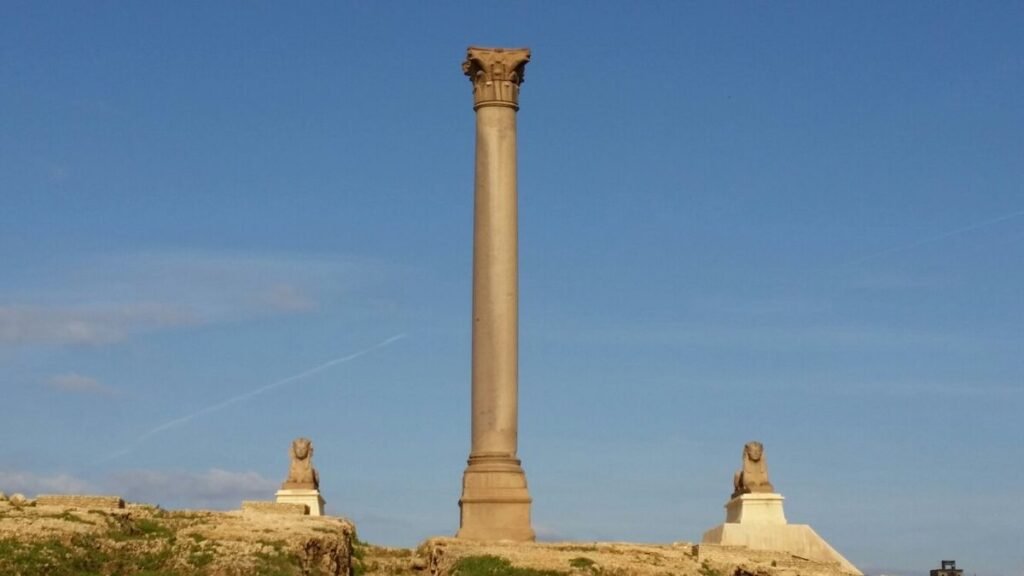
Rising dramatically above the ruins of ancient Alexandria, the magnificent Pompey’s Pillar stands as one of the city’s most iconic and mysterious historical landmarks. Towering nearly 27 meters into the sky, this colossal granite column dominates the surrounding landscape and serves as a powerful reminder of Alexandria’s importance during the Roman era. Despite its popular name, the monument has no actual connection to the Roman general Pompey. Historians believe the pillar was constructed in honor of the Roman Emperor Diocletian around the end of the third century AD, commemorating his military victories and support for the city after a period of political unrest and famine. Carved from a single block of massive red Aswan granite, the pillar remains one of the largest ancient monolithic columns ever created outside Rome and Constantinople. The monument originally stood within the grand Temple of Serapis, one of the most important religious complexes in ancient Alexandria dedicated to the Greco-Egyptian god Serapis, who symbolized the fusion of Egyptian and Greek religious traditions. Although much of the temple was destroyed over time, Pompey’s Pillar survived centuries of earthquakes, invasions, and political change, continuing to overlook the city like a silent guardian of Alexandria’s ancient past. Visitors approaching the site today are immediately struck by the monument’s immense scale and commanding presence against the Mediterranean sky. Surrounding archaeological remains, underground tunnels, sphinx statues, and broken temple ruins further enhance the atmosphere of mystery and historical grandeur. Beyond its architectural significance, Pompey’s Pillar represents Alexandria’s multicultural identity during the Roman period, when Greek, Egyptian, and Roman civilizations blended together within one of the Mediterranean’s greatest cities. For travelers exploring Alexandria, the monument offers a fascinating journey into the world of Roman Egypt, combining impressive engineering, political symbolism, archaeological beauty, and panoramic views into one unforgettable historical experience beside the Mediterranean coast.
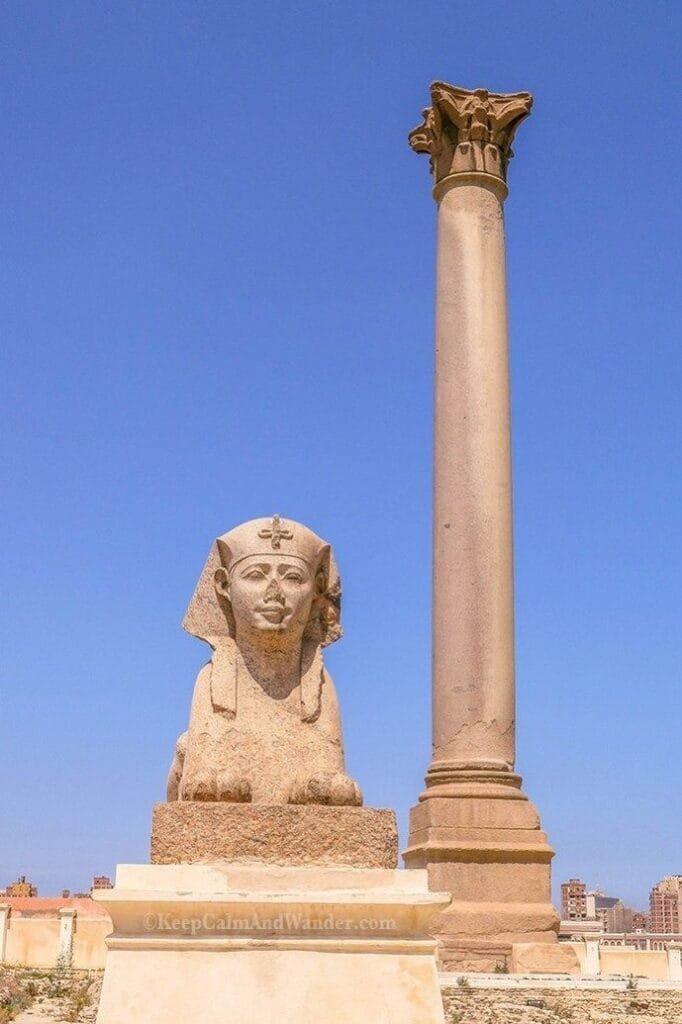
1. The True History Behind the Name “Pompey’s Pillar”
Although the famous Pompey's Pillar is widely associated with the Roman general Pompey, the monument actually has no historical connection to him at all. The name “Pompey’s Pillar” emerged centuries after the structure was built due to a misunderstanding among medieval European travelers and Crusaders visiting Alexandria. Many believed that the pillar marked the burial place or memorial of Pompey, who was assassinated in Egypt in 48 BC after fleeing from his rival Julius Caesar. According to ancient historical accounts, Pompey arrived in Egypt seeking protection from the young Pharaoh Ptolemy XIII during the Roman civil war, but he was betrayed and killed shortly after landing near Alexandria. Over time, legends connected the massive column to his memory despite the complete lack of archaeological evidence supporting this theory. Modern historians and archaeologists later confirmed that the monument was actually constructed nearly three centuries after Pompey’s death during the reign of the Roman Emperor Diocletian. An inscription originally found near the base of the column revealed that the pillar was dedicated to Diocletian in recognition of his support for Alexandria following a major rebellion and famine in the city during the late third century AD. Despite this correction, the popular name “Pompey’s Pillar” continued to survive and eventually became permanently attached to the monument in both local and international culture. The misunderstanding itself reflects Alexandria’s long history of legends, myths, and historical confusion resulting from the city’s extraordinary mixture of civilizations and historical events. Visitors exploring the site today often find the story behind the monument’s name just as fascinating as the pillar itself because it reveals how historical memory can evolve and transform over centuries. The mistaken identity also adds an additional layer of mystery and romance to the monument, connecting it indirectly to one of the most dramatic political conflicts of the ancient Roman world. The story of Pompey’s Pillar therefore demonstrates how Alexandria’s landmarks often exist at the intersection of history, mythology, archaeology, and storytelling, preserving both factual history and centuries of cultural imagination beside the Mediterranean coast.
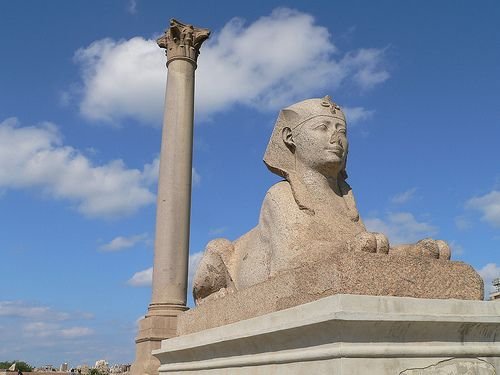
2. Emperor Diocletian and the Roman Monument of Victory
The true origin of Pompey's Pillar dates back to the reign of Diocletian, one of the most important emperors of the late Roman Empire. Constructed around 297 AD, the massive granite column was erected to honor Diocletian after he successfully suppressed a major rebellion in Alexandria and restored political stability to Egypt during a difficult period of famine and unrest. At the time, Alexandria remained one of the Roman Empire’s most valuable cities due to its strategic Mediterranean harbor, thriving economy, and vital grain supply that helped feed large parts of the empire. Any political instability within Alexandria therefore represented a serious threat to Roman authority and economic security. After defeating the rebellion, Diocletian reportedly introduced measures to provide food and support for the suffering population, actions that earned him recognition and gratitude from local authorities. In response, the monumental column was built as a symbol of imperial power, stability, and Roman victory. The pillar originally stood within the great Temple of Serapis complex, one of Alexandria’s most important religious and cultural centers during the Roman era. Rising nearly twenty-seven meters high, the monument demonstrated the engineering capabilities and political symbolism typical of Roman imperial architecture. Carved from a single piece of red granite transported from Aswan in southern Egypt, the column represented not only artistic achievement but also the immense logistical power of the Roman Empire. Visitors standing beside the monument today are often amazed by the sheer size and precision of the ancient structure, especially considering the technological limitations of the period. The pillar symbolized Rome’s dominance over Egypt while also reflecting Alexandria’s continued importance within the empire. Over the centuries, the surrounding temple complex gradually disappeared due to earthquakes, religious conflicts, and urban transformation, yet the column itself survived as one of the last great reminders of Roman Alexandria. The monument therefore stands not only as a tribute to Emperor Diocletian but also as a lasting symbol of Alexandria’s political significance during one of the most complex and transformative periods in Mediterranean history beside the ancient harbor city.
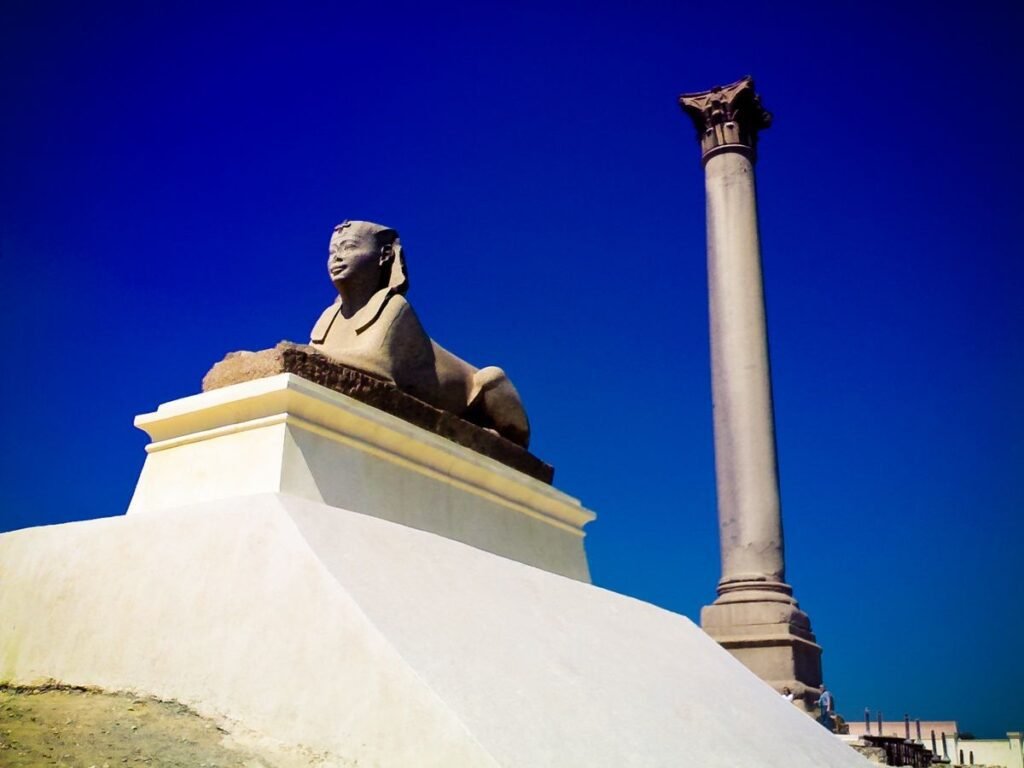
3. The Temple of Serapis and Alexandria’s Sacred Landscape
Before Pompey's Pillar became the famous monument visitors see today, the site originally formed part of the enormous Temple of Serapis, one of the most important religious complexes in ancient Alexandria. The temple was dedicated to the god Serapis, a unique Greco-Egyptian deity created during the Ptolemaic period to unite Greek and Egyptian religious traditions under a single symbol of divine authority. Serapis combined characteristics of Egyptian gods such as Osiris and Apis with the appearance and attributes of Greek deities like Zeus and Hades. This religious fusion reflected Alexandria’s multicultural identity, where Greek, Egyptian, and later Roman influences blended together to create entirely new cultural and spiritual traditions. The Serapeum of Alexandria became not only a major temple but also a center of philosophy, learning, and worship visited by people from across the Mediterranean world. Ancient accounts describe the temple complex as one of the most magnificent structures in Alexandria, filled with massive halls, towering columns, statues, underground chambers, libraries, and ceremonial spaces. Pompey’s Pillar originally stood proudly within this sacred environment as part of the architectural landscape surrounding the temple. The site occupied a strategic elevated position overlooking the city, reinforcing both its religious and political importance. During the Roman period, the Temple of Serapis represented one of Alexandria’s most powerful spiritual centers, attracting worshippers, scholars, and officials alike. However, during the late fourth century AD, rising tensions between pagan religions and Christianity led to the destruction of much of the temple complex. Historical records describe violent conflicts that ultimately resulted in the demolition of the Serapeum under imperial Christian authority. Although most of the temple disappeared over time, fragments of ruins, underground passages, sphinx statues, and Pompey’s Pillar survived the destruction and continue to preserve the memory of Alexandria’s sacred past. Visitors exploring the archaeological site today can still sense the historical significance of the location through the remaining ruins scattered around the massive column. The site provides valuable insight into Alexandria’s religious diversity and the dramatic transformations that reshaped the city during late antiquity. Pompey’s Pillar therefore stands not only as a Roman monument but also as one of the final surviving witnesses to the once-glorious Temple of Serapis and Alexandria’s extraordinary spiritual and cultural landscape.
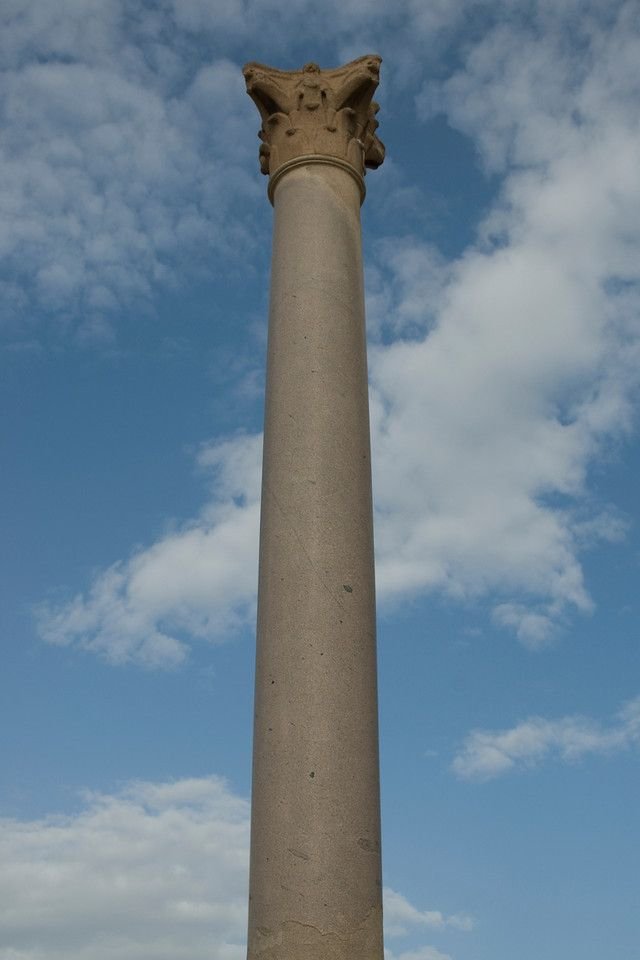
4. The Engineering Marvel of the Monolithic Granite Column
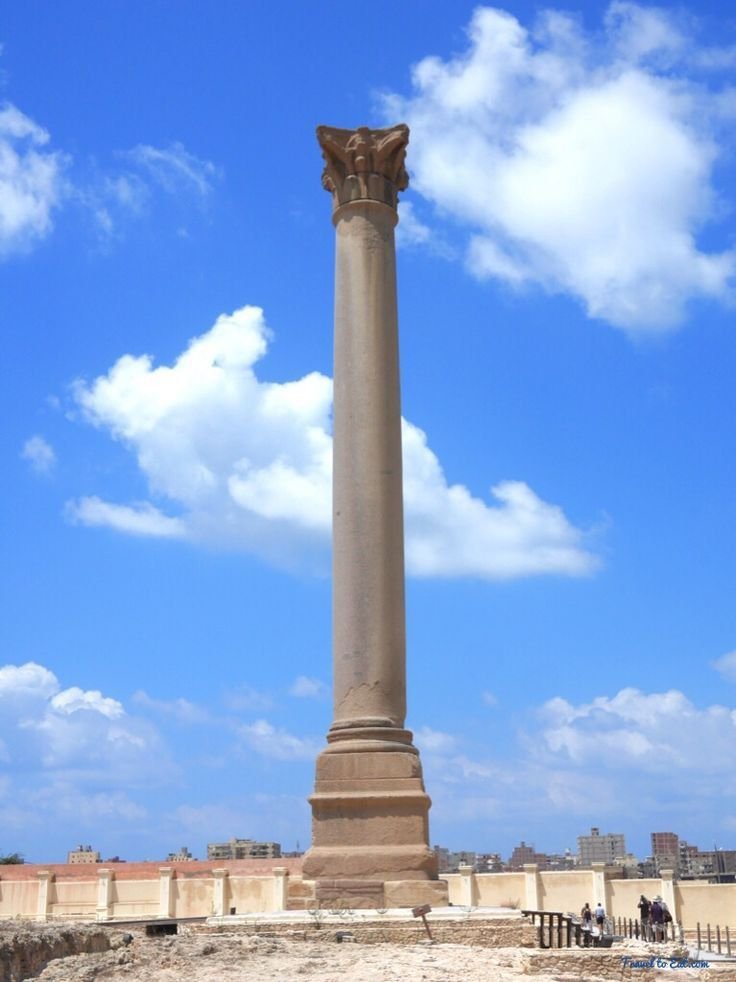
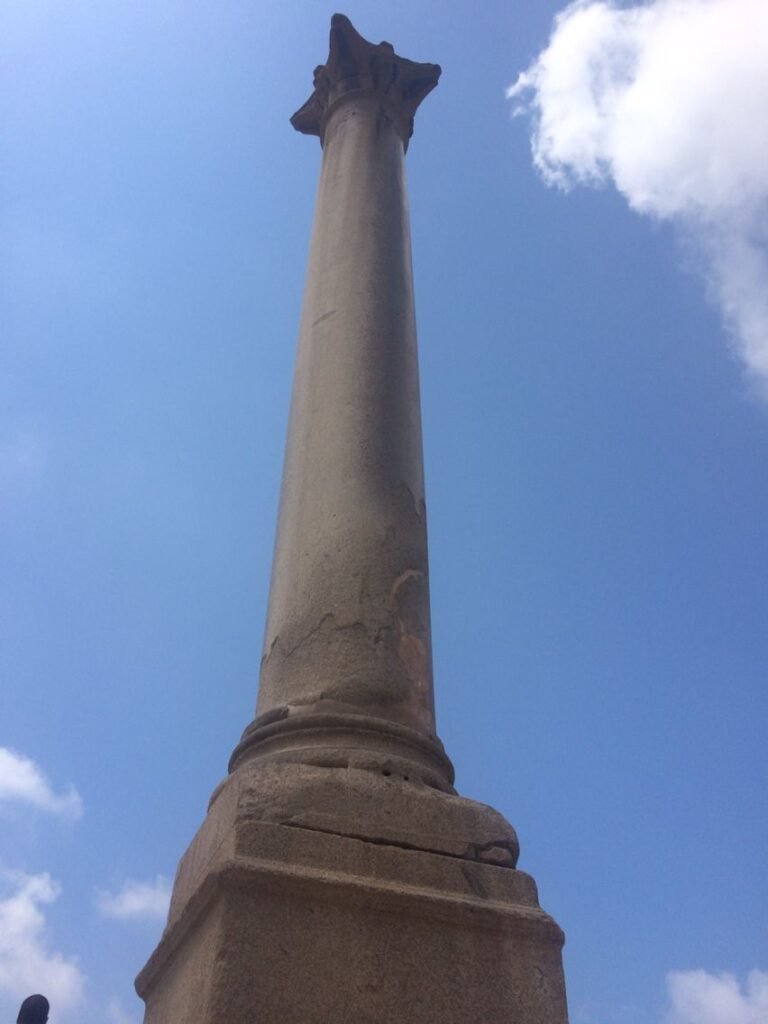
One of the most astonishing aspects of Pompey's Pillar is the extraordinary engineering achievement required to create, transport, and erect such a massive monolithic granite column during the Roman era. Standing approximately twenty-seven meters high including its base and capital, the pillar remains one of the largest ancient monolithic columns ever constructed outside Rome and Constantinople. The central shaft alone was carved from a single enormous block of red granite quarried in Aswan, located hundreds of kilometers south of Alexandria along the Nile River. Ancient engineers faced enormous logistical challenges in cutting, shaping, transporting, and positioning such a colossal piece of stone using only the tools and technology available nearly two thousand years ago. Historians believe the granite block was extracted carefully from Aswan’s famous quarries before being transported northward along the Nile by specially designed barges capable of carrying immense weight. Once the stone arrived in Alexandria, Roman engineers and laborers would have used ramps, ropes, wooden scaffolding, pulleys, and complex lifting techniques to raise the column into its final upright position within the Temple of Serapis complex. The precision achieved during construction continues to impress modern engineers because the pillar has remained standing for centuries despite earthquakes, storms, political conflicts, and environmental changes affecting Alexandria over time. The smooth polished surface of the granite reflects remarkable craftsmanship and attention to detail, while the Corinthian-style capital decorating the top of the column demonstrates the influence of classical Roman architecture. Visitors standing near the monument today often feel overwhelmed by its immense scale and by the realization that ancient builders accomplished this feat without modern machinery or industrial technology. The survival of the pillar also highlights the durability and advanced structural knowledge of Roman engineering in Egypt. Unlike many surrounding structures that collapsed or disappeared over time, Pompey’s Pillar continues to dominate the landscape as a silent symbol of ancient technical mastery. The monument therefore represents not only political and religious history but also one of the greatest engineering accomplishments of Roman Alexandria. Its towering presence beside the Mediterranean coast remains a powerful reminder of humanity’s ability to combine artistry, mathematics, labor, and ambition into monuments capable of surviving across millennia.
5. The Sphinxes and Ruins Surrounding Pompey’s Pillar
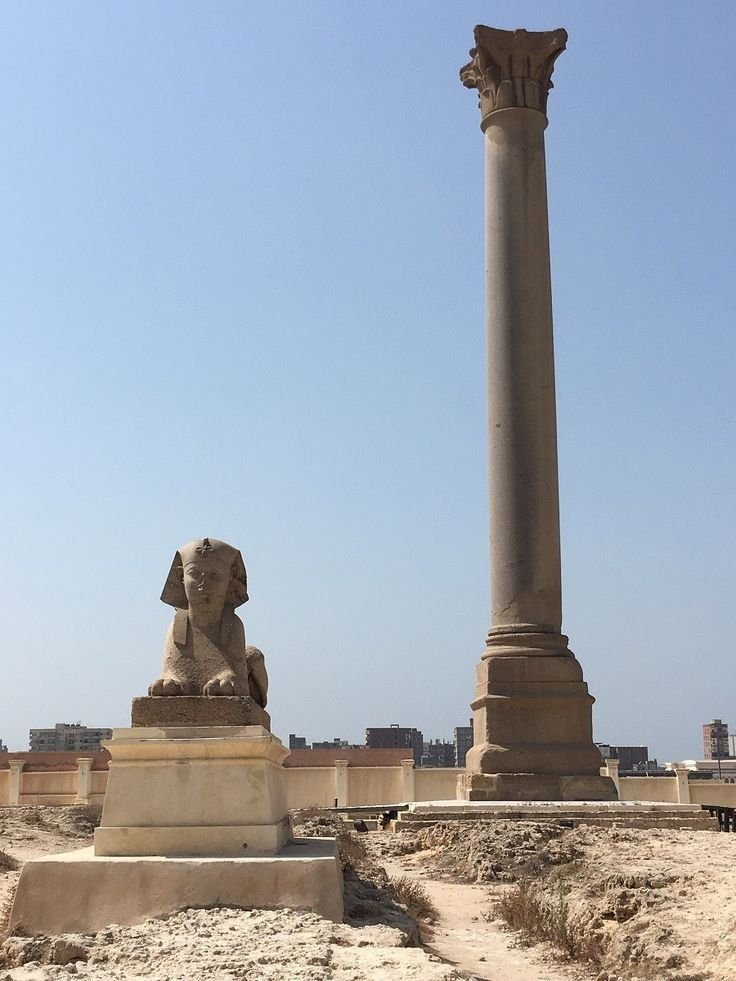
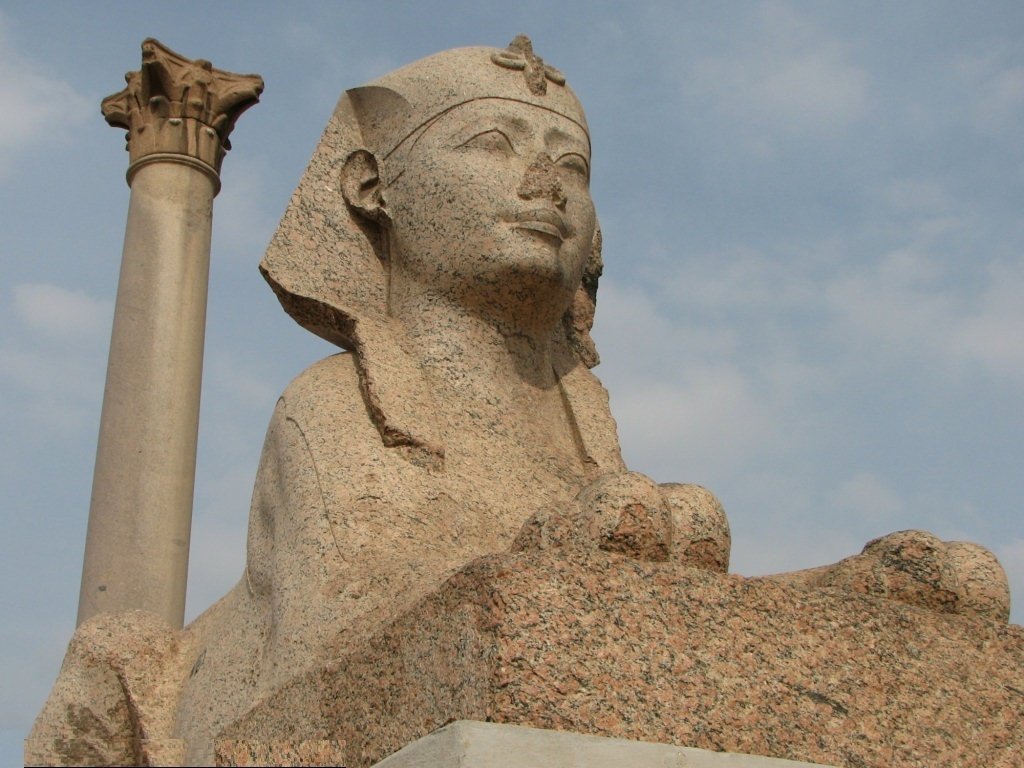
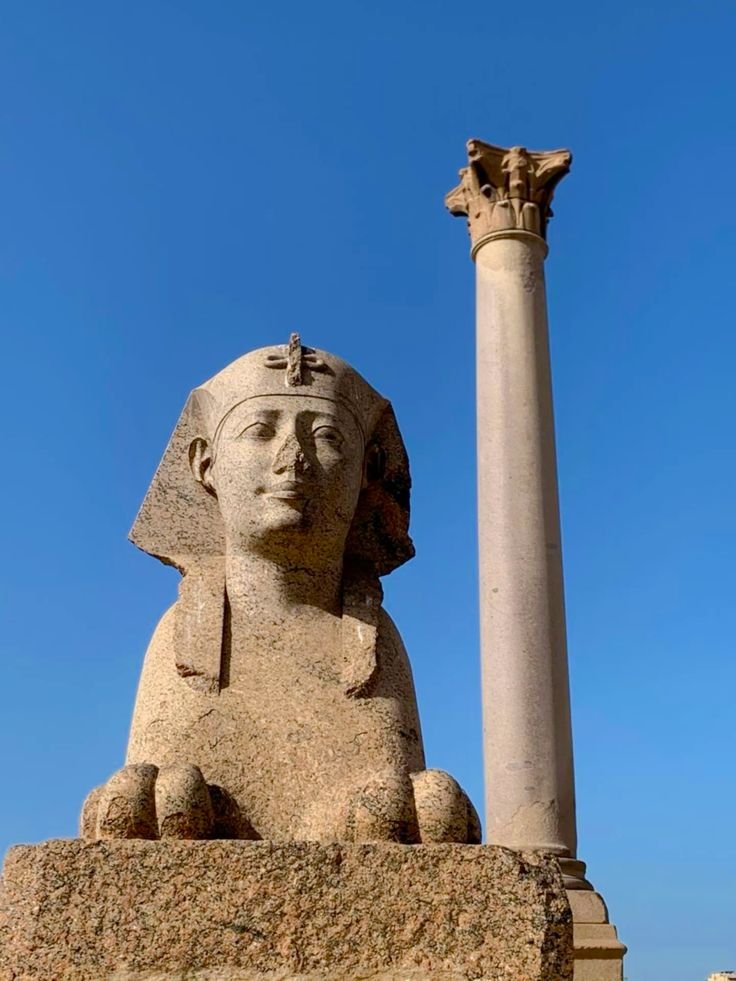
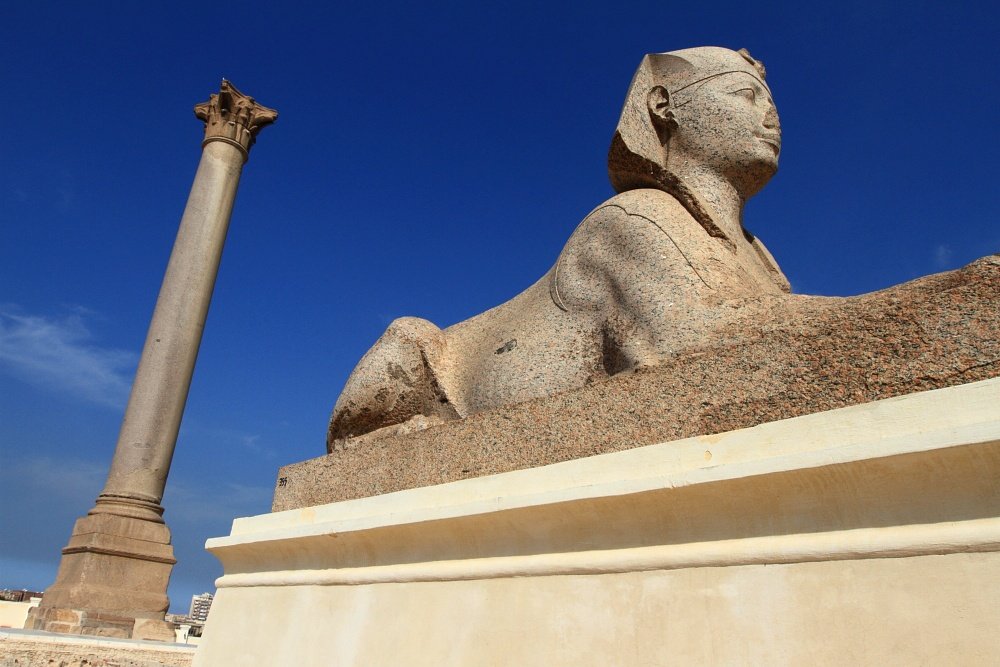
While Pompey's Pillar dominates the archaeological site with its towering height, the surrounding ruins and sphinx statues contribute equally to the atmosphere of historical mystery and grandeur that fascinates visitors exploring the area today. Scattered around the base of the column lie the remnants of the once-magnificent Temple of Serapis complex, including broken stones, collapsed walls, underground chambers, and fragments of ancient architecture that hint at the enormous scale of the original sanctuary. Among the most visually striking features surrounding the pillar are the ancient sphinx statues carved from granite and positioned around the archaeological site. These sphinxes combine the body of a lion with human features, following a tradition deeply rooted in ancient Egyptian symbolism representing strength, wisdom, royal authority, and divine protection. Their presence near the Roman column reflects the remarkable cultural fusion that defined Alexandria during antiquity, where Egyptian artistic traditions continued alongside Greek and Roman influences. Visitors walking through the site often feel transported into a lost world where fragments of different civilizations coexist within one historical landscape. The contrast between the massive upright column and the surrounding ruins creates a powerful visual reminder of both the glory and fragility of ancient civilizations. Archaeologists studying the area continue uncovering evidence of underground passages, temple foundations, ceremonial spaces, and decorative elements connected to the original Serapeum complex. These discoveries provide valuable information about the religious and political significance of the site during the Ptolemaic and Roman periods. The sphinx statues themselves remain favorite subjects for photographers and travelers because they create dramatic scenes beside the enormous granite pillar, especially during sunset when warm Mediterranean light illuminates the ancient stones. Visitors also appreciate the elevated location of the archaeological site, which offers panoramic views over parts of Alexandria while reinforcing the monument’s commanding historical presence. The surrounding ruins encourage imagination, allowing travelers to picture the immense temple complex that once stood proudly around the pillar before centuries of destruction, earthquakes, and urban transformation reshaped the city. Together, Pompey’s Pillar and its surrounding archaeological remains form one of Alexandria’s most atmospheric historical sites, preserving the memory of a sacred and political landscape that once symbolized the power and diversity of the ancient Mediterranean world.
6. Pompey’s Pillar in Medieval Legends and Travelers’ Stories
For centuries, Pompey's Pillar captured the imagination of travelers, historians, explorers, and storytellers who visited Alexandria and attempted to explain the origins and purpose of the mysterious monument towering above the city ruins. During the medieval period, long before modern archaeology provided accurate historical understanding, the pillar became surrounded by legends, myths, and dramatic stories connecting it to famous rulers, hidden treasures, and ancient battles. European Crusaders and travelers visiting Alexandria often believed the column marked the burial place of the Roman general Pompey, whose assassination in Egypt during the conflict with Julius Caesar remained one of antiquity’s most famous historical events. Although historians later proved this theory false, the romantic legend persisted for centuries and permanently shaped the monument’s modern name. Some medieval writers even claimed that Pompey’s severed head was displayed atop the pillar after his death, adding further drama to the story despite the absence of historical evidence. Arab historians and local traditions also associated the monument with ancient kings, magical powers, and lost civilizations hidden beneath Alexandria’s ruins. Due to its enormous size and isolated appearance after the destruction of the Temple of Serapis, the pillar seemed mysterious and almost supernatural to many visitors arriving in the city during the Middle Ages. Explorers described the monument as one of the greatest surviving wonders of the ancient world, often exaggerating its dimensions and historical significance in travel accounts circulated throughout Europe and the Islamic world. These stories helped strengthen Alexandria’s reputation as a city filled with hidden mysteries, buried treasures, and remnants of lost civilizations beneath the Mediterranean coast. Travelers arriving by sea could see the massive column rising above the surrounding ruins, creating an unforgettable first impression of the ancient city. Artists and writers frequently included Pompey’s Pillar in paintings, maps, and literary descriptions portraying Alexandria as a place suspended between myth and history. Even after modern archaeological research corrected many historical misunderstandings, the romantic legends surrounding the monument continued to fascinate visitors and contribute to its enduring cultural appeal. Pompey’s Pillar therefore exists not only as an archaeological structure but also as a symbol shaped by centuries of imagination, storytelling, and historical curiosity. The monument continues to inspire travelers today in much the same way it captivated medieval explorers who stood beneath its towering granite shadow centuries ago.
7. The Panoramic Views from Pompey’s Pillar Site
One of the most rewarding aspects of visiting Pompey's Pillar is the breathtaking panoramic view offered by the elevated archaeological site overlooking large sections of Alexandria. Because the monument stands on one of the city’s higher natural points, visitors exploring the surrounding ruins can enjoy sweeping perspectives that combine modern urban life with the visible remains of ancient history. From the area around the pillar, the contrast between contemporary Alexandria and its buried archaeological past becomes especially striking. The Mediterranean skyline, dense city streets, historic neighborhoods, mosques, and distant coastal views create a dramatic setting surrounding the towering Roman monument. During clear weather, visitors can observe how Alexandria stretches toward the sea while imagining the grandeur of the ancient city that once served as one of the greatest cultural and commercial capitals of the Mediterranean world. The elevated location originally chosen for the Temple of Serapis was not accidental; it emphasized the political and religious importance of the sacred complex while allowing the monument to dominate the surrounding landscape. Today, photographers and travelers frequently pause around the site to admire the scenery and capture images combining the granite column, ancient ruins, sphinx statues, and modern city views within a single frame. Sunset is considered one of the most beautiful times to experience the site because warm Mediterranean light illuminates the red granite pillar while casting long shadows across the archaeological remains below. The changing colors of the sky and sea create an atmosphere of timeless beauty that strengthens the emotional connection between visitors and Alexandria’s ancient heritage. The panoramic perspective also encourages reflection about the layers of civilization that shaped the city over thousands of years, from the era of Alexander the Great and the Ptolemies to the Roman Empire and modern Egypt. Standing beside Pompey’s Pillar while overlooking Alexandria allows travelers to appreciate how the city evolved continuously while preserving traces of its extraordinary past beneath the modern streets. The combination of monumental architecture and expansive urban views makes the site one of Alexandria’s most visually impressive historical destinations. Pompey’s Pillar therefore offers not only archaeological significance but also one of the finest opportunities to experience the unique relationship between ancient history and contemporary life along Egypt’s Mediterranean coast.
8. Photography and Artistic Inspiration at Pompey’s Pillar
The striking visual presence of Pompey's Pillar has inspired photographers, artists, travelers, and historians for centuries, making the monument one of the most photographed historical landmarks in Alexandria. Rising dramatically above the surrounding ruins and city skyline, the massive granite column creates a powerful visual composition that combines simplicity, scale, and historical atmosphere. The monument’s towering height and isolated position against the Mediterranean sky give it an almost cinematic appearance, especially during sunrise and sunset when changing natural light transforms the colors of the granite and surrounding archaeological remains. Photographers are particularly drawn to the contrast between the smooth red stone of the pillar and the fragmented ruins scattered around its base. Ancient sphinx statues, broken temple stones, underground chambers, and weathered architectural fragments create additional visual layers that enrich every photograph taken at the site. The monument’s elevated location also allows artists and visitors to capture panoramic scenes blending ancient history with modern Alexandria’s urban landscape in the background. Throughout history, European travelers and painters visiting Egypt frequently included Pompey’s Pillar in sketches, paintings, and travel illustrations portraying Alexandria as a mysterious city filled with monumental ruins and traces of lost civilizations. The dramatic vertical form of the pillar itself naturally attracts artistic attention because it symbolizes endurance, strength, and survival across centuries of political change and urban transformation. Modern visitors often find that the site offers very different photographic moods depending on the time of day. Early morning creates soft lighting and peaceful atmospheres ideal for capturing architectural details, while sunset bathes the ruins in warm golden tones that emphasize the monument’s grandeur and emotional impact. Nighttime views of the illuminated column also provide unique perspectives that highlight the pillar’s imposing silhouette against Alexandria’s evening skyline. Beyond professional photography, the site inspires reflection and artistic imagination because the monument stands as both a physical structure and a symbol of historical memory. The combination of Roman engineering, Egyptian surroundings, and Mediterranean scenery creates a visual experience unlike any other archaeological site in Egypt. Pompey’s Pillar therefore remains not only a historical monument but also a timeless artistic subject that continues inspiring creativity, exploration, and fascination among visitors from around the world beside the Mediterranean coast.
9. The Archaeological Importance of Pompey’s Pillar
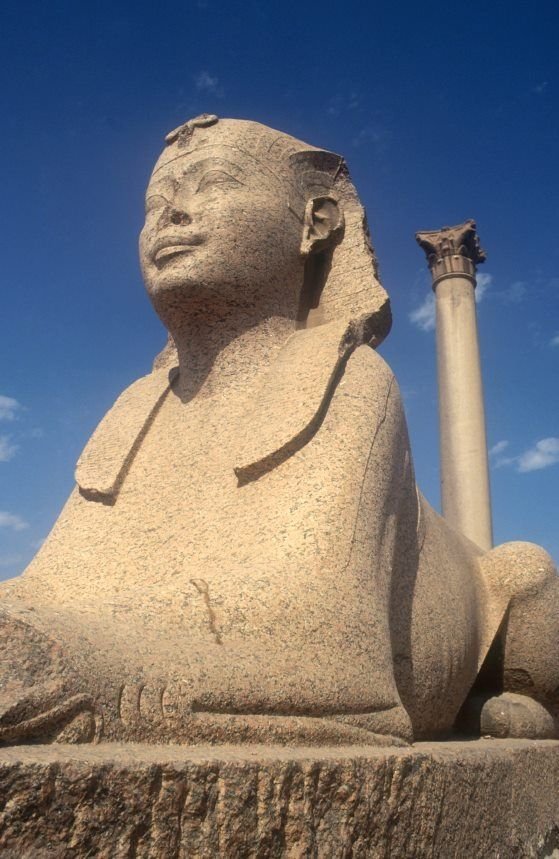
Beyond its impressive appearance and famous legends, Pompey's Pillar holds enormous archaeological importance because it provides valuable insight into the political, religious, and cultural history of Roman Alexandria. The monument serves as one of the last major surviving structures connected to the once-great Temple of Serapis complex, allowing archaeologists to reconstruct aspects of the sacred and political landscape that dominated this part of the ancient city. Excavations around the site revealed remains of temple foundations, underground passages, statues, sphinxes, inscriptions, and architectural fragments that help historians better understand how Alexandria functioned during the Roman period. The pillar itself also preserves evidence of Roman engineering techniques and imperial symbolism, demonstrating how monuments were used to project political authority and celebrate emperors throughout the empire. The discovery of inscriptions associated with Emperor Diocletian played a crucial role in correcting historical misunderstandings about the monument’s true origin and purpose. Archaeologists studying the site continue to analyze the surrounding ruins to learn more about the Temple of Serapis, one of Alexandria’s most important religious centers during antiquity. The Serapeum represented a remarkable fusion of Egyptian and Greek religious traditions, making the site especially valuable for understanding cultural interaction in the ancient Mediterranean world. Researchers also believe the temple complex may have contained libraries, ceremonial spaces, and underground chambers connected to Alexandria’s intellectual and spiritual life. The destruction of much of the Serapeum during late antiquity makes Pompey’s Pillar even more important because it survived as one of the few remaining witnesses to this lost architectural complex. Modern archaeological work continues uncovering new information about the site through excavation, preservation, and digital reconstruction projects. Visitors exploring the area today often see active restoration efforts aimed at protecting the monument and preserving surrounding ruins from environmental damage and urban pressures. Historians consider Pompey’s Pillar one of Alexandria’s most significant surviving Roman monuments because it links multiple historical periods together, from the Ptolemaic kingdom and Roman Empire to the medieval era and modern Egypt. The monument therefore represents far more than a single column of stone; it stands as a key archaeological gateway into the complex history of one of the Mediterranean world’s greatest ancient cities beside the coast of northern Egypt.
10. Pompey’s Pillar and Alexandria’s Roman Identity
The monumental Pompey's Pillar stands today as one of the strongest surviving symbols of Alexandria’s Roman identity and the immense importance the city held within the Roman Empire. Although Alexandria was originally founded by Alexander the Great and shaped heavily by Greek culture during the Ptolemaic era, the city later became one of Rome’s most valuable possessions after Egypt fell under Roman control in 30 BC. During this period, Alexandria transformed into a political, economic, and cultural center connecting Africa, the Mediterranean, and the Near East. The construction of Pompey’s Pillar during the reign of Emperor Diocletian reflected the Roman Empire’s desire to reinforce its authority and presence within this strategically essential city. The monument symbolized imperial strength, political stability, and Roman power rising above Alexandria’s urban landscape. Its immense scale and elevated position within the Temple of Serapis complex ensured that the column could be seen from large parts of the city, constantly reminding residents and visitors of Roman dominance over Egypt. At the same time, the surrounding archaeological remains reveal how Roman culture blended with existing Egyptian and Greek traditions rather than completely replacing them. Alexandria during the Roman era remained a deeply multicultural city where languages, religions, architectural styles, and artistic traditions from different civilizations continued interacting daily. Pompey’s Pillar therefore reflects both Roman political authority and Alexandria’s broader cosmopolitan identity. Historians studying the monument view it as a physical representation of the city’s transition from the Hellenistic world into the Roman imperial system. Visitors standing beside the massive granite column today can still sense the political ambition and imperial symbolism embedded within its design. The monument also highlights how Roman rulers used architecture to communicate power across distant provinces of the empire. Despite the collapse of Roman authority centuries ago, the pillar continues dominating the skyline as one of the clearest surviving reminders of Alexandria’s role within one of history’s greatest empires. The surrounding ruins and archaeological remains further strengthen this connection to the Roman world, creating an environment where visitors can imagine the grandeur, diversity, and political significance of ancient Alexandria during its imperial peak beside the Mediterranean coast of Egypt.
11. Visiting Pompey’s Pillar: A Journey Through Alexandria’s Ancient Past
For travelers exploring Alexandria, visiting Pompey's Pillar offers a fascinating journey through layers of ancient history, mythology, archaeology, and cultural transformation preserved within one extraordinary site. Unlike museums where artifacts are displayed behind glass, Pompey’s Pillar allows visitors to stand directly beside one of the largest surviving monuments from Roman Alexandria while surrounded by the ruins of an ancient sacred complex. Approaching the towering granite column creates an immediate sense of awe because of its immense size and commanding presence above the surrounding landscape. The archaeological site itself combines open-air exploration with historical imagination, inviting travelers to walk among broken temple remains, sphinx statues, underground structures, and centuries-old stones that once formed part of the great Temple of Serapis. Guided tours often help visitors understand the historical significance of the site by explaining the true story behind the pillar’s construction during the reign of Emperor Diocletian, the legends surrounding the name of Pompey, and the role of the Serapeum in Alexandria’s religious life. Many travelers appreciate the peaceful atmosphere of the site compared to busier tourist destinations in Egypt, allowing more time for photography, reflection, and exploration. The elevated position of the monument also offers beautiful views across Alexandria, creating opportunities to connect the ancient ruins with the modern city surrounding them today. Visitors often combine the site with nearby attractions such as Catacombs of Kom El Shoqafa and the Alexandria Corniche to experience multiple aspects of the city’s rich historical heritage within one day. The site appeals especially to history enthusiasts, archaeologists, photographers, and travelers interested in Roman Egypt and Mediterranean civilization. Walking around the pillar encourages reflection on the centuries of change that transformed Alexandria from a Greek royal capital into a Roman imperial city and later into the modern Mediterranean metropolis visible today. The monument’s survival through earthquakes, invasions, and urban transformation gives the experience additional emotional impact because visitors witness a structure that endured across nearly two thousand years of human history. Pompey’s Pillar therefore offers far more than a sightseeing opportunity; it provides an immersive encounter with Alexandria’s ancient soul and one of the city’s most enduring symbols of historical continuity beside the Mediterranean Sea.
12. The Atmosphere of Mystery and Timeless Survival
One of the most powerful aspects of Pompey's Pillar is the extraordinary atmosphere of mystery, endurance, and timeless survival that surrounds the monument. Standing alone above the ruins of the ancient Temple of Serapis, the massive granite column creates a haunting visual impression that immediately captures the imagination of visitors arriving at the site. Unlike fully preserved temples or crowded archaeological complexes, Pompey’s Pillar appears isolated against the sky, surrounded by fragments of a vanished civilization that once dominated this part of Alexandria. The contrast between the towering upright column and the broken stones scattered around its base symbolizes both the glory and fragility of ancient empires across history. For centuries, travelers, historians, and explorers approaching Alexandria described the monument as mysterious and almost supernatural because its enormous scale and uncertain origins inspired myths, legends, and speculation long before modern archaeology explained its true history. Even today, the pillar retains this emotional power because it feels suspended between different eras of civilization. The monument witnessed the rise and fall of the Roman Empire, the destruction of pagan temples, the transformation of Alexandria through Islamic and medieval periods, and the growth of the modern city surrounding it today. Visitors standing beneath the granite column often experience a strong sense of historical continuity and human endurance across time. The weathered stone surface, shaped by centuries of wind and Mediterranean climate, further strengthens the monument’s timeless character. During sunset, when golden light illuminates the pillar and surrounding ruins, the atmosphere becomes especially dramatic and emotional, transforming the archaeological site into one of Alexandria’s most beautiful historical landscapes. The silence surrounding the ruins allows travelers to imagine the ancient ceremonies, crowds, and religious life that once filled the sacred complex centuries ago. Photographers and artists remain deeply inspired by this atmosphere because the monument combines monumental simplicity with profound historical depth. Pompey’s Pillar therefore represents far more than an isolated Roman column; it stands as a timeless survivor carrying the memory of Alexandria’s lost temples, vanished civilizations, and enduring connection between history, mythology, and the Mediterranean world beside the coast of Egypt.
13. The Role of Pompey’s Pillar in Alexandria’s Tourism Industry
Today, Pompey's Pillar plays an essential role in Alexandria’s tourism industry and remains one of the city’s most recognizable historical landmarks attracting travelers from around the world. The monument’s combination of Roman history, archaeological importance, dramatic visual presence, and legendary atmosphere makes it a major destination for visitors seeking to explore Alexandria beyond its Mediterranean beaches and modern urban life. Tourism companies and cultural tours frequently include Pompey’s Pillar within historical itineraries because the site offers travelers an accessible introduction to Alexandria’s ancient past and multicultural heritage. The pillar also serves as one of the most photographed monuments in northern Egypt, appearing regularly in travel brochures, documentaries, historical publications, and digital tourism campaigns promoting Alexandria as a cultural destination. Visitors are often drawn by curiosity surrounding the monument’s famous name and the myths associated with the Roman general Pompey, only to discover the deeper historical story connected to Emperor Diocletian and the Temple of Serapis. This blend of legend and archaeology enhances the site’s appeal and creates memorable experiences for travelers interested in both history and storytelling. The archaeological area surrounding the monument further enriches the visitor experience through sphinx statues, temple ruins, underground remains, and panoramic city views that encourage longer exploration. Local guides, historians, and photographers frequently use the site to explain Alexandria’s transformation from a Greek royal capital into a Roman imperial center and finally into the modern Mediterranean city visible today. The monument’s elevated location and open-air atmosphere also make it a popular destination for cultural events, educational tours, and artistic photography projects. Tourism connected to Pompey’s Pillar contributes significantly to Alexandria’s broader cultural economy by supporting local businesses, guides, transportation services, museums, cafés, and nearby attractions. Travelers often combine the site with visits to the Bibliotheca Alexandrina, the Alexandria Corniche, and the Catacombs of Kom El Shoqafa to create comprehensive historical tours through the city. The monument therefore functions not only as an archaeological treasure but also as a vital cultural symbol connecting Alexandria’s ancient heritage with its modern tourism identity. Pompey’s Pillar continues welcoming visitors from across the world, preserving the memory of Roman Alexandria while contributing actively to the city’s present-day cultural and economic life beside the Mediterranean coast.
14. Preservation Challenges and Archaeological Conservation
Protecting Pompey's Pillar and the surrounding archaeological site presents ongoing challenges for archaeologists, engineers, and conservation specialists working to preserve Alexandria’s ancient heritage in the face of modern environmental and urban pressures. Although the massive granite column survived nearly two thousand years of earthquakes, storms, invasions, and political transformations, the monument remains vulnerable to gradual deterioration caused by weather, pollution, humidity, and the expansion of the modern city surrounding the site. Alexandria’s Mediterranean climate exposes the pillar to salty sea air, fluctuating temperatures, and moisture that slowly affect the stone surface over time. Urban pollution from traffic and industrial activity can also accelerate erosion and discoloration on the ancient granite. Preservation experts regularly monitor the structural condition of the monument to ensure its long-term stability while protecting the delicate archaeological remains surrounding it. Conservation efforts include cleaning stone surfaces, stabilizing damaged architectural fragments, controlling visitor movement, and improving drainage systems around the site to reduce water damage during seasonal rains. Archaeologists also continue excavating and documenting the ruins connected to the Temple of Serapis, uncovering valuable information about Alexandria’s religious, political, and cultural history during the Ptolemaic and Roman periods. Modern technology such as digital scanning, 3D modeling, and structural analysis allows researchers to study the monument in greater detail while preserving records for future generations. One of the major goals of conservation projects is balancing tourism with protection, ensuring that visitors can continue exploring the site without causing irreversible harm to the ancient structures. Informational signs, guided pathways, and visitor management systems help reduce physical impact on fragile archaeological areas surrounding the pillar. Historians and conservationists also emphasize the educational importance of the site, encouraging public awareness about Alexandria’s historical heritage and the necessity of preserving monuments that survived across millennia. The survival of Pompey’s Pillar itself already represents an extraordinary achievement considering the destruction of much of ancient Alexandria over centuries. Every preservation effort therefore contributes to safeguarding one of Egypt’s most important Roman monuments and ensuring that future generations can continue experiencing the grandeur, mystery, and historical significance of Alexandria’s towering granite sentinel beside the Mediterranean Sea.
15. The Best Time to Visit Pompey’s Pillar
Choosing the right time to visit Pompey's Pillar can greatly enhance the overall experience because the atmosphere, lighting, and weather conditions surrounding the monument change significantly throughout the year and at different times of day. Alexandria’s Mediterranean climate makes the city far more moderate than many other Egyptian destinations, allowing visitors to comfortably explore outdoor archaeological sites during most seasons. The ideal period for visiting Pompey’s Pillar is generally between October and April, when temperatures remain pleasantly cool and comfortable for walking through the open-air ruins and surrounding archaeological areas. During these months, travelers can enjoy clear skies, refreshing sea breezes, and ideal conditions for photography without the intense summer heat common in southern Egypt. Winter in Alexandria also creates a unique atmosphere around the monument because cloudy skies and soft Mediterranean light add dramatic character to the ancient ruins and granite column. Early morning remains one of the best times of day to explore the site because the area tends to be quieter, allowing visitors to experience the peaceful historical atmosphere with fewer crowds. Morning sunlight also illuminates the red granite surface beautifully, highlighting the texture and scale of the massive monolithic column. Sunset offers an equally spectacular experience as golden light transforms the monument and surrounding ruins into one of Alexandria’s most photogenic historical landscapes. Photographers especially appreciate the warm evening tones reflecting against the ancient stones and Mediterranean sky. Weekdays are often recommended for travelers seeking calmer conditions and more opportunities to explore the site without heavy tourist activity. During summer months, temperatures can become warmer, particularly around midday, although Alexandria’s coastal location still provides more moderate conditions than cities farther south. Visitors are advised to wear comfortable shoes because the archaeological site contains uneven surfaces and stone pathways surrounding the ruins. Guided tours can significantly enrich the experience by explaining the monument’s historical background, legends, Roman symbolism, and archaeological importance within Alexandria’s ancient landscape. Many travelers combine Pompey’s Pillar with nearby attractions such as the Catacombs of Kom El Shoqafa to create a full day of historical exploration. Regardless of the season, visiting Pompey’s Pillar remains one of Alexandria’s most memorable cultural experiences, offering travelers a chance to stand beside one of the last great surviving monuments of Roman Egypt beside the Mediterranean coast.
16. Pompey’s Pillar for Families and Young History Enthusiasts
Visiting Pompey's Pillar offers families and young travelers an exciting opportunity to experience ancient history in an open and visually dramatic environment that naturally captures curiosity and imagination. Unlike enclosed museums where history may feel distant or formal, Pompey’s Pillar allows children and teenagers to walk freely among real archaeological ruins while standing beside one of the tallest surviving Roman monuments in Egypt. The enormous scale of the granite column immediately fascinates young visitors, who are often amazed that ancient engineers succeeded in transporting and raising such a massive structure nearly two thousand years ago without modern technology. The stories surrounding the monument also help transform the visit into an engaging historical adventure. Children frequently become interested in the legends connected to the Roman general Pompey, the powerful Emperor Diocletian, and the mysterious Temple of Serapis that once surrounded the pillar. The nearby sphinx statues and scattered ruins create additional excitement because they encourage imagination and exploration within the archaeological landscape. Families visiting the site often use the experience as an educational opportunity to introduce younger generations to ancient civilizations, Roman history, Egyptian culture, mythology, architecture, and archaeology in a way that feels interactive and memorable rather than academic. Guided tours designed for families can make the historical background easier to understand while keeping children engaged through storytelling and visual examples. The open-air setting also allows visitors to enjoy Alexandria’s Mediterranean atmosphere while exploring the monument at a comfortable pace. Teenagers and photography enthusiasts often appreciate the panoramic city views and dramatic visual contrasts between the towering column, ancient ruins, and modern Alexandria visible in the distance. Parents frequently combine the visit with nearby attractions such as the Catacombs of Kom El Shoqafa or Alexandria’s Corniche to create a full cultural day suitable for all ages. The site’s combination of history, mythology, architecture, and open exploration makes it especially appealing for school groups and educational tourism. Many young visitors leave the site with a stronger interest in ancient history and a deeper understanding of Alexandria’s role within the Roman world. Pompey’s Pillar therefore remains not only a historical monument but also an inspiring destination where families can experience the excitement of discovering the ancient Mediterranean world together beside Egypt’s northern coast.
17. Nearby Attractions Around Pompey’s Pillar
The area surrounding Pompey's Pillar contains several important archaeological, cultural, and coastal attractions that allow visitors to transform a single monument visit into a comprehensive journey through Alexandria’s rich historical heritage. One of the closest and most fascinating nearby sites is the famous Catacombs of Kom El Shoqafa, an extraordinary underground necropolis blending Egyptian, Greek, and Roman artistic traditions beneath the modern city. Many travelers choose to visit both sites together because they complement each other historically and geographically, offering insights into Alexandria’s Roman-era society, religion, architecture, and burial customs. The contrast between Pompey’s towering open-air monument and the mysterious underground catacombs creates a unique and balanced historical experience. Visitors can also explore the surrounding Kom El-Dikka district, where archaeological excavations revealed Roman baths, theaters, villas, and educational buildings connected to Alexandria’s ancient urban life. Further toward the Mediterranean coast lies the famous Bibliotheca Alexandrina, a modern cultural landmark inspired by the legendary ancient Library of Alexandria. The library attracts visitors interested in literature, architecture, museums, exhibitions, and intellectual history while symbolizing Alexandria’s continuing connection to knowledge and global culture. Travelers exploring the city after visiting Pompey’s Pillar often enjoy relaxing along the Alexandria Corniche, where cafés, seafood restaurants, and panoramic sea views offer a more contemporary side of the Mediterranean city. The nearby Citadel of Qaitbay also remains one of Alexandria’s most iconic landmarks, standing on the historic site of the ancient Lighthouse of Alexandria and providing spectacular coastal scenery. Museums throughout Alexandria display statues, coins, manuscripts, and artifacts connected to the civilizations represented by Pompey’s Pillar and the Temple of Serapis. Walking through the surrounding neighborhoods also reveals Alexandria’s multicultural atmosphere, where traces of Greek, Roman, Islamic, and modern Egyptian history coexist within everyday urban life. Visitors often appreciate how easily Alexandria combines ancient ruins with vibrant modern culture, allowing travelers to experience multiple historical periods within a single day. Pompey’s Pillar therefore serves not only as an individual attraction but also as a gateway into the broader historical and cultural landscape that makes Alexandria one of Egypt’s most fascinating Mediterranean destinations.
18. Pompey’s Pillar: The Eternal Survivor of Ancient Alexandria
In the end, Pompey's Pillar remains far more than a single granite column rising above a field of ruins. It stands as one of the most enduring symbols of Alexandria itself—a timeless survivor that witnessed the rise and fall of empires, the transformation of religions, the destruction of temples, and the evolution of one of the Mediterranean world’s greatest cities across nearly two thousand years of history. The monument’s extraordinary survival gives it a powerful emotional presence unlike many other archaeological sites in Egypt. While much of ancient Alexandria disappeared beneath the modern city, Pompey’s Pillar continued standing proudly against the skyline, preserving the memory of the Roman Empire, the Temple of Serapis, and the multicultural world that once flourished beside the Mediterranean coast. Visitors approaching the site today still experience the same sense of awe and curiosity that inspired medieval travelers, historians, artists, and explorers centuries ago. The massive monolithic column symbolizes human ambition, engineering brilliance, political power, and the enduring ability of great monuments to survive beyond the civilizations that created them. At the same time, the surrounding ruins and broken stones remind visitors of the fragility of even the most magnificent empires and sacred complexes. Pompey’s Pillar therefore exists as both a monument of triumph and a silent witness to historical change. The site also represents Alexandria’s unique identity as a city shaped by Egyptian, Greek, Roman, Islamic, and Mediterranean influences woven together across time. Every visitor standing beneath the towering granite structure becomes connected to centuries of history, mythology, and cultural memory preserved within the ancient stones. Whether admired for its engineering achievement, historical significance, legendary atmosphere, panoramic views, or artistic beauty, the monument leaves a lasting impression on all who encounter it. Modern preservation efforts ensure that future generations will continue experiencing the grandeur and mystery of this remarkable site while learning about the civilizations that shaped Alexandria’s extraordinary heritage. Pompey’s Pillar ultimately remains one of Egypt’s greatest historical landmarks because it captures the timeless spirit of Alexandria itself—a city where history, legend, culture, and survival continue to stand together beside the Mediterranean Sea, just as the great granite column has done for centuries beneath the Egyptian sky.