- Excursions in Egypt
- Egypt Tour Packages
- Cairo Tours and Excursions
- Hurghada Tours and Excursions
- Soma Bay Tours and Excursions
- Makadi Bay Tours and Excursions
- Sahl Hasheesh Tours and Excursions
- El Gouna Tours and Excursions
- Marsa Alam Tours and Excursions
- Port Ghalib Tours and Excursions
- El Quseir Tours and Excursions
- Dendera and Abydos Day Tours
- Aswan Tours and Excursions
- Luxor Tours and Excursions
- Sharm El Sheikh Tours and Excursions
- Top Rated Egypt Tours in 2026
- Optional Excursions in Egypt
- Private Transfer
- Blogs About egypt
- Ancient Egypt
- Historical Sites in Egypt
- Cairo
- Alexandria
- Luxor
- Aswan
- The Red Sea
- Dendera Temple
- El Fayoum Oasis
- Bahariya Oasis
- Siwa Oasis
- Al Alamein
- Marsa Matruh
- Why Egypt Is One of the Safest Countries to Visit in the Middle East
- What You Need To know Before Your First Trip To Egypt
- Egypt Travel Costs in 2026 Full Budget Guide
- Top 10 Tourist Activities in Egypt
- Top 50 Activities You Can’t Miss in Egypt in 2026
- The Guide to Guided Tours in Egypt
- Egypt’s Ancient and Modern History
- The Nile River
- The Deserts of Egypt
- Ancient Egyptian gods
- famous Egyptian dishes
- UNESCO World Heritage sites
- About Us
- Egypt Hotels and Resorts
- Excursions in Egypt
- Egypt Tour Packages
- Cairo Tours and Excursions
- Hurghada Tours and Excursions
- Soma Bay Tours and Excursions
- Makadi Bay Tours and Excursions
- Sahl Hasheesh Tours and Excursions
- El Gouna Tours and Excursions
- Marsa Alam Tours and Excursions
- Port Ghalib Tours and Excursions
- El Quseir Tours and Excursions
- Dendera and Abydos Day Tours
- Aswan Tours and Excursions
- Luxor Tours and Excursions
- Sharm El Sheikh Tours and Excursions
- Top Rated Egypt Tours in 2026
- Optional Excursions in Egypt
- Private Transfer
- Blogs About egypt
- Ancient Egypt
- Historical Sites in Egypt
- Cairo
- Alexandria
- Luxor
- Aswan
- The Red Sea
- Dendera Temple
- El Fayoum Oasis
- Bahariya Oasis
- Siwa Oasis
- Al Alamein
- Marsa Matruh
- Why Egypt Is One of the Safest Countries to Visit in the Middle East
- What You Need To know Before Your First Trip To Egypt
- Egypt Travel Costs in 2026 Full Budget Guide
- Top 10 Tourist Activities in Egypt
- Top 50 Activities You Can’t Miss in Egypt in 2026
- The Guide to Guided Tours in Egypt
- Egypt’s Ancient and Modern History
- The Nile River
- The Deserts of Egypt
- Ancient Egyptian gods
- famous Egyptian dishes
- UNESCO World Heritage sites
- About Us
- Egypt Hotels and Resorts
Welcome to
The Al-Azhar Mosque: The Resplendent Beacon of Islamic Knowledge and Spirit
In the labyrinthine heart of Historic Cairo, where the scent of ancient spices mingles with the call to prayer from a thousand minarets, stands a monument that is far more than a masterpiece of stone and marble; it is the beating heart of the Islamic world’s intellectual and spiritual life. The Al-Azhar Mosque, founded in 970 AD, is a sanctuary of such profound historical weight that it serves as the definitive anchor for over a millennium of Egyptian and Islamic heritage. Established by the Fatimid Caliphate as a grand mosque for the newly founded city of Cairo, Al-Azhar—meaning “The Resplendent”—was destined from its first brick to become a global lighthouse of wisdom. It is the world’s most prestigious center for Sunni Islamic learning and its second-oldest continuously operating university, a place where the pursuit of divine proximity and the rigors of academic inquiry have existed in perfect, luminous harmony for more than one thousand and fifty years.
Al-Azhar is an architectural marvel that has survived the rise and fall of countless dynasties, each of which sought to immortalize their reign by adding to its sprawling complex. From its original Fatimid keel-shaped arches to the towering, intricate minarets of the Mamluk Sultans and the elegant expansions of the Ottomans, the mosque is a living “palimpsest” of Islamic art history. Yet, its significance transcends its physical beauty. It has been a fortress of national resistance against colonial invaders, a sanctuary for the world’s most renowned scholars, and a global platform for the “Middle Path” of moderate Islamic thought. To enter the white marble courtyard of Al-Azhar is to leave the chaotic energy of the modern city and step into a timeless realm of light and silence. In this exhaustive 18-paragraph exploration, we will uncover the secrets of its ancient columns, the tragedies and triumphs of its political history, and the enduring traditions of its study circles that continue to shape the moral and intellectual compass of millions around the globe.
1. The Fatimid Foundation: The Resplendent Birth of Cairo’s Soul
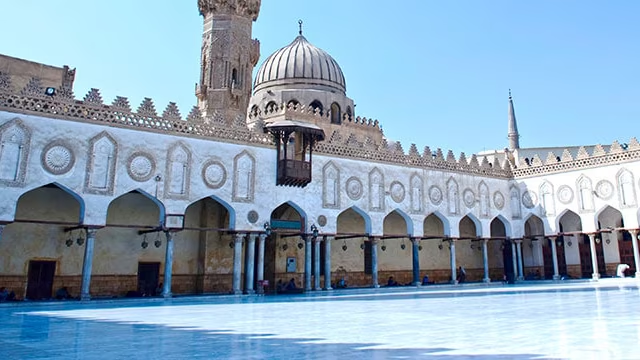
The story of the Al-Azhar Mosque is inseparable from the very birth of Cairo itself. In 969 AD, after the Fatimid commander Jawhar al-Siqilli conquered Egypt, he immediately set out to establish a new capital, Al-Qahira (The Victorious). At the heart of this grand imperial plan, he laid the foundation for Al-Azhar, which was completed in 972 AD. Named "Al-Azhar" (The Resplendent), likely in honor of Fatimah al-Zahra, the daughter of the Prophet Muhammad, the mosque was initially intended to be the primary center for spreading the Shi'a Ismaili doctrine. However, its destiny was far greater than a sectarian outpost. Within just three years of its inauguration, formal academic lectures began, transforming the mosque into a "Madrasa" and effectively establishing what would become the second-oldest continuously operating university in the world. The original Fatimid core of the mosque was a marvel of Mediterranean and Middle Eastern fusion. It featured a large open courtyard surrounded by three vaulted halls, characterized by "keel-shaped" arches and exquisite stucco carvings. This early architecture was not just about aesthetics; it was a psychological tool designed to showcase the cultural sophistication of the Fatimid Caliphate to a newly conquered population. For the modern visitor, these original sections offer a hauntingly beautiful glimpse into the 10th century. The intricate "Kufic" calligraphy and floral "arabesque" patterns carved into the plaster were the "DNA" of what would become the distinct Cairene Islamic style. Standing under these ancient arches, one realizes that Al-Azhar was built to be a bridge between heaven and earth—a sanctuary where the pursuit of divine light and human knowledge were forever unified under one resplendent roof.
2. Architectural Evolution: A Thousand-Year Palimpsest of Stone
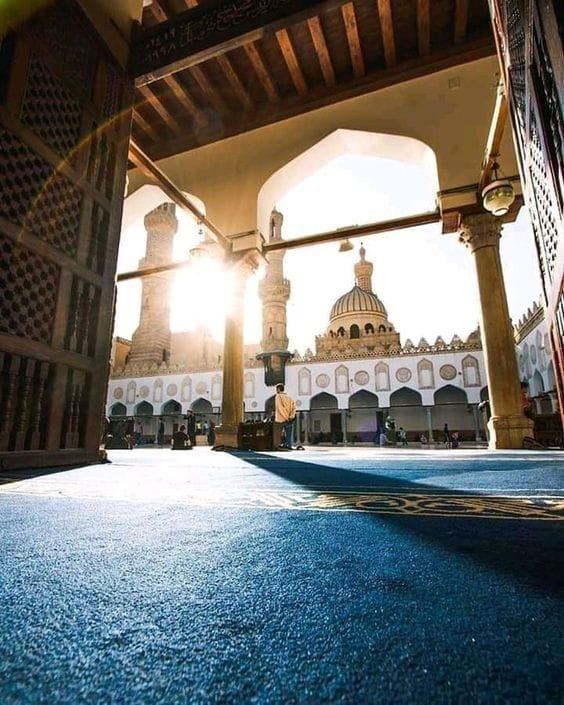
What makes Al-Azhar Mosque unique among the world’s religious monuments is that it was never truly "finished." Instead, it evolved organically as a "palimpsest"—a parchment that has been written upon by every major dynasty in Egyptian history. After the fall of the Fatimids, the Ayyubids, Mamluks, Ottomans, and finally the Muhammad Ali dynasty each sought to leave their mark on this sacred ground to gain religious and political legitimacy. This continuous process of expansion has turned the mosque into a living museum of Islamic art. Walking through its corridors, you can witness the transition from the delicate Fatimid plasterwork to the robust, fortress-like stone masonry of the Mamluks, and finally to the more ornate and floral decorative styles of the Ottoman era. The Mamluk Sultans, in particular, were prolific builders within Al-Azhar. They added magnificent minarets, grand portals, and entire separate colleges (Madrasas) into the mosque's perimeter. These additions were not haphazard; they were carefully integrated to maintain the mosque’s spiritual flow while increasing its capacity to house thousands of students. For the architectural enthusiast, Al-Azhar is a puzzle where different eras of history are physically stacked upon one another. You might see a 15th-century stone dome resting near a 10th-century courtyard, or a Roman-era column repurposed to support an 18th-century ceiling. This architectural layering ensures that Al-Azhar does not belong to a single moment in time, but rather represents the collective genius of Islamic civilization over more than a millennium, standing as a solid mountain of stone that has survived earthquakes, fires, and the rise and fall of empires.
3. The Cradle of Knowledge: The World’s Most Enduring University
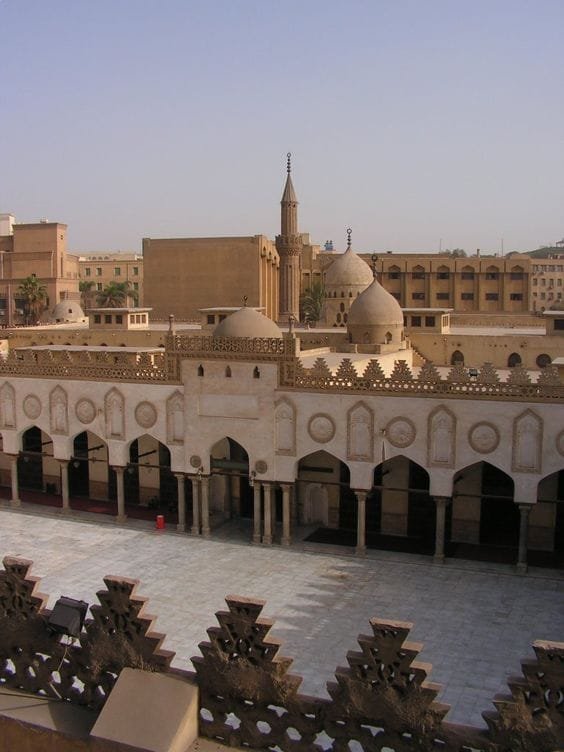
While most mosques are primarily places of ritual, Al-Azhar earned its global fame as a "City of Scholars." Long before the universities of Oxford or Paris reached their prime, Al-Azhar was already a bustling hub of intellectual activity. Its educational system was revolutionary, centered around the "Halaqa" (The Circle), where students from across the globe would sit on the marble floors in semi-circles around their professors. This was not a rigid, top-down system; it was a vibrant marketplace of ideas where students engaged in deep debates on theology, Arabic grammar, logic, and eventually the hard sciences like astronomy and mathematics. By the 14th century, Al-Azhar had become the undisputed intellectual capital of the Sunni world, attracting the greatest minds of the age, such as the historian Ibn Khaldun. The impact of Al-Azhar’s university on global culture cannot be overstated. It was here that the Arabic language was preserved and standardized, and where the "Middle Path" of Islamic moderate thought was formalized. The university was uniquely international, hosting students from as far away as West Africa, Southeast Asia, and the Balkans. These students lived in specialized hostels called "Riwaqs," each dedicated to a specific nationality. This diversity transformed Al-Azhar into a "melting pot" of Islamic cultures, ensuring that its teachings were never narrow or provincial. Today, as the university continues to educate tens of thousands of international students, it remains the primary guardian of Islamic intellectual heritage. For the traveler, seeing a study circle in progress today is a powerful reminder that Al-Azhar is not a museum of the past, but a living heart that continues to beat with the pulse of human inquiry and religious devotion.
4. The Great Marble Sahn: A Sanctuary of Light and Silence
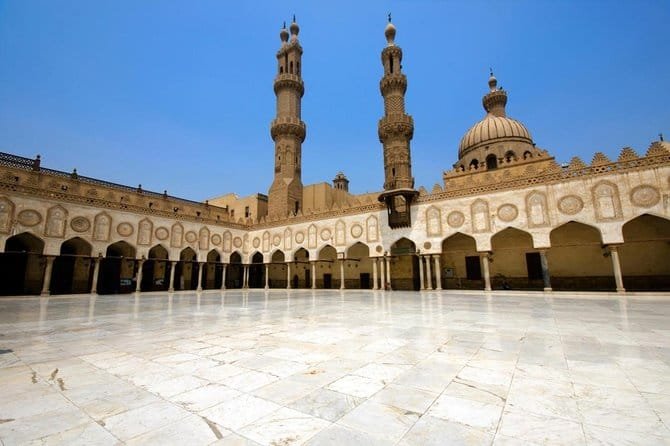
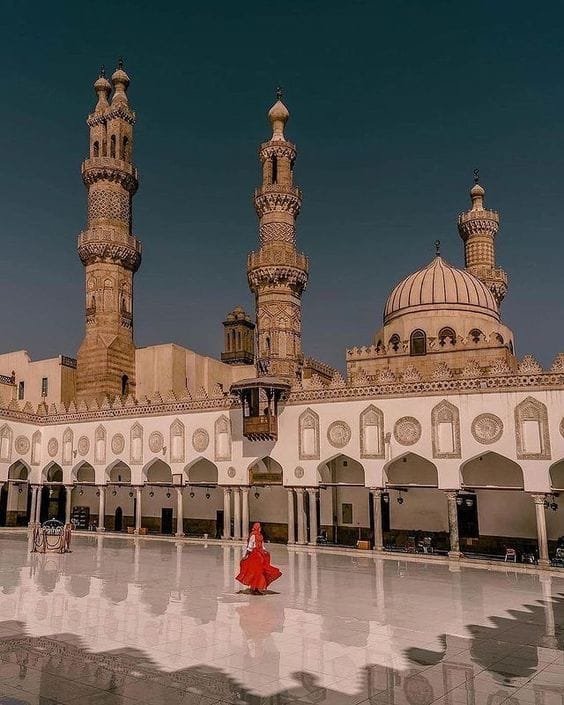
The central courtyard, or Sahn, of Al-Azhar Mosque is one of the most spiritually evocative spaces in the Islamic world, serving as a tranquil "heart" that pulses with serenity amidst the chaotic energy of Historic Cairo. This vast open-air expanse is paved with brilliant white marble that reflects the intense Egyptian sun, creating an atmosphere of "radiant light" that perfectly mirrors the mosque’s name, Al-Azhar (The Resplendent). Enclosing this courtyard are majestic arcades that trace their origins back to the Fatimid era, featuring characteristic "keel-shaped" arches supported by a forest of slender marble columns. Many of these columns were repurposed from ancient Roman and Byzantine structures, physically anchoring the 10th-century mosque to Egypt's classical antiquity. Architecturally, the Sahn was designed to be much more than a transitional space; it was a functional "open-air classroom." For over a millennium, students from across the globe have gathered here in study circles (halaqas), seated on the cool marble floors to debate theology and law under the open sky. The design also serves a practical environmental purpose: the courtyard acts as a thermal regulator, drawing cool breezes into the surrounding prayer halls while providing a shaded refuge in its perimeter. For the visitor, standing in the center of the Sahn offers a profound sense of psychological liberation. The high, decorated walls—adorned with intricate stucco carvings and Kufic inscriptions—effectively block out the noise of the neighboring markets, leaving only the sky as a ceiling. It is a masterpiece of spatial harmony where stone, light, and silence converge to create an environment dedicated entirely to the elevation of the soul.
5. The Five Minarets: A Symphony of Authority and Artistry
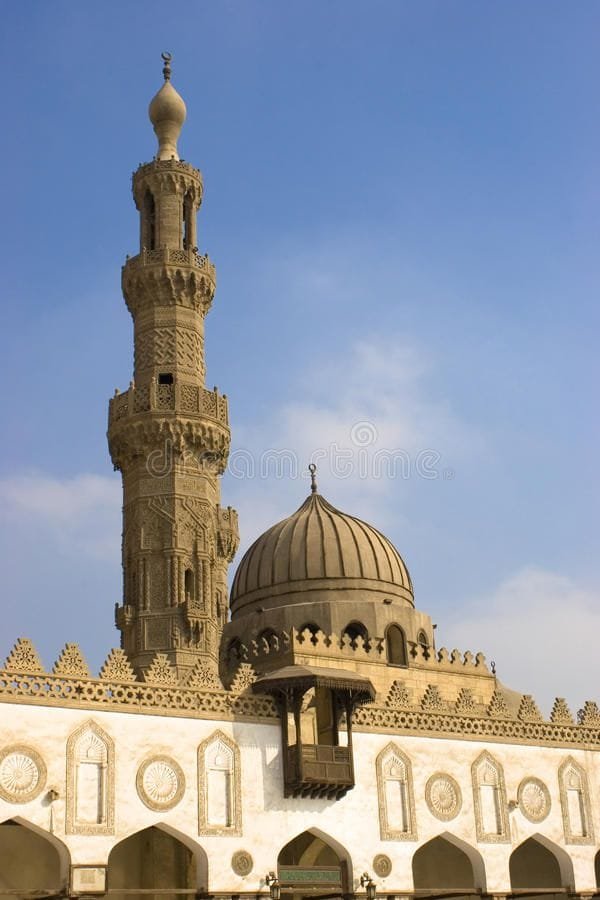
The skyline of Al-Azhar is defined by its five magnificent minarets, which act as a vertical history book of Cairo’s architectural evolution. Each tower was commissioned by a different ruler who sought to immortalize their piety and power by adding to the mosque's silhouette. The most iconic is the Minaret of Sultan Qaitbay, built in 1495, which is considered the absolute pinnacle of Mamluk stone-carving. Its shaft is covered in breathtaking geometric and floral patterns, carved directly into the hard limestone with lace-like precision. Nearby stands the double-headed minaret of Sultan Qansuh al-Ghuri, a unique engineering marvel featuring two separate spiral staircases that allow two muezzins to ascend simultaneously without ever crossing paths—a testament to the advanced geometric knowledge of 16th-century Egyptian architects. These minarets are not merely functional towers for the call to prayer; they are "fingers of faith" that have dominated the Cairo skyline for centuries. The diversity of their styles—ranging from the square Fatimid bases to the octagonal Mamluk tiers and the more slender Ottoman pencils—represents the artistic movements that shaped the Middle East. For the cultural traveler, observing these minarets as a collective ensemble provides a rare opportunity to see how different dynasties respected and built upon the work of their predecessors. At sunset, when the minarets are bathed in a golden hue and the call to prayer echoes from their balconies, they serve as a powerful reminder of Al-Azhar’s enduring status as a beacon of guidance. They are stone sentinels that have watched over the city’s triumphs and tragedies, symbolizing a light of knowledge that has never been extinguished.
6. The Gate of the Barbers: A Portal to the Medieval Mind
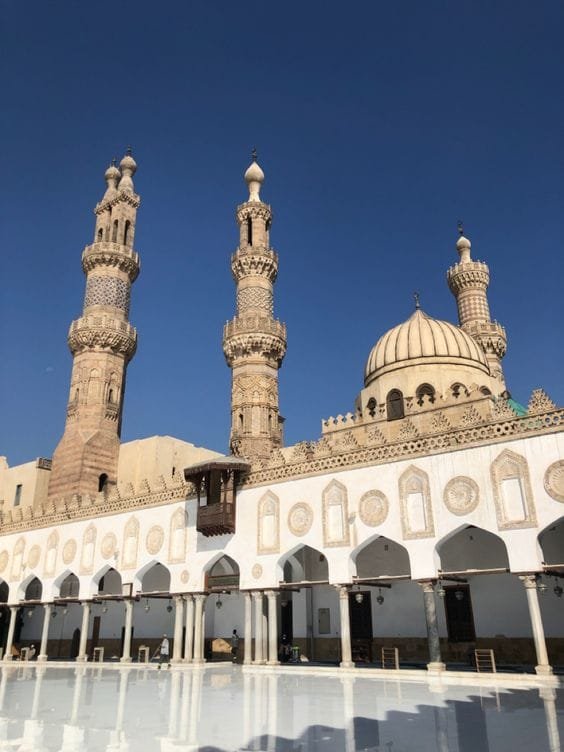
The Bab al-Muzayinin, or "Gate of the Barbers," serves as the primary ceremonial entrance to Al-Azhar today and is a stunning example of late-era Islamic architecture. Commissioned in the 18th century by the Ottoman benefactor Abd al-Rahman Katkhuda, the gate earned its colorful name because students historically had their heads shaved by barbers just outside its threshold before entering the mosque to begin their scholarly lives. This act of "becoming a student" was a rite of passage, transitioning the young men from the secular world into a life of asceticism and academic rigor. The gate itself features a grand double-arched opening, decorated with intricate stonework and calligraphic inscriptions that welcome the seeker of knowledge into the sanctuary. Crossing the threshold of Bab al-Muzayinin is an immersive sensory experience. As you pass under its heavy stone arch, the deafening roar of Al-Azhar Street and the bustling Hussein district suddenly vanishes, replaced by a heavy, reverent silence. This gate was strategically designed to act as a "buffer zone," mentally preparing the visitor for the spiritual and intellectual atmosphere within. Inside the gate’s vestibule, the tradition of removing one’s shoes remains a powerful symbol of leaving worldly concerns behind. For centuries, thousands of students from Indonesia, Morocco, and the Levant have walked through this very portal, carrying nothing but their books and their dreams. Today, it remains the most photogenic entrance to the complex, a monumental gateway that bridges the vibrant life of modern Cairo with the timeless, scholarly tranquility of the "Resplendent Mosque."
7. The Qibla Hall: A Forest of Ancient Columns
The main prayer hall, or Qibla Iwan, is the spiritual powerhouse of Al-Azhar, a vast, awe-inspiring space that feels like a stone forest. Inside, over three hundred marble columns support the weight of the roof, creating a labyrinthine vista that draws the worshipper’s eyes toward the Mihrab (prayer niche) at the center of the wall facing Mecca. Many of these columns are "spolia"—architectural treasures salvaged from ancient Roman, Byzantine, and even Pharaonic ruins—repurposed to serve the Islamic faith. This recycling of history serves as a profound metaphor: Al-Azhar is the culmination of Egypt’s long and layered heritage, where the ancient past physically supports the intellectual foundations of the present. The ceiling above is a delicate masterpiece of painted wood, featuring intricate geometric designs that have been painstakingly restored to their original vibrancy. The atmosphere within the Qibla Hall is one of immense, heavy gravity. The floor is covered in thick, woven carpets where, for centuries, millions of worshippers have stood shoulder-to-shoulder, transcending social class and nationality in collective prayer. The Mihrab itself, while modest in size compared to the Mamluk-era masterpieces, is a fine example of early Islamic art, decorated with Kufic inscriptions that speak to the eternal nature of the divine. For the scholar or the seeker, sitting in the quiet corners of this hall is an experience of deep temporal dislocation; the air feels thick with the whispers of countless generations of students and saints who have walked these paths. It is here, amidst this forest of marble, that the mosque truly fulfills its purpose as the "Resplendent" center of Cairo, providing a sanctuary where time seems to stand still.
8. The Madrasas: Integrated Colleges of Elite Learning
Within the sprawling perimeter of the Al-Azhar complex lie several specialized Madrasas (colleges), the most prominent being the Taybarsiya and the Aqbughawiyya. These were not merely rooms within the mosque; they were elite, autonomous institutions of higher learning, funded by wealthy Mamluk Emirs to promote specific schools of jurisprudence. The Taybarsiya Madrasa, in particular, is a work of art, featuring a stunning facade and an interior that holds some of the most precious manuscripts in the Islamic world. In the medieval period, these schools were the "Harvard and Oxford" of their time, where the most advanced subjects—including astronomy, mathematics, medicine, and logic—were taught alongside theology. Each madrasa is adorned with its own intricate dome and a mihrab that rivals the main hall in beauty, showcasing the immense wealth and religious dedication of the Mamluk elite who competed to leave their legacy here. Today, these madrasas continue to serve as quiet refuges for scholars and senior students who have moved beyond the introductory circles of the courtyard to specialized, intensive study. They are the "inner sanctums" of Al-Azhar, housing ancient libraries and offering a level of intellectual seclusion that is rare in the center of a modern metropolis. For the cultural traveler, these spaces offer a chance to appreciate the Mamluk architectural genius for blending functionality with extreme ornamentation. The integration of these madrasas into the mosque's structure is what turned Al-Azhar from a singular prayer site into a "federal" university system. Walking from the open, public courtyard into the cool, scholarly atmosphere of these madrasas, one gains an appreciation for the highly organized and sophisticated nature of medieval Islamic education.
9. Al-Azhar as a Fortress: The Political Heart of Egypt
Al-Azhar has never been just a center of prayer or study; it has always been the political conscience and the ultimate fortress of the Egyptian people. Throughout history, whenever the nation faced a crisis—from foreign invasions to domestic tyranny—Al-Azhar became the headquarters of the national resistance. When Napoleon Bonaparte invaded Egypt in 1798, the scholars (Ulema) of Al-Azhar led the people in a fierce revolt against French occupation, using the mosque as a base for strategic planning and as a sanctuary for the wounded. Napoleon’s troops eventually stormed the sacred space with their horses, an act of sacrilege that deeply scarred the Egyptian psyche and cemented Al-Azhar’s status as a symbol of national sovereignty and dignity. This pattern continued through the 19th and 20th centuries. From the struggle against British colonial rule to the 1919 Revolution, every major political movement in Egypt was born, debated, or sanctioned within the walls of Al-Azhar. The mosque is not an ivory tower; it is deeply connected to the pulse of the Egyptian street. When the people needed a voice, they looked to the Grand Imam of Al-Azhar. This role as a political anchor has at times placed the mosque in direct conflict with ruling powers, but it has also secured its position as the moral compass of the nation. For the visitor, understanding this history is essential; it explains why Al-Azhar is so deeply revered. It is a building that has bled for the freedom and identity of Egypt, proving that in this land, the pen, the prayer rug, and the sword of resistance are all part of the same sacred narrative.
10. The Fatimid Stucco: The Ancient DNA of Cairene Art
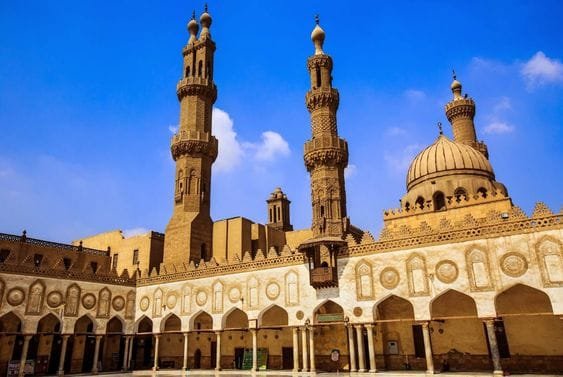
One of the most precious and fragile artistic treasures preserved within the walls of Al-Azhar is the original Fatimid stucco carving. Unlike the muscular stone carvings of the later Mamluk era, the early Fatimid decorations were fashioned from a specialized plaster mixture, allowing artisans to achieve a level of lace-like delicacy that seems to defy the passage of ten centuries. These carvings are primarily found in the oldest sections of the mosque, encircling the high windows and the drum of the original domes. The designs represent the birth of a specific "Cairo style" of Islamic art—a departure from the more rigid, geometric forms of the Umayyad and Abbasid eras in Damascus and Baghdad. Here, the art is fluid and organic, featuring "Kufic" calligraphy where the letters morph into blooming flowers and curling vines, a style known as "foliated Kufic." For the art historian, these stucco friezes are the "architectural DNA" of Egypt’s Islamic identity. They showcase a unique synthesis of North African, Persian, and Mediterranean influences, reflecting the cosmopolitan nature of the Fatimid Caliphate. These patterns—known as "Arabesque"—represent the infinite nature of God, with designs that have no beginning and no end, designed to lead the eye of the worshipper into a meditative state of contemplation. Despite the hundreds of years of humidity and the structural shifts of the building, these original plasterworks have survived, often hidden under layers of later paint and restoration. Studying them today offers a rare, direct connection to the aesthetic world of 10th-century Cairo, providing proof that even at its inception, Al-Azhar was intended to be a masterpiece of human creativity dedicated to the glorification of the divine.
11. The Grand Imam: The Voice of Islamic Moderation
The leadership of Al-Azhar is headed by the Grand Imam, a position often referred to as the Sheikh al-Azhar. This role is not merely a local religious title; it is arguably the most influential position in Sunni Islam globally. The Grand Imam is seen as the primary guardian of the "Middle Path" (Al-Wasatiyyah)—a theological framework that champions moderation, reason, and a rejection of extremism. Over the decades, the Grand Imam has served as a diplomat for peace, engaging in high-level interfaith dialogues with world leaders, including the Pope and global philosophers. Because Al-Azhar is an institution that values pluralism and the study of all four schools of Islamic jurisprudence, the Grand Imam's edicts, or Fatwas, carry immense weight from Morocco to Indonesia, providing a stabilizing moral compass in an often turbulent modern world. The office of the Grand Imam is housed within a beautiful administrative complex adjacent to the mosque, where the "Council of Senior Scholars" deliberates on the most pressing ethical and social issues of the day. This leadership ensures that Al-Azhar remains a modern, living institution rather than a relic of the past. Whether it is addressing climate change, human rights, or the challenges of artificial intelligence, the Grand Imam provides a bridge between ancient scripture and the complexities of 21st-century life. For the visitor, understanding the gravity of this office adds a layer of contemporary relevance to the mosque. Al-Azhar is not just a place where history is kept; it is a place where the future of Islamic thought is actively debated and defined, making it a critical player in global cultural diplomacy.
12. The Library of Al-Azhar: A Treasure Trove of Ancient Wisdom
The Al-Azhar Library is one of the most significant repositories of human knowledge in existence, housing a collection that is as vast as it is ancient. It contains over 50,000 rare manuscripts, some of which are nearly a thousand years old and exist as the only copies in the world. These are not just religious texts; the collection includes foundational works on medicine, astronomy, mathematics, and philosophy that were studied by the great thinkers of the Middle Ages. For centuries, these books were kept in the mosque's Riwaqs, sometimes chained to columns to ensure their preservation while still being accessible to students. Today, they are housed in a state-of-the-art, climate-controlled facility nearby, where they are protected from the elements and meticulously cataloged by a team of specialist archivists. The library serves as a silent witness to the era when the Islamic world was the global leader in scientific discovery. Among its treasures are beautifully illuminated Qurans from the Mamluk period, early scientific treatises on the anatomy of the eye, and the original notes of world-renowned historians like Ibn Khaldun. A massive digitization project is currently underway, aiming to make this entire "treasure house of wisdom" available to researchers around the world for free. This initiative reflects Al-Azhar’s long-standing philosophy that knowledge is a gift to be shared, not hoarded. For any traveler with a passion for history, the existence of this library is a reminder that the stones of Al-Azhar are supported by an even more monumental foundation: a million pages of human intellect and spiritual devotion that have survived the fires of history.
13. The Ottoman Expansion: Doubling the Capacity for Prayer
While the Fatimids laid the foundation and the Mamluks added the vertical grandeur, it was the Ottoman era—specifically the 18th-century benefactor Abd al-Rahman Katkhuda—that transformed Al-Azhar into the massive complex we see today. Katkhuda was one of the most prolific builders in Cairo’s history, and his contribution to Al-Azhar was revolutionary. He essentially doubled the size of the mosque by adding a vast new prayer hall behind the original Fatimid sanctuary. This expansion was necessary to accommodate the growing number of students and worshippers who flocked to Cairo as the Ottoman Empire consolidated its hold on the region. The Ottoman additions introduced a different aesthetic: larger windows, higher ceilings, and more delicate, floral decorative motifs that contrasted with the heavy stone-carving of the Mamluk era. This period of expansion was not just about size; it was about modernizing the "city within a city." Katkhuda also built several grand gates and Sabils (public water fountains) around the perimeter, ensuring that both students and the local community had access to fresh water—a vital act of charity in the crowded medieval city. These Ottoman layers provided Al-Azhar with a more airy and spacious feel, allowing light to penetrate deeper into the forest of columns. For the visitor, walking from the older, more intimate Fatimid sections into the soaring Ottoman halls is a lesson in spatial history. It showcases how Al-Azhar was never a stagnant monument but a living entity that grew to meet the needs of its time. This era of construction ensured that the mosque remained the premier religious university of the Ottoman world, bridging the gap between Cairo’s medieval past and its transition toward the modern era.
14. The Living Traditions: The Eternal "Halaqa" Study Circles
One of the most profound sights within the Al-Azhar Mosque today is the continuation of the "Halaqa" (The Circle), an educational tradition that has remained virtually unchanged for over a thousand years. Despite the presence of modern satellite campuses and digital libraries, the mosque floor remains the primary site for the traditional transmission of knowledge. In shaded corners and along the marble arcades, you will see a venerable scholar sitting on a low wooden chair or the carpeted floor, surrounded by a semi-circle of students from dozens of different countries. There are no desks or formal podiums; the focus is entirely on the text being read and the teacher's oral commentary. This method relies on the "Isnad", or a direct chain of transmission, where the teacher passes down knowledge they received from their own master, stretching back in an unbroken line to the earliest centuries of Islam. This "circle of learning" creates a deep, familial bond between generations. A student doesn’t just learn facts at Al-Azhar; they learn the character, the logic, and the spiritual etiquette of their teacher. These circles cover everything from advanced Arabic poetry and grammar to the most complex nuances of Islamic law. For the cultural traveler, witnessing a Halaqa in session is a powerful sensory experience. The rhythmic murmur of recitation, the smell of old paper, and the sight of a student from Indonesia or Nigeria nodding in agreement with a scholar from rural Egypt is a living testament to the mosque's global reach. It is a reminder that in Al-Azhar, knowledge is not something to be consumed through a screen, but a sacred fire to be passed from hand to hand, heart to heart, across the vast expanse of time.
15. Al-Azhar in the Modern Era: Reforming for the 21st Century
As the world entered the 20th and 21st centuries, Al-Azhar faced the monumental challenge of reconciling its ancient traditions with the demands of a modern, globalized society. In 1961, a landmark reform law significantly expanded the university’s mission. While it remained the world's foremost authority on religious studies, it introduced new faculties for medicine, engineering, and the hard sciences. This "dual education" philosophy was designed to produce graduates who are both grounded in their religious heritage and capable of contributing to modern technical fields. This evolution has transformed Al-Azhar into one of the largest educational networks in the world, with primary schools and university branches reaching into every village in Egypt and many countries abroad. This period of reform has also seen a massive physical renewal of the mosque itself. Recent restoration projects have utilized state-of-the-art technology to clean the ancient limestone, restore the structural integrity of the minarets, and install modern lighting systems that highlight the architectural details without damaging the stone. These efforts ensure that the "Resplendent Mosque" continues to function as a high-traffic urban center while preserving its fragile archaeological layers. Today, Al-Azhar uses social media and digital platforms to broadcast its message of moderation to millions worldwide, proving that its "Middle Path" theology is as relevant in the age of artificial intelligence as it was in the age of the Caliphs. This ability to adapt without losing its soul is why Al-Azhar remains the ultimate symbol of Egyptian resilience—an institution that is firmly rooted in the past but always looking toward the light of the future.
16. The Spiritual Atmosphere: A Refuge from the Cairo Rush
Beyond the political history and the academic prestige, Al-Azhar is deeply cherished by the people of Cairo for its unique "Ruhiya" (spirituality). In a metropolis as hyper-active, loud, and crowded as Cairo, Al-Azhar provides a rare, almost supernatural sanctuary of peace. The moment one crosses the threshold, the decibel level of the city drops away, replaced by a heavy, cool silence that seems to radiate from the ancient stones. Locals come here not just for formal prayer, but to escape the midday heat, to read in quiet contemplation, or simply to sit and absorb the "Baraka" (blessing) that is said to permeate the mosque. It is a place where the barrier between the mundane and the divine feels thin. At night, the atmosphere undergoes a magical transformation. As the modern floodlights illuminate the five minarets against the dark Egyptian sky, the mosque becomes a beacon of gold and shadow. The scent of aged wood, incense, and the faint traces of rosewater often used to clean the floors create a sensory experience that grounds the visitor in the present moment. For many Cairenes, Al-Azhar is the city's "spiritual lung"—a place where one can breathe deeply and reconnect with their inner self. This intangible quality of peace is perhaps the mosque’s greatest gift to the city; it remains a communal living room for the soul, welcoming everyone from the weary market porter to the high-ranking scholar into its democratic, tranquil embrace.
17. A Practical Guide for Visitors: Etiquette and Logistics
Visiting Al-Azhar is a highlight of any trip to Egypt, but it requires a level of respect and preparation befitting its status as a premier religious site. Located in the Al-Darb al-Ahmar district, it sits directly across from the famous Khan el-Khalili bazaar and the Al-Hussein Mosque. It is generally open to non-Muslim visitors outside of the five daily prayer times, though it is best to visit in the morning to avoid the largest crowds. Modest dress is strictly required: men should wear long trousers, and women must cover their hair with a scarf and wear loose-fitting clothing that covers the arms and legs. Most entrances provide traditional cloaks or wraps for tourists who may not be sufficiently covered. The ritual of entry is part of the experience. You will be required to remove your shoes before stepping onto the marble floors; most visitors leave them with an attendant at the door for a small tip (a few Egyptian pounds) upon exit. Photography is generally allowed, but it is essential to be discreet and avoid taking photos of people during their private moments of prayer. The best way to experience Al-Azhar is to move slowly—sit in the courtyard, observe a study circle from a respectful distance, and look upward at the intricate stucco of the Fatimid arches. After your visit, a stop at the nearby Fishawy’s Cafe for a glass of mint tea offers the perfect opportunity to process the historical and spiritual weight of the "Resplendent Mosque."
18. Conclusion: The Immortal Sentinel of the Nile
As the sun sets over the thousands of minarets that define the Cairo skyline, Al-Azhar stands as the eternal sentinel of the Nile. It has seen the rise and fall of the Fatimids, survived the crusades of the Ayyubids, witnessed the warrior-kings of the Mamluks, and weathered the colonial storms of the French and British. Through every upheaval, it has remained unchanged in its core mission: to be a lighthouse for the mind and a sanctuary for the spirit. It is the "Pyramid" of the Islamic era—a structure built not to house a dead king, but to nourish a living civilization. Al-Azhar’s endurance is a testament to the power of knowledge and the resilience of a people who have always found their greatest strength in their faith and their heritage. To understand Egypt is to understand Al-Azhar. It is the institution that preserved the Arabic language when it was under threat, the university that taught the world’s greatest thinkers, and the mosque that gave a voice to the voiceless in times of occupation. As it enters its second millennium, the "Resplendent Mosque" remains as vibrant and relevant as ever, bridging the gap between ancient tradition and the digital age. It is a place where history is not just remembered, but lived. For the traveler, the scholar, and the seeker, Al-Azhar remains the ultimate destination—a monument of stone and light that continues to shine as the intellectual heart of the Islamic world and the eternal soul of Cairo.