

- Excursions in Egypt
- Egypt Tour Packages
- Cairo Tours and Excursions
- Hurghada Tours and Excursions
- Soma Bay Tours and Excursions
- Makadi Bay Tours and Excursions
- Sahl Hasheesh Tours and Excursions
- El Gouna Tours and Excursions
- Marsa Alam Tours and Excursions
- Port Ghalib Tours and Excursions
- El Quseir Tours and Excursions
- Dendera and Abydos Day Tours
- Aswan Tours and Excursions
- Luxor Tours and Excursions
- Sharm El Sheikh Tours and Excursions
- Top Rated Egypt Tours in 2026
- Optional Excursions in Egypt
- Private Transfer
- Blogs About egypt
- Ancient Egypt
- Historical Sites in Egypt
- Cairo
- Alexandria
- Luxor
- Aswan
- The Red Sea
- Dendera Temple
- El Fayoum Oasis
- Bahariya Oasis
- Siwa Oasis
- Al Alamein
- Marsa Matruh
- Why Egypt Is One of the Safest Countries to Visit in the Middle East
- What You Need To know Before Your First Trip To Egypt
- Egypt Travel Costs in 2026 Full Budget Guide
- Top 10 Tourist Activities in Egypt
- Top 50 Activities You Can’t Miss in Egypt in 2026
- The Guide to Guided Tours in Egypt
- Egypt’s Ancient and Modern History
- The Nile River
- The Deserts of Egypt
- Ancient Egyptian gods
- famous Egyptian dishes
- UNESCO World Heritage sites
- About Us
- Egypt Hotels and Resorts
- Excursions in Egypt
- Egypt Tour Packages
- Cairo Tours and Excursions
- Hurghada Tours and Excursions
- Soma Bay Tours and Excursions
- Makadi Bay Tours and Excursions
- Sahl Hasheesh Tours and Excursions
- El Gouna Tours and Excursions
- Marsa Alam Tours and Excursions
- Port Ghalib Tours and Excursions
- El Quseir Tours and Excursions
- Dendera and Abydos Day Tours
- Aswan Tours and Excursions
- Luxor Tours and Excursions
- Sharm El Sheikh Tours and Excursions
- Top Rated Egypt Tours in 2026
- Optional Excursions in Egypt
- Private Transfer
- Blogs About egypt
- Ancient Egypt
- Historical Sites in Egypt
- Cairo
- Alexandria
- Luxor
- Aswan
- The Red Sea
- Dendera Temple
- El Fayoum Oasis
- Bahariya Oasis
- Siwa Oasis
- Al Alamein
- Marsa Matruh
- Why Egypt Is One of the Safest Countries to Visit in the Middle East
- What You Need To know Before Your First Trip To Egypt
- Egypt Travel Costs in 2026 Full Budget Guide
- Top 10 Tourist Activities in Egypt
- Top 50 Activities You Can’t Miss in Egypt in 2026
- The Guide to Guided Tours in Egypt
- Egypt’s Ancient and Modern History
- The Nile River
- The Deserts of Egypt
- Ancient Egyptian gods
- famous Egyptian dishes
- UNESCO World Heritage sites
- About Us
- Egypt Hotels and Resorts
Welcome to
The Nile River: The Lifeblood of Ancient Egypt
For thousands of years, the Nile River has been the heart and soul of Egypt, shaping one of the world’s greatest civilizations and earning its reputation as the “Lifeblood of Ancient Egypt.” Flowing more than 6,600 kilometers through northeastern Africa, the Nile transformed an otherwise harsh desert landscape into a fertile paradise where agriculture, trade, religion, and monumental architecture could flourish. Without the Nile, the rise of ancient Egyptian civilization would have been impossible.
The annual flooding of the Nile deposited rich black silt along its banks, creating fertile farmland that supported millions of people and allowed ancient Egypt to prosper for over three thousand years. The river provided fresh water, food, transportation, trade routes, and natural protection, while also playing a central role in Egyptian religion, mythology, and daily life. From the construction of the Great Pyramids of Giza and the magnificent temples of Luxor and Aswan to the growth of powerful cities and royal capitals, nearly every aspect of ancient Egyptian society depended on the Nile.
In this comprehensive guide, explore the history, importance, and lasting legacy of the Nile River in ancient Egypt. Discover how the river influenced Egyptian agriculture, economy, religion, transportation, architecture, and culture, and learn why the ancient Greek historian Herodotus famously described Egypt as “the gift of the Nile.” Whether you are a history enthusiast, traveler, student of Egyptology, or simply curious about one of the world’s most remarkable rivers, this guide reveals why the Nile remains one of the greatest natural wonders in human history.
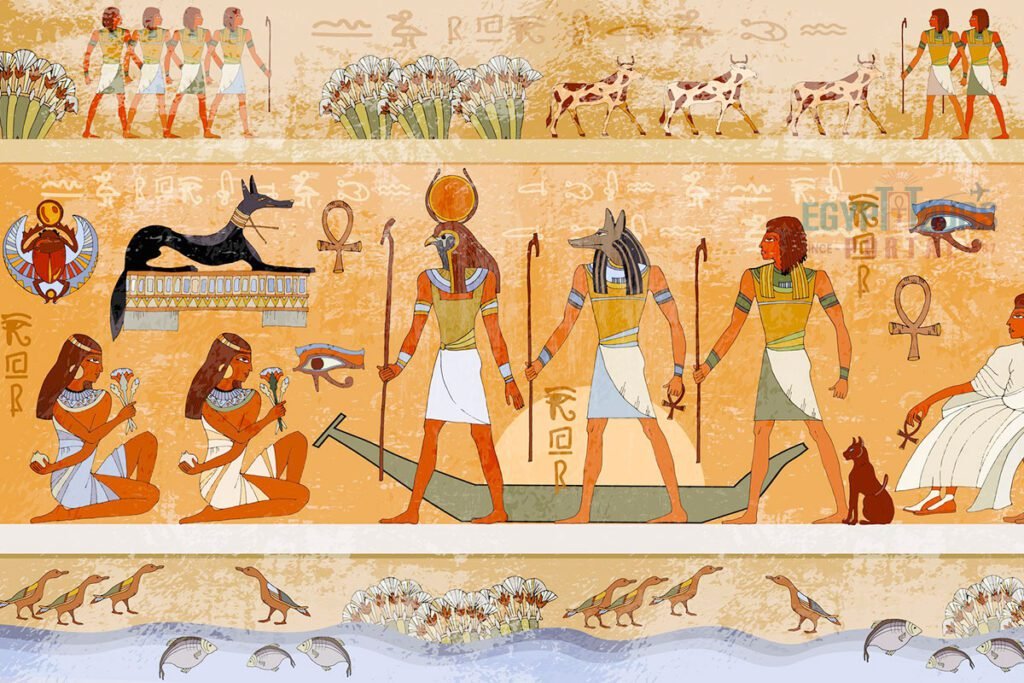
1. Why the Nile River Was Essential to Ancient Egypt
The Nile River was the single most important factor in the success and survival of Ancient Egyptian civilization. Flowing through vast stretches of desert, the river created a fertile corridor where people could settle, farm, trade, and build communities. Without the Nile, Egypt would have remained largely uninhabitable, and the civilization that produced the pyramids, temples, and pharaohs might never have existed. The river provided a reliable source of fresh water in an otherwise arid environment. This water supported agriculture, livestock, drinking supplies, and countless daily activities. Communities naturally developed along the riverbanks, where access to water made permanent settlement possible. One of the Nile's greatest contributions was its annual flood cycle. Each year, floodwaters carried nutrient-rich silt from central Africa and deposited it along the riverbanks. This black soil, known as "Kemet," was extremely fertile and allowed Egyptian farmers to produce abundant harvests. The agricultural surplus generated by Nile farming supported population growth, economic development, and political stability. The river also functioned as Egypt's primary transportation route. Boats could travel north with the current and south using favorable winds, creating an efficient system of communication and trade. Goods, people, building materials, and military forces could move quickly across vast distances. The Nile's influence extended into religion and culture. Egyptians viewed the river as a divine gift and associated it with fertility, prosperity, and life itself. Many gods were connected to the Nile, and festivals celebrated its annual flooding. Because of its role in agriculture, transportation, religion, and daily life, the Nile became the foundation of Egyptian civilization. Every aspect of Ancient Egyptian society depended upon its waters.
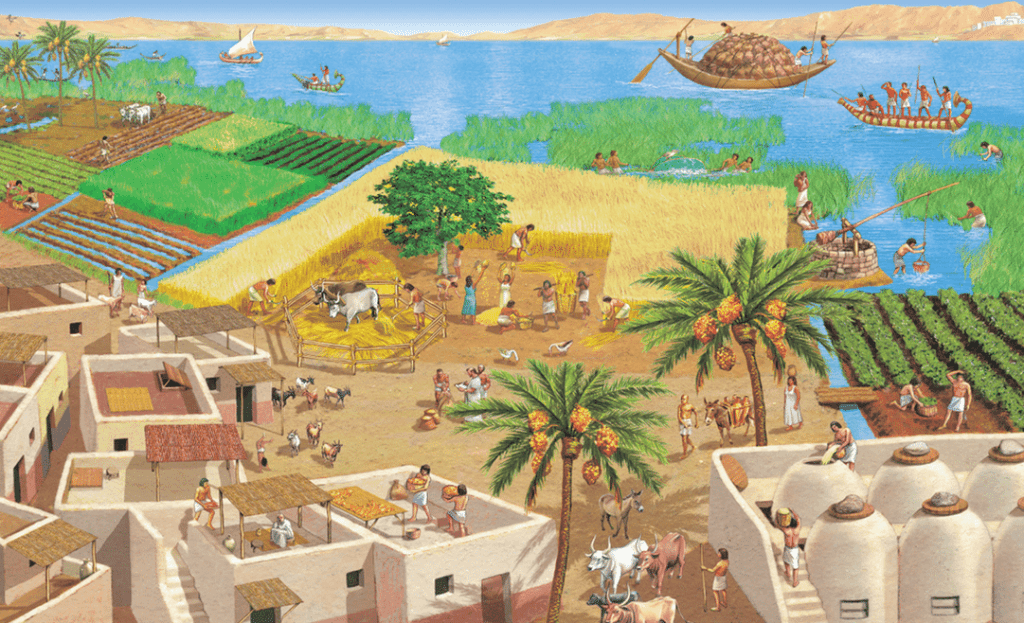
2. The Geography of the Nile River
The Nile River is one of the most remarkable geographical features in the world. Stretching across northeastern Africa, it flows through multiple countries before reaching Egypt and emptying into the Mediterranean Sea. Its unique geography shaped the development of Ancient Egypt and influenced nearly every aspect of Egyptian life. The Nile consists of two major tributaries: the White Nile and the Blue Nile. The White Nile originates in the Great Lakes region of central Africa, while the Blue Nile begins in the Ethiopian Highlands. These rivers merge in present-day Sudan before continuing northward into Egypt. Unlike most major rivers, the Nile flows from south to north. This unusual direction had significant implications for transportation and trade. Boats traveling north could drift with the current, while those heading south could use prevailing winds blowing from the Mediterranean. This natural transportation system made movement remarkably efficient. Upon entering Egypt, the Nile created a narrow fertile valley surrounded by deserts. To the east lay the Eastern Desert and the Red Sea, while the vast Western Desert stretched toward Libya. These natural barriers helped protect Egypt from invasion and contributed to its long-term stability. In northern Egypt, the river branches into multiple channels, forming the Nile Delta. This triangular region became one of the most fertile agricultural areas in the ancient world. Dense populations, prosperous cities, and thriving trade networks developed throughout the Delta. The geography of the Nile provided Egypt with fertile farmland, transportation routes, natural defenses, and access to international trade. These advantages helped transform a narrow river valley into one of history's greatest civilizations.
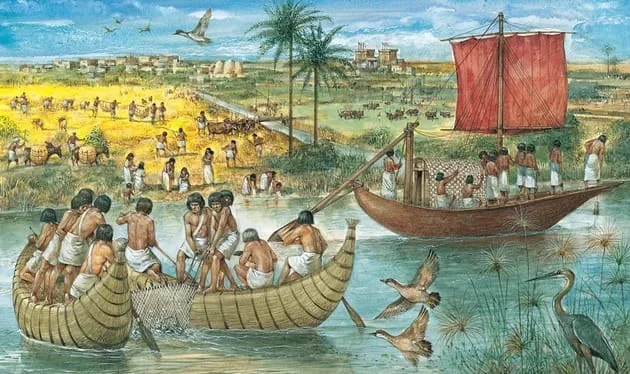
3. The Annual Nile Flood and Its Importance
The annual flooding of the Nile River was one of the most important natural events in Ancient Egypt. Known as the Inundation, this predictable cycle brought water and fertile soil that sustained Egyptian agriculture and made civilization possible. Each summer, heavy rains in the Ethiopian Highlands caused the Blue Nile to swell. These waters traveled northward and flooded the Nile Valley in Egypt between June and September. As the floodwaters spread across the fields, they deposited rich black silt filled with nutrients essential for farming. Ancient Egyptians divided their agricultural year into three seasons based on the Nile's behavior. The first season, Akhet, was the flood season. During this time, fields were submerged beneath water and farmers focused on repairing tools, participating in public works projects, and preparing for planting. After the waters receded, the season of Peret began. Farmers planted crops in the newly enriched soil. Wheat, barley, flax, vegetables, and fruits grew exceptionally well thanks to the fertile sediment left behind by the flood. The final season, Shemu, was the harvest season. Successful harvests provided food, supported trade, and generated tax revenue for the state. Good floods often led to prosperity, while poor floods could result in famine and hardship. Egyptians viewed the annual flood as a divine blessing. Many religious ceremonies and festivals celebrated the inundation, and the river's life-giving waters became symbols of rebirth and renewal. The predictability of the Nile flood distinguished Egypt from many other ancient civilizations. This natural cycle created stability, encouraged agricultural planning, and allowed Egyptian society to prosper for thousands of years.
4. Agriculture Along the Nile River
Agriculture was the foundation of Ancient Egyptian civilization, and the Nile River made it possible. In a land surrounded by deserts, the fertile banks of the Nile created one of the most productive agricultural regions in the ancient world. The river provided water, nutrient-rich soil, and a predictable growing cycle that enabled Egyptians to cultivate crops on a massive scale and support a thriving civilization for thousands of years. The annual flooding of the Nile transformed the landscape each year. When the waters receded, they left behind a layer of rich black silt that replenished the soil's fertility. This natural fertilization reduced the need for additional soil management and allowed farmers to produce abundant harvests. Egyptians referred to this fertile land as "Kemet," meaning "The Black Land," in contrast to the surrounding desert, known as "The Red Land." Farmers grew a wide variety of crops along the Nile. Wheat and barley were the most important staples, forming the basis of bread and beer, which were essential components of the Egyptian diet. Other crops included flax, used to make linen; vegetables such as onions, garlic, lettuce, and cucumbers; and fruits including dates, figs, grapes, and pomegranates. To maximize agricultural productivity, Egyptians developed sophisticated irrigation systems. Canals, dikes, reservoirs, and water basins helped distribute Nile water to fields beyond the immediate riverbanks. Farmers also used tools such as the shaduf, a hand-operated device for lifting water from the river to irrigate crops. Agriculture generated the wealth that funded temples, pyramids, palaces, and government administration. Surplus food supported artisans, priests, soldiers, and officials who were not directly involved in farming. As a result, the success of Egyptian civilization depended heavily on the productivity of Nile agriculture. The river's ability to sustain agriculture explains why the Nile was truly the lifeblood of Ancient Egypt. Without its waters and fertile soil, the kingdom could never have achieved its remarkable prosperity and longevity.
5. Transportation and Trade on the Nile River
The Nile River served as the main transportation and trade route of Ancient Egypt. Long before roads and railways existed, the river functioned as a natural highway that connected cities, villages, temples, and royal capitals across the kingdom. Its unique geography allowed goods and people to move efficiently throughout Egypt, helping to unite the country economically and politically. Travel on the Nile was remarkably convenient because of the river's current and prevailing winds. Boats heading north could drift with the current toward the Mediterranean Sea, while vessels traveling south could use winds blowing from the north. This natural system made transportation easier than in many other ancient civilizations. Egyptians built a wide range of boats for different purposes. Small reed boats were used for fishing and local travel, while larger wooden vessels transported grain, livestock, stone blocks, timber, soldiers, and luxury goods. The Nile became a bustling corridor filled with commercial activity. Trade flourished because of the river. Agricultural products from Upper Egypt could be shipped to cities in the Nile Delta, while imported goods arriving from foreign lands could be distributed throughout the kingdom. Gold from Nubia, cedar wood from the Levant, incense from Punt, copper from Sinai, and luxury items from distant regions all traveled along the Nile. The construction of Egypt's greatest monuments also depended on river transportation. Massive stone blocks used in the pyramids, temples, and obelisks were often transported by boat. The river enabled builders to move enormous quantities of materials over long distances. In addition to economic benefits, the Nile facilitated communication and government administration. Officials could travel quickly between regions, ensuring that royal authority extended throughout the kingdom. The Nile's role as a transportation network was essential to Egypt's success. It connected people, resources, and ideas, creating a unified civilization that thrived along its banks.
6. The Nile River in Ancient Egyptian Religion
The Nile River held profound religious significance in Ancient Egypt and was regarded as a divine gift from the gods. Egyptians believed that the river's waters sustained life, ensured agricultural fertility, and reflected the divine order of the universe. As a result, the Nile occupied a central place in Egyptian mythology, religious rituals, and spiritual beliefs. One of the most important deities associated with the Nile was Hapi, the god of the annual inundation. Hapi was depicted as a figure symbolizing abundance and fertility, often carrying offerings of food and agricultural products. Egyptians believed that Hapi's blessings brought the floodwaters necessary for successful harvests. The river was also connected to Osiris, the god of the afterlife, resurrection, and regeneration. Just as the Nile renewed the land each year through its floods, Osiris symbolized rebirth and eternal life. This connection reinforced the association between the river and the cycle of life, death, and renewal. Many religious festivals celebrated the Nile and its annual flooding. Ceremonies were performed to thank the gods for providing water and fertility. Priests offered prayers, sacrifices, and rituals intended to ensure favorable floods and abundant harvests. The Nile's sacred status influenced temple architecture and religious symbolism. Sacred lakes within temple complexes represented the primordial waters of creation from which the world emerged according to Egyptian mythology. Water from the Nile was often used in purification rituals conducted by priests before religious ceremonies. The river also played an important role in beliefs about the afterlife. Tomb paintings frequently depict scenes of boating, fishing, and agricultural abundance along Nile-like waterways, reflecting hopes for eternal prosperity in the next world. To the Ancient Egyptians, the Nile was far more than a river. It was a living symbol of divine power, fertility, prosperity, and eternal renewal. Its sacred waters connected the natural world with the spiritual realm and helped shape one of history's most enduring religious traditions.
7. The Nile River and the Rise of Ancient Egyptian Civilization
The Nile River was the driving force behind the rise of Ancient Egyptian civilization. Long before the construction of pyramids, temples, and monumental cities, early communities settled along the fertile banks of the Nile because it provided everything necessary for survival. Over time, these settlements grew into one of the most powerful and influential civilizations in human history. Around 5,000 years ago, people living near the Nile discovered that the river's annual floods created exceptionally fertile farmland. This reliable food supply allowed communities to produce agricultural surpluses, which in turn supported population growth. As villages expanded, larger towns and cities emerged along the riverbanks. The abundance generated by Nile agriculture enabled specialization within society. Not everyone needed to farm. Some people became artisans, builders, merchants, priests, scribes, and government officials. This division of labor contributed to economic development and cultural advancement. The Nile also helped unify Egypt politically. Because settlements were concentrated along a narrow river valley, communication and transportation were relatively easy. Leaders could travel between regions, collect taxes, organize labor, and maintain control over distant communities. This connectivity played a crucial role in the unification of Upper and Lower Egypt under the first pharaohs. The wealth generated by Nile agriculture funded the construction of some of the world's most famous monuments, including the pyramids at Giza Pyramid Complex and the magnificent temples of Karnak Temple Complex. These achievements required enormous resources that would not have been possible without the productivity of the Nile Valley. The river's influence extended into religion, government, trade, and culture. Virtually every aspect of Egyptian civilization depended on its waters. The stability provided by the Nile helped Egypt flourish for more than three thousand years, making it one of the longest-lasting civilizations in world history. For this reason, historians often describe the Nile River as the foundation upon which Ancient Egypt was built.
8. Fishing and Wildlife Along the Nile River
The Nile River supported an extraordinary variety of wildlife and provided a rich source of food for Ancient Egyptians. Fish, birds, reptiles, and mammals thrived in and around the river, contributing to the economy, diet, religion, and culture of Ancient Egypt. Fishing was one of the most important activities along the Nile. Ancient Egyptians caught fish using nets, hooks, traps, spears, and fishing lines. Tomb paintings frequently depict fishermen working in boats or standing along the riverbanks. Fish were consumed fresh, dried, salted, or preserved, making them an important source of protein for many Egyptians. Several species of fish inhabited the Nile, including tilapia, catfish, perch, and mullet. The abundance of aquatic life ensured that fishing remained a reliable source of food throughout Egyptian history. The river's wetlands also attracted large numbers of birds. Ducks, geese, herons, ibises, cranes, and kingfishers were common sights along the Nile. Many birds were hunted for food, while others held religious significance. The ibis, for example, was associated with Thoth, the god of wisdom and writing. Among the Nile's most feared inhabitants were crocodiles and hippopotamuses. Crocodiles inspired both fear and reverence and were associated with Sobek, a deity linked to strength, fertility, and military power. Hippopotamuses could be extremely dangerous and sometimes damaged crops, yet they also appeared in Egyptian art and mythology. The fertile environment surrounding the Nile supported numerous plant species, including papyrus, reeds, lotus flowers, and aquatic vegetation. These plants provided materials for paper, boats, baskets, ropes, and religious ceremonies. The rich biodiversity of the Nile helped sustain Egyptian society and reinforced the river's reputation as the source of life and abundance.
9. Cities and Settlements on the Nile River
Virtually every major city and settlement in Ancient Egypt developed along the Nile River. The river provided water, fertile land, transportation, food, and economic opportunities, making it the ideal location for human habitation. As a result, the Nile became the backbone of Egypt's urban development. Early Egyptian villages were established on slightly elevated ground near the riverbanks. These locations offered protection from floods while maintaining easy access to water and farmland. Over time, many of these settlements grew into thriving cities that played important roles in government, religion, trade, and culture. One of the earliest and most influential cities was Memphis, which served as the capital of Egypt during much of the Old Kingdom. Located near the point where Upper and Lower Egypt met, Memphis benefited from its strategic position along the Nile and became a major political and economic center. Further south, the city of Thebes emerged as one of Egypt's most important religious capitals. Situated along the Nile in Upper Egypt, Thebes was home to magnificent temples, royal tombs, and powerful priesthoods. Many of Egypt's greatest monuments were built in and around this city. The Nile Delta also supported numerous prosperous settlements because of its fertile soil and access to Mediterranean trade routes. Cities in the Delta became important centers of commerce, agriculture, and international exchange. The river allowed these urban centers to remain connected despite the vast distances separating them. Boats transported goods, officials, merchants, and travelers between cities, creating a unified network that linked the entire kingdom. Even today, many of Egypt's largest cities remain concentrated along the Nile, reflecting the river's enduring importance. The pattern established thousands of years ago continues to shape Egyptian settlement and development. The growth of cities along the Nile demonstrates how the river served as the foundation of Egyptian civilization, providing the resources and connectivity necessary for urban life to flourish.
10. The Nile River and Ancient Egyptian Trade Networks
The Nile River was the backbone of Ancient Egypt's trade network and one of the primary reasons for the civilization's economic success. Acting as a natural highway that stretched from the southern borders of Nubia to the Mediterranean Sea, the river connected farms, villages, cities, temples, and international trade routes. Through the Nile, Egypt became one of the wealthiest and most influential civilizations of the ancient world. Trade within Egypt depended heavily on river transportation. Farmers shipped grain, vegetables, fruits, livestock, flax, papyrus, and other products along the Nile to urban centers where these goods could be sold or redistributed. Because transporting cargo by boat was easier than moving it across the desert, the Nile dramatically reduced transportation costs and increased economic efficiency. The river also connected Egypt to foreign lands. To the south, trade routes linked Egypt with Nubia, a region rich in gold, ivory, ebony, incense, and exotic animals. Egyptian expeditions frequently traveled along the Nile to acquire these valuable resources, which contributed significantly to the kingdom's wealth. To the north, the Nile Delta provided access to the Mediterranean Sea and international trade networks. Egyptian merchants exchanged goods with civilizations in the Levant, Cyprus, Crete, and other parts of the ancient Mediterranean world. Cedar wood, olive oil, wine, copper, silver, and luxury items entered Egypt through these connections. The Nile played a crucial role in government administration as well. Taxes collected from agricultural regions could be transported efficiently to state granaries and royal treasuries. This centralized control helped pharaohs maintain political authority and finance major construction projects. Many temples became economic centers because of their location along the river. These institutions owned agricultural lands, managed warehouses, and participated in regional trade. The movement of goods along the Nile supported both religious and governmental activities. The success of Ancient Egypt's trade networks depended on the Nile's ability to connect people, resources, and markets. The river transformed Egypt into a prosperous commercial power whose influence extended far beyond its borders.
11. Boats and Navigation on the Nile
Boats were among the most important technologies developed by the Ancient Egyptians, and the Nile River served as the perfect environment for navigation. For thousands of years, Egyptians relied on boats to transport people, goods, building materials, livestock, soldiers, and religious processions. The development of river navigation played a critical role in the growth and success of Egyptian civilization. The earliest Egyptian boats were constructed from bundles of papyrus reeds. These lightweight vessels were suitable for fishing, hunting birds, and traveling short distances along the river. As Egyptian society became more advanced, boatbuilders began constructing larger wooden ships capable of carrying heavy cargo and large numbers of passengers. Ancient Egyptians became highly skilled sailors. They understood the Nile's currents, seasonal water levels, and prevailing winds. Boats traveling north toward the Mediterranean could simply follow the river's current, while those heading south raised sails to take advantage of winds blowing from the north. This natural system made navigation exceptionally efficient. Large cargo vessels transported grain, stone blocks, timber, and other materials needed for construction projects. The pyramids, temples, obelisks, and colossal statues of Ancient Egypt would have been impossible to build without the transportation capabilities provided by Nile boats. The river also played an important role in religious ceremonies. Sacred boats carried statues of gods during festivals and processions. One of the most famous examples is the ceremonial barque used in festivals honoring Amun at the Karnak Temple Complex. Royal boats were often elaborately decorated and served both practical and ceremonial functions. Some pharaohs were even buried with boats intended to transport them through the afterlife. The famous solar boat of Khufu, discovered near the Great Pyramid, provides remarkable evidence of Egyptian shipbuilding expertise. Boats and navigation were essential to Egyptian daily life, trade, religion, and government. The Nile's navigable waters helped unite the kingdom and contributed greatly to its prosperity.
12. The Nile River in Ancient Egyptian Art and Literature
The Nile River occupied a central place in Ancient Egyptian art and literature, reflecting its immense importance to Egyptian life. Artists, scribes, poets, and religious leaders frequently celebrated the river as a source of prosperity, beauty, fertility, and divine blessing. Through paintings, reliefs, inscriptions, hymns, and stories, the Nile became one of the most enduring symbols of Egyptian civilization. Tomb paintings provide some of the most vivid depictions of life along the Nile. These artworks often show scenes of fishing, boating, bird hunting, farming, and daily activities taking place on or near the river. Such images were not merely decorative; Egyptians believed they could magically provide these experiences to the deceased in the afterlife. The Nile's wildlife also appeared prominently in Egyptian art. Artists portrayed fish, crocodiles, hippopotamuses, birds, lotus flowers, and papyrus plants with remarkable detail. These images reflected both the natural richness of the river environment and its symbolic significance. Religious texts frequently praised the Nile. One of the most famous examples is the "Hymn to the Nile," which describes the river as the provider of food, water, and abundance. The hymn celebrates the annual inundation and expresses gratitude for the blessings brought by the floodwaters. Literature often linked the Nile to concepts of creation and renewal. Egyptian myths described life emerging from the primordial waters, and the river became a symbol of this creative force. Stories, prayers, and temple inscriptions reinforced the connection between the Nile and divine power. The lotus and papyrus, both closely associated with the Nile, became recurring artistic motifs. These plants appeared in architecture, jewelry, furniture, and decorative objects throughout Egyptian history. The river's presence in art and literature demonstrates how deeply it influenced Egyptian identity. More than a physical feature, the Nile was a cultural and spiritual symbol that inspired generations of artists and writers.
13. The Nile River and Ancient Egyptian Religion and Gods
The Nile River was deeply intertwined with Ancient Egyptian religion and was regarded as one of the greatest gifts bestowed upon humanity by the gods. Egyptians believed that the river's waters sustained life, ensured fertility, and maintained the balance of the universe. Because of its vital importance, the Nile became closely associated with numerous deities, religious rituals, myths, and sacred traditions. Among the most important gods connected to the river was Hapi, the deity who personified the annual inundation. Hapi was viewed as the bringer of abundance, fertility, and prosperity. Artistic depictions often show him carrying offerings of grain, fruits, and agricultural products, symbolizing the wealth generated by the Nile's floodwaters. Egyptians offered prayers and ceremonies to Hapi in hopes of receiving favorable floods. The Nile was also linked to Osiris, one of the most significant gods in Egyptian mythology. Osiris represented death, resurrection, fertility, and rebirth. Just as the Nile renewed the land each year through its inundation, Osiris symbolized the cycle of life and regeneration. This connection made the river a powerful symbol of eternal renewal. Another important deity associated with the Nile was Sobek, the crocodile god. Because crocodiles inhabited the river, Sobek became linked to strength, protection, fertility, and military power. Temples dedicated to Sobek often stood near waterways where crocodiles were common. Many religious festivals revolved around the Nile and its flooding cycle. Priests performed rituals to honor the gods responsible for the river's blessings, and communities celebrated the arrival of the floodwaters that ensured successful harvests. The Nile also played an important role in creation myths. Egyptians believed that life emerged from the primordial waters at the beginning of time. As a result, the river became a living representation of creation, order, and divine power. Through its association with gods, myths, and sacred ceremonies, the Nile occupied a central position in Ancient Egyptian spirituality and religious life.
14. Irrigation and Water Management Along the Nile
One of Ancient Egypt's greatest achievements was its ability to manage and control the waters of the Nile River. Although the annual inundation provided fertile soil and essential moisture, successful agriculture required careful planning and sophisticated water management systems. Egyptian engineers and farmers developed innovative irrigation techniques that allowed them to maximize agricultural productivity and support a growing population. The simplest form of irrigation involved basin irrigation. Farmers constructed earthen embankments that divided farmland into large basins. During the flood season, water entered these basins and remained there long enough for the soil to absorb moisture and nutrients. Once the floodwaters receded, crops could be planted in the fertile soil. As Egyptian civilization expanded, more complex irrigation systems emerged. Canals connected different areas of farmland to the river, allowing water to reach fields located farther from the Nile. Reservoirs and storage basins helped retain water for use during dry periods. One of the most famous irrigation devices used in Ancient Egypt was the shaduf. This simple but effective tool consisted of a long pole balanced on a pivot with a bucket attached to one end and a counterweight on the other. Farmers used the shaduf to lift water from the river or canals and distribute it to fields located at higher elevations. Government officials closely monitored water levels because successful agriculture depended on the size of the annual flood. Structures known as nilometers measured the river's height and helped predict harvest yields. These measurements influenced taxation, planning, and resource management. The ability to control water contributed significantly to Egypt's prosperity. Efficient irrigation increased crop production, reduced the impact of droughts, and supported population growth. The agricultural surplus generated through irrigation funded monumental construction projects, trade, and government administration. Ancient Egyptian irrigation systems demonstrate the remarkable ingenuity of a civilization that learned to harness one of nature's most powerful resources.
15. The Nile Delta and Its Importance to Ancient Egypt
The Nile Delta was one of the most fertile and economically significant regions of Ancient Egypt. Located in northern Egypt where the Nile River branches into multiple channels before entering the Mediterranean Sea, the Delta formed a vast triangular area of rich farmland, thriving settlements, and strategic trade connections. The Delta's fertility resulted from centuries of sediment deposition carried by the Nile. As the river slowed near its mouth, it deposited enormous quantities of nutrient-rich silt, creating exceptionally productive agricultural land. Farmers in the Delta cultivated wheat, barley, flax, vegetables, fruits, and other crops that contributed significantly to Egypt's food supply. The region became densely populated because of its agricultural abundance. Numerous towns and cities developed throughout the Delta, serving as centers of commerce, administration, and industry. The Delta's extensive waterways facilitated transportation and communication, making it one of the most economically active areas of the kingdom. Its location also provided access to international trade networks. Through the Mediterranean Sea, Egyptian merchants established commercial relationships with civilizations in the Levant, Cyprus, Crete, and other regions. Goods such as timber, wine, olive oil, copper, silver, and luxury items entered Egypt through Delta ports. The Nile Delta held strategic importance as well. Because it served as Egypt's northern gateway, controlling the Delta was essential for defense and political stability. Many foreign powers seeking to conquer Egypt first entered through this region. Religiously, the Delta contained numerous sacred sites, temples, and pilgrimage centers. It also played an important role in Egyptian mythology and royal ideology. The unification of Upper and Lower Egypt, a defining event in Egyptian history, emphasized the significance of the Delta as part of the kingdom's identity. The Nile Delta was more than a fertile agricultural zone. It was a center of trade, culture, politics, and international exchange that contributed enormously to the success of Ancient Egyptian civilization.
16. Environmental Challenges of the Nile River
Although the Nile River was the source of life and prosperity for Ancient Egypt, it also presented significant environmental challenges. The success of Egyptian civilization depended heavily on the river's behavior, and fluctuations in the Nile's annual flood cycle could have dramatic consequences for agriculture, the economy, and society. Ancient Egyptians constantly adapted to these challenges, developing strategies to manage the risks associated with their dependence on the river. One of the greatest concerns was the unpredictability of the annual inundation. While the Nile generally flooded each year, the size of the flood varied considerably. If the floodwaters were too low, insufficient water reached the fields, leading to poor harvests, food shortages, and famine. Conversely, excessively high floods could destroy homes, damage irrigation systems, and wash away valuable crops. Periods of prolonged drought posed even greater dangers. Historical evidence suggests that some of Egypt's most difficult times coincided with years of weak Nile floods. Reduced agricultural production could weaken the economy, increase social unrest, and contribute to political instability. Scholars believe that environmental factors linked to changes in Nile flooding may have played a role in the decline of certain periods of Egyptian history. The river's wildlife also created challenges. Hippopotamuses often damaged crops and irrigation canals, while crocodiles posed risks to fishermen, farmers, and travelers. Despite their religious significance, these animals could be dangerous and required careful management. Maintaining irrigation systems demanded continuous labor. Canals had to be cleared of silt, embankments repaired, and water levels monitored. Without regular maintenance, agricultural productivity could decline significantly. Disease represented another challenge. Stagnant water in irrigation channels and flood basins could contribute to the spread of certain illnesses and parasites. Communities living close to the river had to contend with health risks associated with waterborne diseases. Despite these obstacles, Ancient Egyptians demonstrated remarkable resilience and ingenuity. Their ability to adapt to environmental challenges allowed them to build one of the most enduring civilizations in world history.
17. The Legacy of the Nile River in Modern Egypt
The influence of the Nile River did not end with the fall of the pharaohs. Today, the river remains the most important natural resource in Egypt and continues to shape the country's economy, culture, population distribution, and national identity. The legacy of the Nile stretches across thousands of years, linking modern Egypt to its ancient past. More than 95 percent of Egypt's population lives within a relatively short distance of the Nile Valley and the Nile Delta. Just as in ancient times, the river provides water for agriculture, drinking, industry, and daily life. Cities such as Cairo, Luxor, and Aswan continue to thrive along its banks. Modern irrigation systems have expanded Egypt's agricultural capacity, allowing farmers to cultivate crops throughout the year. While contemporary technology has transformed water management, the basic principle remains unchanged: Egypt's prosperity depends heavily on the Nile. The river also remains a major transportation and tourism corridor. Nile cruises attract visitors from around the world who wish to explore Egypt's ancient temples, tombs, and archaeological sites. Many of the country's most famous landmarks, including the temples of Karnak Temple Complex, Luxor Temple, and Philae Temple, are located near the river. The Nile continues to inspire Egyptian art, literature, music, and national pride. Its image appears in cultural traditions, educational materials, and tourism campaigns that celebrate Egypt's heritage. International cooperation regarding Nile water resources has become increasingly important in the modern era. Discussions concerning water management among countries sharing the Nile Basin highlight the continuing significance of the river as a vital resource. The enduring importance of the Nile demonstrates the remarkable continuity between Ancient Egypt and modern Egypt. More than five thousand years after the first Egyptian farmers settled along its banks, the river remains the nation's lifeline.
18. Why the Nile Was Truly the Lifeblood of Ancient Egypt
Few natural features have shaped human history as profoundly as the Nile River shaped Ancient Egypt. Flowing through a vast desert landscape, the Nile provided the water, fertile soil, transportation routes, food resources, and economic opportunities that made one of the world's greatest civilizations possible. Every major achievement of Ancient Egypt can be traced, directly or indirectly, to the influence of this extraordinary river. The annual inundation transformed barren land into productive farmland, supporting millions of people and generating agricultural surpluses that fueled economic growth. The river connected distant regions of the kingdom, facilitating trade, communication, and political unity. It supplied fish, wildlife, papyrus, and countless other resources essential to daily life. The Nile's impact extended beyond practical concerns. It inspired religious beliefs, artistic traditions, myths, literature, and cultural identity. Egyptians viewed the river as a sacred gift from the gods, associating it with fertility, rebirth, abundance, and eternal life. Temples, festivals, and religious ceremonies celebrated its importance throughout the pharaonic era. The construction of pyramids, temples, monuments, and cities depended upon the wealth and resources generated by Nile agriculture. Without the river, Egypt could never have become one of the most influential civilizations in history. Even today, the Nile remains central to Egyptian life, continuing a relationship that began thousands of years ago. Modern cities, farms, industries, and communities still rely on the same river that sustained the pharaohs and their people.