- Excursions in Egypt
- Egypt Tour Packages
- Cairo Tours and Excursions
- Hurghada Tours and Excursions
- Soma Bay Tours and Excursions
- Makadi Bay Tours and Excursions
- Sahl Hasheesh Tours and Excursions
- El Gouna Tours and Excursions
- Marsa Alam Tours and Excursions
- Port Ghalib Tours and Excursions
- El Quseir Tours and Excursions
- Dendera and Abydos Day Tours
- Aswan Tours and Excursions
- Luxor Tours and Excursions
- Sharm El Sheikh Tours and Excursions
- Top Rated Egypt Tours in 2026
- Optional Excursions in Egypt
- Private Transfer
- Blogs About egypt
- Ancient Egypt
- Historical Sites in Egypt
- Cairo
- Alexandria
- Luxor
- Aswan
- The Red Sea
- Dendera Temple
- El Fayoum Oasis
- Bahariya Oasis
- Siwa Oasis
- Al Alamein
- Marsa Matruh
- Why Egypt Is One of the Safest Countries to Visit in the Middle East
- What You Need To know Before Your First Trip To Egypt
- Egypt Travel Costs in 2026 Full Budget Guide
- Top 10 Tourist Activities in Egypt
- Top 50 Activities You Can’t Miss in Egypt in 2026
- The Guide to Guided Tours in Egypt
- Egypt’s Ancient and Modern History
- The Nile River
- The Deserts of Egypt
- Ancient Egyptian gods
- famous Egyptian dishes
- UNESCO World Heritage sites
- About Us
- Egypt Hotels and Resorts
- Excursions in Egypt
- Egypt Tour Packages
- Cairo Tours and Excursions
- Hurghada Tours and Excursions
- Soma Bay Tours and Excursions
- Makadi Bay Tours and Excursions
- Sahl Hasheesh Tours and Excursions
- El Gouna Tours and Excursions
- Marsa Alam Tours and Excursions
- Port Ghalib Tours and Excursions
- El Quseir Tours and Excursions
- Dendera and Abydos Day Tours
- Aswan Tours and Excursions
- Luxor Tours and Excursions
- Sharm El Sheikh Tours and Excursions
- Top Rated Egypt Tours in 2026
- Optional Excursions in Egypt
- Private Transfer
- Blogs About egypt
- Ancient Egypt
- Historical Sites in Egypt
- Cairo
- Alexandria
- Luxor
- Aswan
- The Red Sea
- Dendera Temple
- El Fayoum Oasis
- Bahariya Oasis
- Siwa Oasis
- Al Alamein
- Marsa Matruh
- Why Egypt Is One of the Safest Countries to Visit in the Middle East
- What You Need To know Before Your First Trip To Egypt
- Egypt Travel Costs in 2026 Full Budget Guide
- Top 10 Tourist Activities in Egypt
- Top 50 Activities You Can’t Miss in Egypt in 2026
- The Guide to Guided Tours in Egypt
- Egypt’s Ancient and Modern History
- The Nile River
- The Deserts of Egypt
- Ancient Egyptian gods
- famous Egyptian dishes
- UNESCO World Heritage sites
- About Us
- Egypt Hotels and Resorts
Welcome to
Saint Simon the Tanner Monastery: The Spiritual Fortress of Mokattam
Perched on the rugged cliffs of the Mokattam Hills in southeastern Cairo, the Monastery of Saint Simon the Tanner—widely known as the Cave Church—stands as a breathtaking testament to faith, resilience, and architectural ingenuity. This extraordinary complex is not merely a place of worship; it is a spiritual fortress carved directly into the living rock of the mountain, serving as the heartbeat of the “Zabbaleen” (Garbage Collectors) community. The monastery is named after the 10th-century Coptic saint, Simon the Tanner, who is revered in Coptic tradition for the miraculous moving of the Mokattam Mountain—a story that defines the identity of this site. To enter the monastery, one must journey through the narrow, bustling streets of Manshiyat Naser, a passage that serves as a profound transition from the grit of urban survival to the soaring, silent majesty of a sanctuary that can hold thousands of souls beneath its natural limestone canopy.
The scale of the monastery is truly monumental, featuring seven distinct churches and chapels, the largest of which is the Amphitheater of Saint Simon, capable of seating over 20,000 people, making it the largest church in the Middle East. What makes this site a global marvel is the seamless integration of nature and artistry; the walls are adorned with massive, intricate stone carvings and bas-reliefs depicting biblical scenes, all hand-sculpted by a Polish artist who dedicated years to the mountain. This sanctuary represents the modern triumph of the Coptic community, which transformed a desolate limestone quarry into a world-class pilgrimage site beginning in the 1970s. It is a place where the earth itself opens up to provide refuge, reminding every visitor that even in the most challenging surroundings, beauty and faith can carve out a space that is both eternal and resplendent.
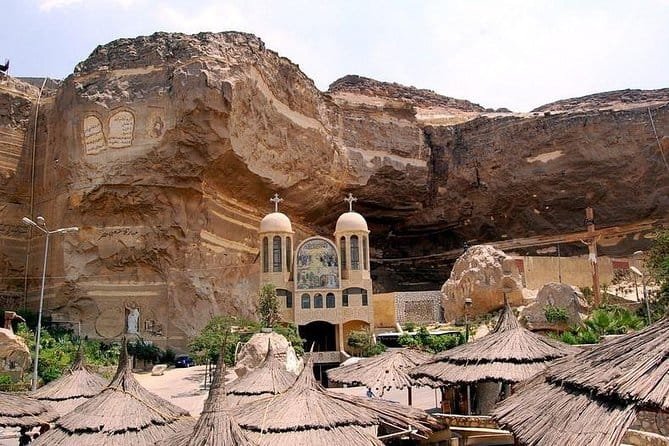
1. The Miracle of Mokattam: The Legend of Saint Simon
The spiritual foundation of this monastery is built upon one of the most famous legends in Coptic history: the Moving of the Mokattam Mountain. According to tradition, in the late 10th century, the Fatimid Caliph Al-Muizz challenged the Coptic Pope, Abraham the Syrian, to prove the validity of the biblical verse stating that faith as small as a mustard seed could move mountains. Failure to do so would have meant the persecution or expulsion of the Christian community. In a state of deep prayer and fasting, the Pope received a vision of the Virgin Mary, who told him to seek a one-eyed man carrying a water jar—a humble tanner named Simon. Simon, known for his secret piety and for plucking out his own eye to avoid a sinful thought, instructed the Pope and the faithful to gather at the base of the mountain and cry out "Kyrie Eleison" (Lord have mercy). Tradition records that as the people prayed and the sun rose, the mountain lifted off the ground three times, allowing the sun to shine beneath it. This miraculous event secured the safety of the Copts in Egypt and forever tied the identity of Saint Simon to this specific geography. For centuries, however, the site remained a rugged, uninhabited cliffside. It wasn't until the 1970s that the "Zabbaleen" (garbage collectors) community began to settle in the area and rediscover the spiritual significance of the caves. The construction of the modern monastery is seen by many as a "second miracle"—the transformation of a limestone wasteland into a world-renowned sanctuary. Today, the legend of Saint Simon serves as a powerful symbol of the "faith of the marginalized," proving that the most humble individuals can be the architects of the most monumental shifts in history.
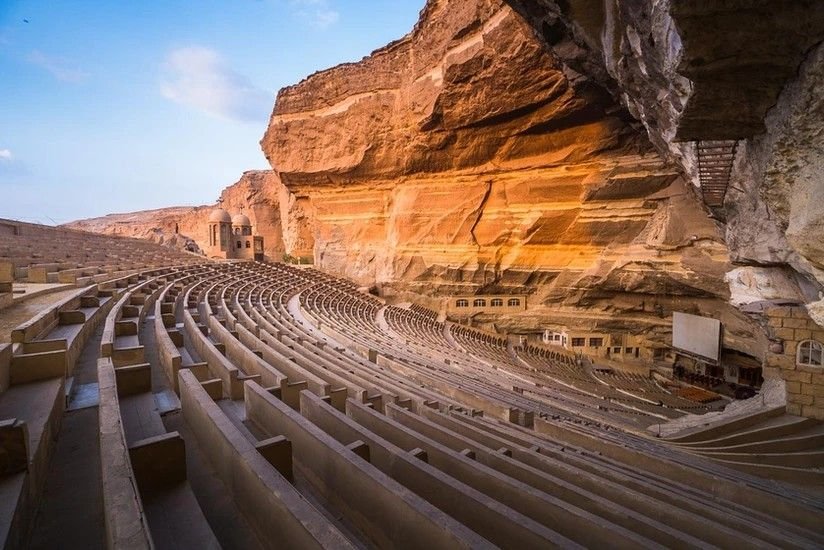
2. Architectural Marvel: The Great Amphitheater
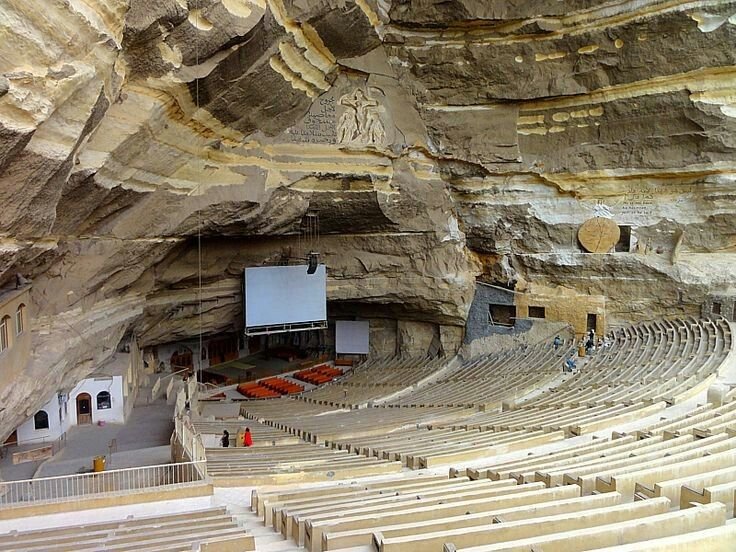
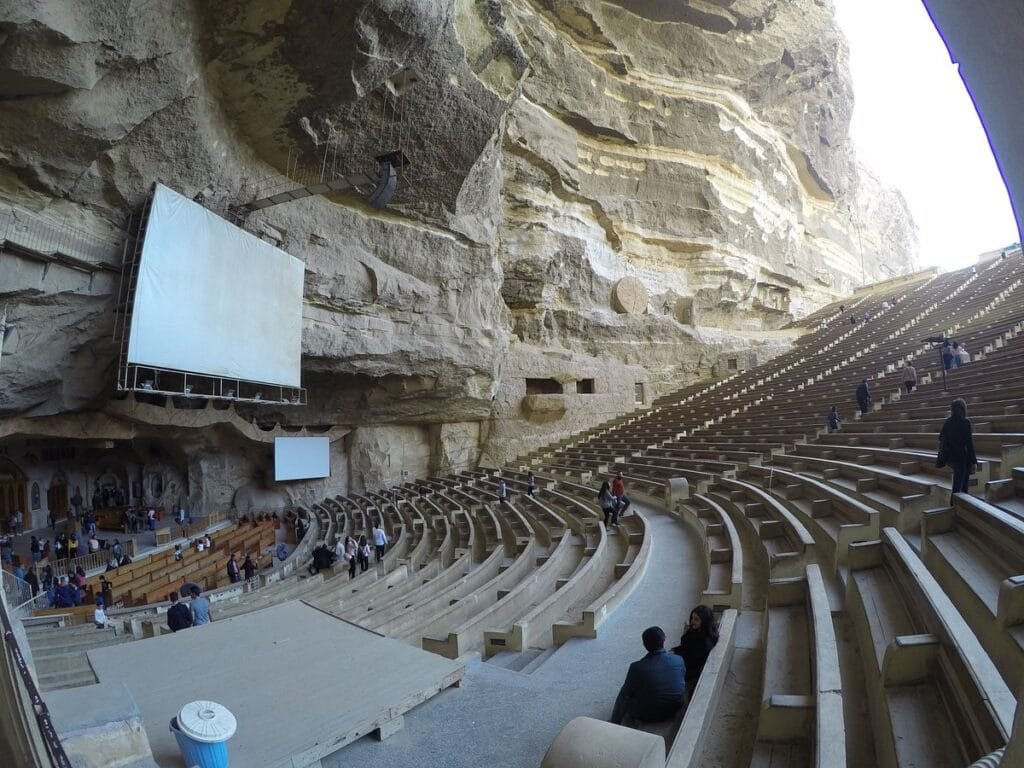
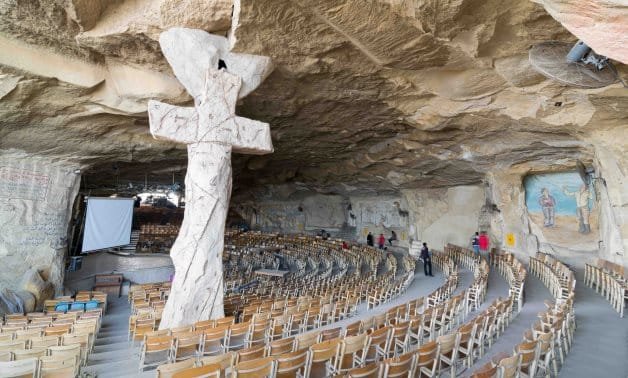
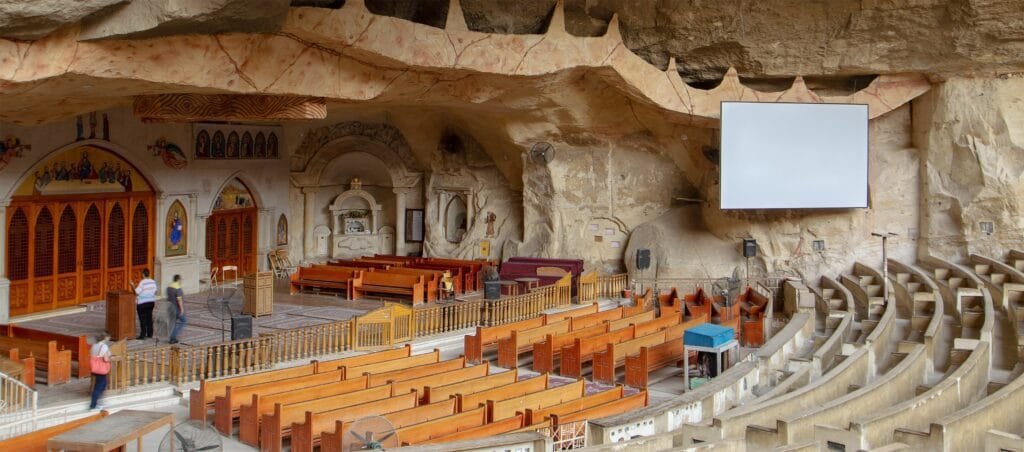
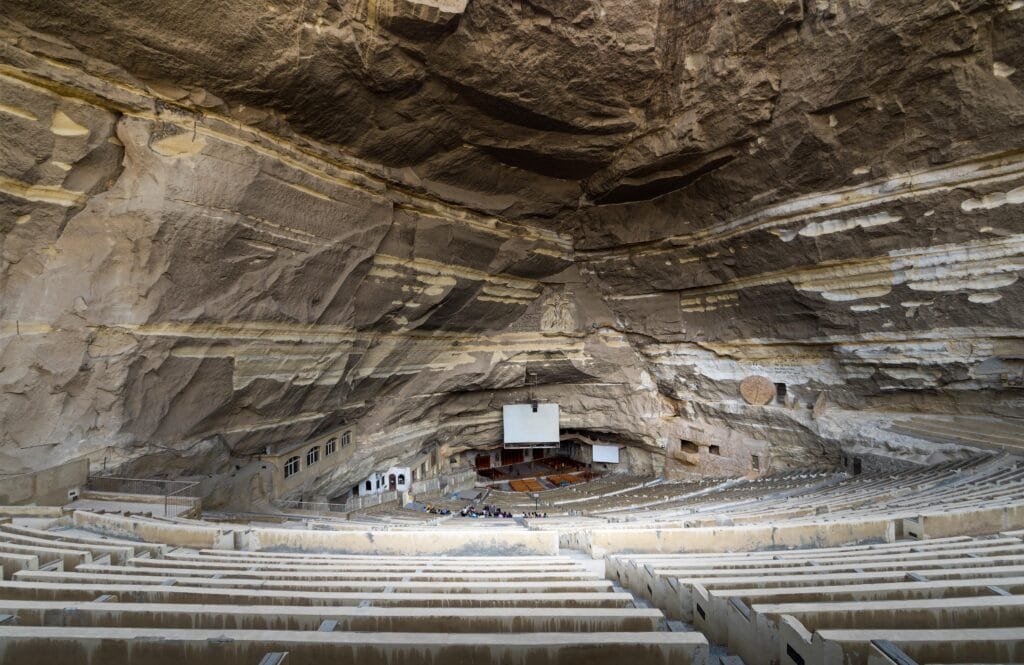
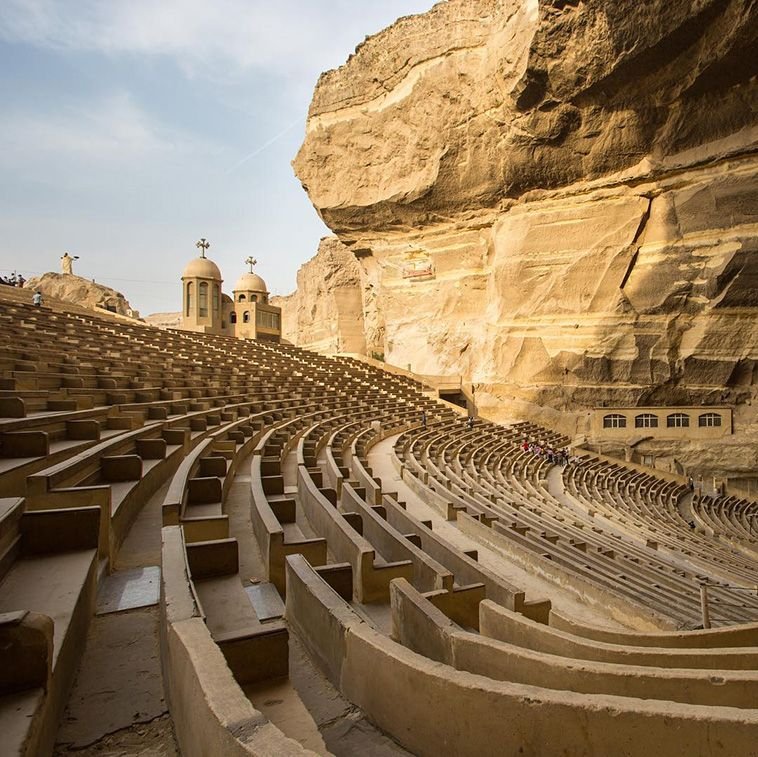
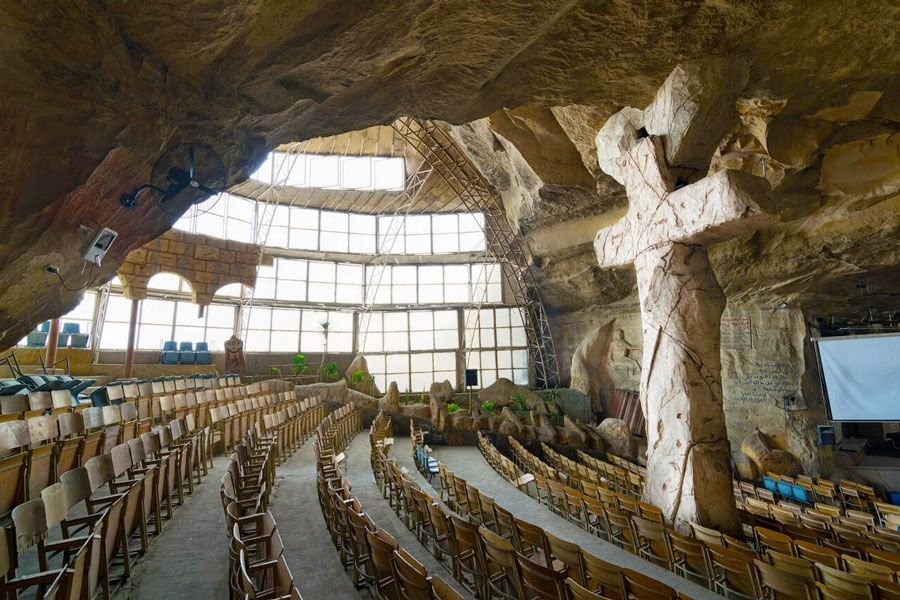
The Amphitheater of Saint Simon is an architectural feat that defies traditional church design. Rather than building a structure on the mountain, the community built the church into it. Utilizing a massive natural cavern that had been partially hollowed out by ancient quarrying, the space was transformed into a colossal open-air cathedral. The amphitheater is designed with a steep, semi-circular seating arrangement that mimics the ancient Roman theaters, capable of accommodating over 20,000 worshippers. This makes it the largest Christian sanctuary in the Middle East. The "ceiling" is the raw, vaulted limestone of the Mokattam cliff itself, which provides a natural acoustic chamber that carries sound with crystalline clarity, even to the furthest rows of the gallery. What makes the architecture so compelling is its raw, industrial beauty. The seating is made of simple concrete and stone, yet the sheer scale of the cavern creates a sense of divine grandiosity. The altar area is positioned at the base of the cave, framed by the natural folds of the rock, which are illuminated by strategically placed floodlights to emphasize the geological history of the site. This architectural choice reflects the lifestyle of the Zabbaleen community—a people who live by reclaiming and repurposing what others discard. By taking a "hollow" in the earth and turning it into a holy of holies, they created a space that is both environmentally integrated and spiritually soaring. For the visitor, standing at the top of the amphitheater and looking down into the vastness of the cave is a dizzying, awe-inspiring experience that highlights the incredible things humans can achieve when they work in harmony with the natural landscape.
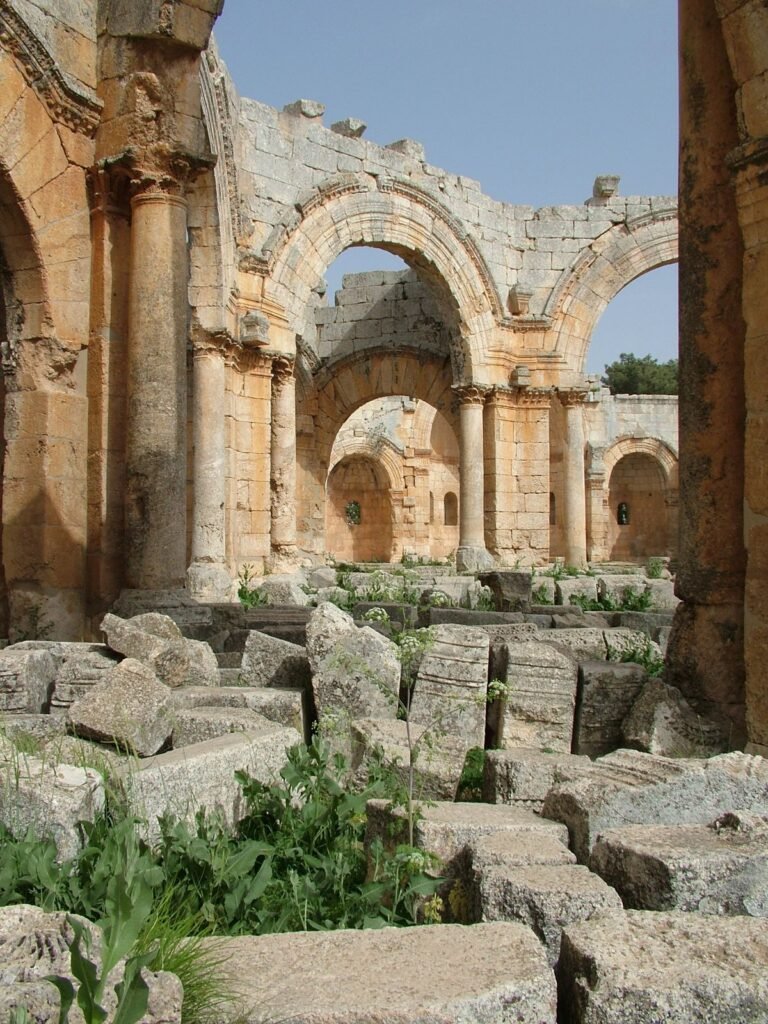
3. The Stone Carvings: Mario’s Artistic Legacy
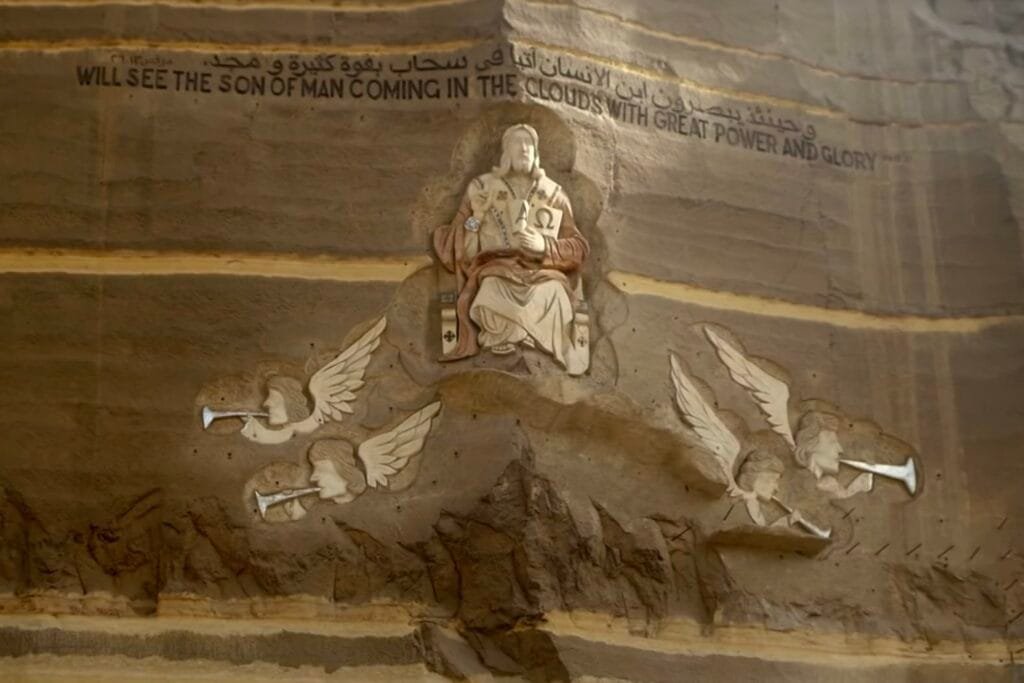
The visual identity of the Monastery of Saint Simon is defined by the extraordinary stone carvings and bas-reliefs that adorn its walls. These are not ancient relics, but the life’s work of a modern master: a Polish artist named Mario (Mariusz Dybich). Arriving in Egypt in the 1990s, Mario was captivated by the spiritual energy of the Cave Church and spent years hanging from ropes and scaffolding, carving biblical scenes directly into the limestone faces of the mountain. His work has transformed the raw rock into a giant, open-air Bible. From massive depictions of the Last Supper to scenes of the Resurrection and the Virgin Mary, these carvings are characterized by their bold, expressive lines and their ability to capture human emotion in cold stone. These carvings serve a dual purpose: they are both high art and a form of "visual liturgy" for the community. Many of the residents of the surrounding "Garbage City" may have lacked formal education in the past, and Mario’s sculptures provided a powerful, accessible way to engage with sacred stories. The carvings are massive in scale—some stretching several meters high—and they change character throughout the day as the sun moves across the cliffs, casting deep shadows that give the figures a life-like, three-dimensional quality. This artistic legacy has turned the monastery into a global landmark for "sacred land art." It is a rare example of a modern artist dedicating his entire career to a single, communal religious project, proving that the mountain is not just a place of prayer, but a living canvas where the stories of the past are etched into the foundations of the future.
4. Manshiyat Naser: The Journey Through "Garbage City"
The journey to the Monastery of Saint Simon is an experience in itself, requiring a passage through Manshiyat Naser, often internationally referred to as "Garbage City." This neighborhood is home to the Zabbaleen, a community that has for decades performed the essential role of managing Cairo’s waste through a highly efficient, manual recycling system. For the uninitiated visitor, the sight of the densely packed, narrow streets, the mounds of collected materials, and the constant hum of activity can be overwhelming. However, this grit is the very foundation of the monastery’s existence; it is a community of extraordinary ingenuity, where every scrap of paper, plastic, or metal is sorted and repurposed. To reach the cave church, one must navigate this urban landscape, which provides a stark, powerful contrast to the serene, spiritual haven that lies at the mountain's peak. The monastery is literally built above the roofs of this working-class community. For many visitors, passing through Manshiyat Naser is an education in human perseverance. The monastery is not an isolated retreat away from the struggles of the world; it is the spiritual anchor for a community that lives at the very intersection of survival and faith. This proximity is crucial to understanding the "Cave Church." It is a place of refuge for a people who do the most difficult work in the city, providing a sanctuary where they can find peace after a long day of labor. The monastery does not turn its back on the poverty of its surroundings; it embraces it, transforming the mountain into a cathedral that reflects the dignity and hard work of the Zabbaleen.
5. The Seven Churches: A Labyrinth of Faith
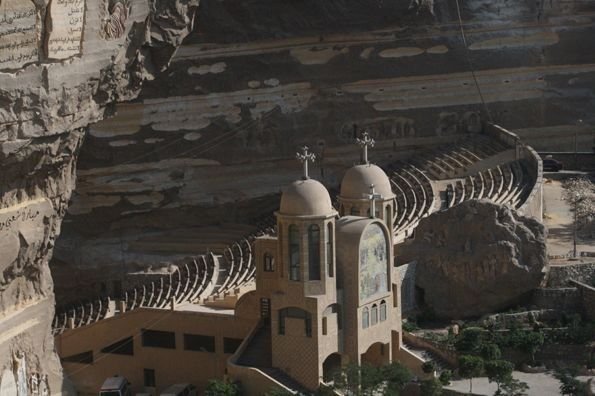
The Monastery of Saint Simon is not just a single cave; it is a vast complex of seven distinct churches and chapels, carved into different levels of the Mokattam cliffside. Each space has its own atmosphere and historical significance. Beyond the massive Great Amphitheater, there are intimate sanctuaries like the Church of St. Mark, the Church of Saint Simon the Tanner, and the Church of Saint Paul the Hermit. These smaller chapels are interconnected by a network of tunnels and exterior staircases that wind around the mountain, offering hidden viewpoints of the city below. The layout feels like a labyrinthine city of faith, where every turn leads to a new altar, a new set of carvings, or a quiet spot for prayer. The architecture within these chapels is varied—some retain the rough, jagged texture of the natural cave, while others have been polished and reinforced with concrete and limestone blocks to ensure structural safety. The smaller chapels are often used for baptisms, weddings, and weekday services, providing a more intimate spiritual experience compared to the massive gatherings in the Great Amphitheater. This variety allows the monastery to function as a full-scale religious center, capable of hosting large festivals and small, quiet liturgies simultaneously. For the explorer, wandering through these seven churches reveals the sheer depth of the community's commitment to building this sanctuary. It is a space where the geography of the mountain determines the geography of the faith, turning a series of geological voids into a cohesive, multifaceted spiritual city that feels both ancient and remarkably modern.
6. The Relics of Saint Simon: A Discovery from the 1990s
For centuries, the story of Saint Simon the Tanner was largely a matter of oral tradition and Coptic hagiography, with little physical evidence of his life. That changed dramatically in 1991, during the ongoing construction and expansion of the monastery. While workers were clearing a space in one of the caves, they uncovered a mummified skeleton accompanied by a scroll and a collection of artifacts that appeared to be from the 10th century. After careful analysis by Coptic scholars and historians, the discovery was widely attributed to the long-lost remains of Saint Simon himself. This moment was a turning point for the monastery, transforming it from a commemorative site into a true reliquary. Today, the relics of Saint Simon are kept in a special glass-fronted shrine within the church that bears his name. The discovery served to validate the faith of the Zabbaleen community, providing a physical link to their patron saint. For the modern visitor, seeing the shrine is the emotional climax of a trip to the monastery. It is a moment where the "legend" becomes a "reality." The presence of the relics has significantly increased the number of pilgrims who visit throughout the year, especially on the feast day of the saint. The shrine acts as the spiritual heart of the entire complex, a place where people leave prayer requests and personal petitions, believing that the saint who once moved the mountain remains a powerful intercessor for the people who live in its shadow today.
7. The Cave Church Festivals: A Tapestry of Coptic Liturgy
The Monastery of Saint Simon is at its most vibrant during the major Coptic Christian festivals, particularly during the Feast of Saint Simon and the Great Lent. During these times, the massive amphitheater is filled to its 20,000-person capacity, creating a sea of worshippers that is unparalleled in the Middle East. The air is thick with the scent of incense and the sound of traditional Coptic hymns, which are characterized by their ancient, rhythmic, and hauntingly beautiful melodies. These festivals are not just religious ceremonies; they are grand social gatherings that reinforce the identity of the Zabbaleen community. Families gather in their finest clothes, and the mountain echoes with the shared joy of a people who have built their own sanctuary from nothing. The atmosphere during a midnight mass at the Cave Church is transformative. The contrast between the dark, rugged limestone walls and the brilliant white robes of the deacons and priests creates a visual tableau that feels as if it were plucked from the fourth century. Large digital screens are often used to ensure that those in the furthest reaches of the cave can follow the liturgy, blending modern technology with ancient tradition. For the visitor, witnessing a festival at Saint Simon is to see Coptic Christianity in its most raw and powerful form. It is a reminder that the church is not a building of dead stones, but a "Living Church" made of the people who inhabit it. These events act as a spiritual battery for the community, providing the strength needed to face the daily challenges of life in the city below.
8. The Acoustics of the Mountain: Sound and Silence
One of the most remarkable features of the Monastery of Saint Simon is its natural acoustics. The limestone of the Mokattam Hills has a unique density that both absorbs and reflects sound in a way that creates a rich, resonant environment. In the Great Amphitheater, the natural curve of the cave wall acts as a giant parabolic reflector, allowing the voice of a single speaker at the altar to be heard clearly throughout the vast space. This acoustic phenomenon was one of the reasons the site was chosen; long before modern sound systems were installed, the natural properties of the cave allowed thousands to participate in the liturgy simultaneously. The sound of a choir singing in the cave is described as "angelic," with the rock providing a natural reverb that adds depth to the music. However, the mountain also offers the gift of profound silence. In the smaller, deeper chapels carved further into the rock, the thickness of the mountain acts as a perfect sound barrier against the noise of Cairo's traffic and the industrial hum of Manshiyat Naser. This silence is an essential part of the monastic experience, providing a space for "Hesychasm" (stillness) and contemplative prayer. For many who live in the crowded and noisy streets of the Garbage City, the monastery is the only place where they can find true quiet. This duality—the thunderous joy of 20,000 voices in the amphitheater and the pin-drop silence of the inner caves—makes the monastery a masterpiece of sensory design. It is a place where the mountain itself participates in the worship, either by carrying the sound to the heavens or by holding the silence of the heart.
9. Global Recognition: A Landmark of Faith and Ingenuity
In recent decades, the Monastery of Saint Simon has transitioned from a local secret of the Zabbaleen to a global cultural landmark. It is now recognized by international heritage organizations and travel experts as one of the most significant sites of modern religious architecture in the world. Its fame has been spread by photographers, documentary filmmakers, and high-profile visitors who are drawn to its unique "outsider art" aesthetic and its story of communal triumph. The monastery has become a symbol of how marginalized communities can create world-class cultural heritage through collective will. It is often cited as a prime example of "vernacular architecture," where the design is dictated by the needs of the community and the constraints of the local environment. This global recognition has brought a new wave of "spiritual tourism" to Cairo. People from all over the world travel to the Mokattam Hills not just to see the church, but to learn about the Zabbaleen and their incredible recycling efforts. The monastery has served as a bridge between this often-misunderstood community and the rest of the world. It has forced a global audience to look past the "garbage" and see the artistic and spiritual brilliance of the people who manage it. As a result, the Cave Church is now considered an unofficial "UNESCO-level" wonder—a site that represents the "intangible heritage" of human resilience. It stands as a reminder that the most significant monuments of the 21st century are not necessarily those built by empires, but those carved by the hands of the humble, seeking to find the divine in the heart of the mountain.
10. The Life of the Zabbaleen: The People Behind the Stone
The Monastery of Saint Simon is inseparable from the Zabbaleen, the traditional garbage collectors of Cairo who constitute the majority of the congregation. For over half a century, this community has lived and worked in Manshiyat Naser, developing one of the world’s most efficient—and almost entirely manual—recycling systems. Far from being a group defined by poverty, the Zabbaleen are a community of incredible industry; they sort nearly 80% of the waste they collect, a rate that far exceeds most modern Western recycling programs. The monastery serves as the spiritual and social "living room" for these families. It is the place where they celebrate their children's baptisms, mourn their elders, and find a sense of dignity that the outside world often denies them. The relationship between the people and the stone is deeply personal. The monastery was built with the "sweat equity" of the Zabbaleen themselves, who provided the labor, the funding, and the passion to transform the caves into a cathedral. This sense of ownership is palpable; when you walk through the complex, you see residents of all ages tending to the grounds or sitting in quiet prayer. The monastery has also become a center for social services, providing vocational training, literacy classes, and healthcare for a population that has historically been marginalized. It stands as a testament to the fact that the Zabbaleen are not merely "garbage collectors," but a resilient and culturally rich community that has carved its faith into the very bedrock of Egypt. For the visitor, understanding the monastery requires acknowledging that these stones were moved by the faith and hands of a people who find treasure where others see only waste.
11. The Modern Sculptures: A Gallery in the Rock
While the massive bas-reliefs by Mario are the most famous, the monastery also serves as a dynamic gallery of modern religious art and sculpture. Throughout the complex, one finds a variety of artistic expressions, from smaller bronze statues to vivid, modern mosaics that use recycled materials—a subtle nod to the community’s livelihood. These works often focus on the theme of "Spiritual Labor," showing saints engaged in humble tasks. This artistic choice bridges the gap between the divine and the daily grind of the Zabbaleen. The carvings are not confined to the interior; they spill out onto the cliff faces, turning the entire mountain into a three-dimensional religious epic that can be seen from the rooftops of the neighborhood below. The art at Saint Simon is unique because it is "living art." Unlike a museum where pieces are static, the sculptures here are touched, kissed, and prayed over by thousands of people every week. This constant interaction gives the art a "soul" and a patina of devotion. Some of the newer carvings integrate contemporary Coptic design with traditional Pharaonic motifs, symbolizing the long, unbroken line of Egyptian heritage. For the art enthusiast, the monastery offers a rare look at "Outsider Art" on a monumental scale—art that was created outside the traditional academic system, driven purely by religious fervor and a desire to beautify a rugged environment. It reminds us that art does not need a polished gallery to be profound; sometimes, the most moving masterpieces are those found in a limestone cave, illuminated by the dusty sunlight of the Mokattam Hills.
12. High-Ropes and Adventure: Modern Outreach at the Monastery
In a surprising twist for a traditional religious site, the Monastery of Saint Simon has recently become a hub for adventure-based youth outreach and high-ropes courses. Recognizing the need to engage the younger generation of the Zabbaleen and provide them with constructive outlets for their energy, the monastery installed professional-grade rock climbing walls, zip-lines, and high-rope obstacle courses that traverse the heights of the caves. This initiative, often supported by international youth organizations, uses the physical challenge of the mountain as a metaphor for the spiritual and social challenges the youth face in their daily lives. It has turned the "Cave Church" into a place of physical empowerment as much as spiritual refuge. These facilities have attracted people from all over Cairo—not just Christians, but Egyptians of all backgrounds and international tourists—who come to experience the thrill of climbing the Mokattam cliffs in a safe environment. This "Adventure Ministry" has broken down many of the social barriers that once surrounded Manshiyat Naser. It teaches teamwork, resilience, and confidence to the local children, many of whom grow up in a very high-stress urban environment. For the visitor, seeing children zip-lining across the top of a 20,000-seat amphitheater is a surreal and joyful sight. it represents the "new face" of the monastery—a place that is not just a relic of a 10th-century miracle, but a modern, vibrant institution that uses every part of its unique geography to build a better future for its people.
13. The View from Above: Cairo’s Horizon from Mokattam
Standing on the upper terraces of the Saint Simon Monastery, one is treated to a perspective of Cairo that is both humbling and vast. From this high altitude on the Mokattam Hills, the city reveals itself not as a series of tourist landmarks, but as an endless, pulsing sea of life. Through the haze of the desert air, one can spot the distant, sharp silhouettes of the Pyramids of Giza to the west, the towering minarets of the Saladin Citadel to the north, and the dense, rhythmic rooftops of the Zabbaleen neighborhood directly below. It is one of the few places in Egypt where the ancient, the medieval, and the hyper-modern collide in a single field of vision. This view provides a moment of profound clarity for the visitor. Looking down at the "Garbage City" from the quiet height of the monastery, the social and economic layers of Egypt become visible. You realize that the monastery is the "crown" of this mountain, offering a sense of literal and figurative elevation to a community that works at the city's foundation. As the sun begins to set, the entire limestone cliffside glows with a golden hue, and the lights of Cairo begin to twinkle like a mirrored sky. This vista reminds us that the monastery is not just a cave; it is an observatory of the human condition, standing at the edge of the world’s most historic city and offering a silent, panoramic blessing over its 20 million inhabitants.
14. Security and Travel: Visiting with Respect and Safety
A visit to the Cave Church requires a blend of logistical planning and cultural sensitivity. Because the monastery is located deep within Manshiyat Naser, the most practical way to reach it is by hiring a private driver or using a ride-sharing service familiar with the area; large tour buses often struggle with the narrow, winding streets of the neighborhood. While the area is safe for tourists, it is essential to remember that you are traveling through a working neighborhood. Visitors should dress modestly—covering shoulders and knees—out of respect for the religious nature of the site and the conservative values of the local community. The monastery is generally open from 9:00 AM to 5:00 PM, but it is highly recommended to check for special liturgical events or feast days, which can significantly limit access or, conversely, provide a unique opportunity to witness the church in full festive glory. There is typically no entrance fee, though donations for the upkeep of the social services and the church are greatly appreciated. Photography is encouraged, but it is polite to ask before taking photos of individuals, especially during prayer. Navigating the journey with an open heart and a respectful attitude ensures that your visit is not just a sightseeing trip, but a meaningful encounter with one of Egypt’s most resilient and welcoming communities.
15. Theological Symbolism: The Theology of the "Cave"
In the Coptic Orthodox tradition, the cave is far more than a geological feature; it is a space of profound theological significance. The Monastery of Saint Simon draws upon the ancient "Desert Father" tradition, where the cave represented a place of complete surrender to God, away from the distractions of the world. In the Bible, caves were sites of refuge for prophets like Elijah and the birthplace of Christ Himself. By carving their churches into the Mokattam Mountain, the Zabbaleen community was not just solving a logistical problem of space; they were physically reenacting a return to the roots of their faith. The raw limestone walls serve as a reminder of the "unhewn" nature of a spiritual life—unpolished, rugged, but enduring. This symbolism is reflected in the way the light enters the Great Amphitheater. Because the space is open to the elements, the "roof" is the sky, creating a literal connection between the earthly congregation and the heavens. The transition from the dark, narrow entrance tunnels into the light-filled, vast expanse of the main cave is meant to mirror the spiritual journey from the darkness of sin to the light of salvation. For the worshippers, the mountain is a "Living Altar." The fact that the mountain was once moved by faith, according to their tradition, makes every prayer offered within these walls feel more potent. It is a theology of presence, where the very earth under their feet is a witness to the power of God, providing a sense of divine protection that is both ancient and immediate.
16. Hidden Masterpieces: The "Secret" Carvings of Mario
While the large-scale bas-reliefs of the Last Supper and the Virgin Mary are easily spotted, the Monastery of Saint Simon is home to hundreds of smaller, hidden carvings that require a keen eye and a patient spirit to find. The artist Mario (Mariusz Dybich) did not just focus on the grand stages; he spent years etching smaller parables, symbols, and Coptic crosses into the nooks and crannies of the mountain. Some of these carvings are located in high, narrow crevices that were only accessible by rappelling down the cliffside, while others are tucked behind modern pillars or within the smaller service chapels. These "hidden" works often depict more intimate scenes, such as the Flight into Egypt or individual portraits of desert saints. Finding these smaller works is like a spiritual treasure hunt for the visitor. Each carving is signed with a small, discreet mark, and many include inscriptions in both Arabic and Coptic. These details show the level of personal devotion Mario poured into the project; it was not a job, but a lifelong prayer. These smaller works also highlight the geological diversity of the Mokattam limestone, as Mario adjusted his style to fit the specific texture and "grain" of the rock in different areas. These hidden masterpieces remind us that the monastery is a "maximalist" work of art; there is no corner of the mountain that has not been touched by human hands and spiritual intent. It encourages the visitor to look closer, proving that in this monastery, even the smallest stone has a story to tell.
17. The Social Bridge: A New Image for Cairo
In the 21st century, the Monastery of Saint Simon has emerged as a vital "social bridge" that has helped change the global narrative surrounding Manshiyat Naser and the Zabbaleen. For decades, the community was viewed through a lens of poverty and struggle. However, the international fame of the "Cave Church" has forced a shift in perception. Today, the monastery is a point of pride for all Egyptians, regardless of their religion. It is frequently featured in international architecture journals, fashion shoots, and travel documentaries, showcasing a side of Cairo that is creative, organized, and culturally sophisticated. This "soft power" has empowered the local community, bringing in resources and interest that have improved local infrastructure and education. Furthermore, the monastery has become a site of intercultural dialogue. Because it attracts such a diverse array of visitors—from European pilgrims to local Muslim students and global environmentalists—it serves as a neutral ground where people can meet and learn from one another. The Zabbaleen themselves have become ambassadors of their own culture, explaining their recycling systems and their faith to curious outsiders. This interaction has broken down long-standing stigmas, proving that a community’s value is not determined by what they collect, but by what they build. The monastery has effectively put "Garbage City" on the map for the right reasons, transforming a mountain of limestone into a global beacon of what is possible when a community’s spirit is as unyielding as the rock itself.
18. Conclusion: The Mountain That Moved and Stays Moved
The Monastery of Saint Simon the Tanner is more than an architectural curiosity; it is a living monument to the idea that faith can quite literally reshape the earth. Whether one views the "Moving of the Mountain" as a historical event or a powerful metaphor, the physical reality of this sanctuary is a miracle in its own right. In a span of just a few decades, a marginalized community took a barren limestone quarry and carved out a cathedral that has captured the imagination of the entire world. It is a place where the "discarded" of society—both people and materials—have created something of undeniable, soaring beauty. As a part of Egypt's diverse religious landscape, the Cave Church stands alongside the Pyramids and the Great Mosques as a testament to the nation’s eternal spirit. It proves that the Egyptian soul is not just found in the monuments of the past, but in the vibrant, creative energy of the present. The monastery remains a "fortress of hope," a place where the jagged rocks of the Mokattam Hills have been softened by prayer and artistry. For every visitor who descends from the mountain and heads back into the chaos of Cairo, the memory of the Cave Church remains—a reminder that no matter how heavy the mountain, human faith and collective labor have the power to move it, one stone at a time.