- Excursions in Egypt
- Egypt Tour Packages
- Cairo Tours and Excursions
- Hurghada Tours and Excursions
- Soma Bay Tours and Excursions
- Makadi Bay Tours and Excursions
- Sahl Hasheesh Tours and Excursions
- El Gouna Tours and Excursions
- Marsa Alam Tours and Excursions
- Port Ghalib Tours and Excursions
- El Quseir Tours and Excursions
- Dendera and Abydos Day Tours
- Aswan Tours and Excursions
- Luxor Tours and Excursions
- Alexandria Egypt Tours and Excursions
- Sharm El Sheikh Tours and Excursions
- Top Rated Egypt Tours in 2026
- Optional Excursions in Egypt
- Private Transfer
- Blogs About egypt
- Ancient Egypt
- Why Egypt Is One of the Safest Countries to Visit in the Middle East
- What You Need To know Before Your First Trip To Egypt
- Egypt Travel Costs in 2026 Full Budget Guide
- Top 10 Tourist Activities in Egypt
- Top 50 Activities You Can’t Miss in Egypt in 2026
- The Guide to Guided Tours in Egypt
- Egypt’s Ancient and Modern History
- The Nile River
- The Deserts of Egypt
- Historical Sites in Egypt
- Cairo
- Alexandria
- Luxor
- Aswan
- The Red Sea
- Dendera Temple
- El Fayoum Oasis
- Bahariya Oasis
- Siwa Oasis
- Al Alamein
- Marsa Matruh
- Ancient Egyptian gods
- famous Egyptian dishes
- UNESCO World Heritage sites
- About Us
- Egypt Hotels and Resorts
- Excursions in Egypt
- Egypt Tour Packages
- Cairo Tours and Excursions
- Hurghada Tours and Excursions
- Soma Bay Tours and Excursions
- Makadi Bay Tours and Excursions
- Sahl Hasheesh Tours and Excursions
- El Gouna Tours and Excursions
- Marsa Alam Tours and Excursions
- Port Ghalib Tours and Excursions
- El Quseir Tours and Excursions
- Dendera and Abydos Day Tours
- Aswan Tours and Excursions
- Luxor Tours and Excursions
- Alexandria Egypt Tours and Excursions
- Sharm El Sheikh Tours and Excursions
- Top Rated Egypt Tours in 2026
- Optional Excursions in Egypt
- Private Transfer
- Blogs About egypt
- Ancient Egypt
- Why Egypt Is One of the Safest Countries to Visit in the Middle East
- What You Need To know Before Your First Trip To Egypt
- Egypt Travel Costs in 2026 Full Budget Guide
- Top 10 Tourist Activities in Egypt
- Top 50 Activities You Can’t Miss in Egypt in 2026
- The Guide to Guided Tours in Egypt
- Egypt’s Ancient and Modern History
- The Nile River
- The Deserts of Egypt
- Historical Sites in Egypt
- Cairo
- Alexandria
- Luxor
- Aswan
- The Red Sea
- Dendera Temple
- El Fayoum Oasis
- Bahariya Oasis
- Siwa Oasis
- Al Alamein
- Marsa Matruh
- Ancient Egyptian gods
- famous Egyptian dishes
- UNESCO World Heritage sites
- About Us
- Egypt Hotels and Resorts
Welcome to
The Solar Boat of Khufu: A Vessel of Eternity for the King’s Celestial Voyage
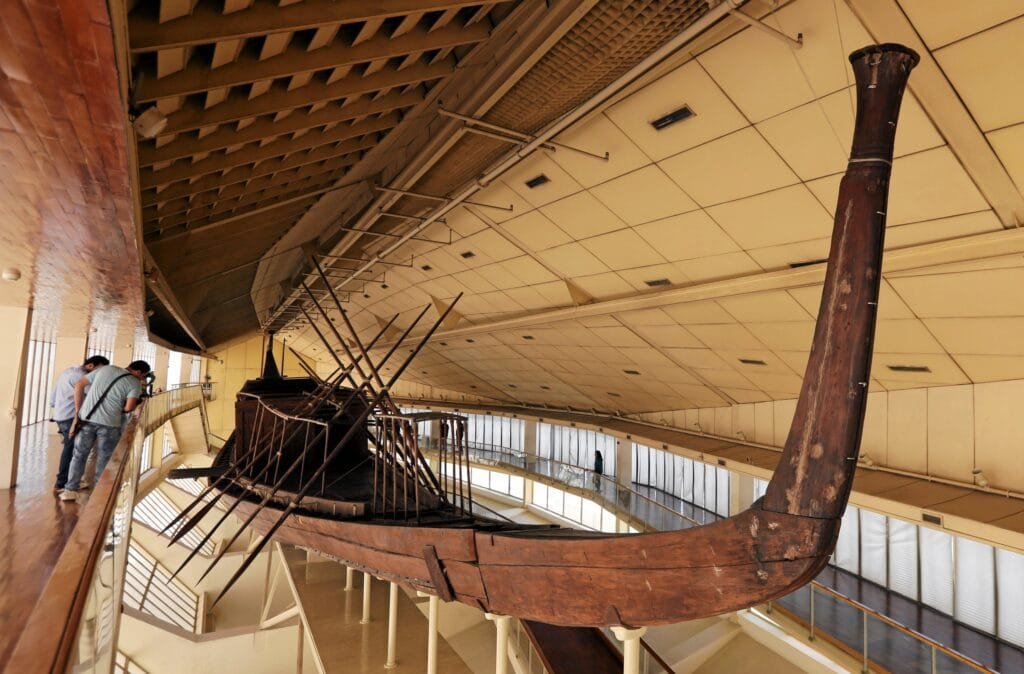
Buried for over 4,500 years beneath the shifting sands at the foot of the Great Pyramid of Giza, the Solar Boat of Khufu is perhaps the most significant maritime discovery in the history of archaeology. Discovered in 1954 by the Egyptian archaeologist Kamal el-Mallakh, this magnificent vessel was found dismantled into 1,224 individual pieces, meticulously arranged in a sealed limestone pit. Made of fine Lebanese cedar wood, the boat measures approximately 43 meters in length, representing the pinnacle of Ancient Egyptian shipbuilding and engineering. Unlike any other artifact from the Old Kingdom, the solar boat offers a tangible, physical link to the sophisticated craftsmanship and deep spiritual beliefs of the 4th Dynasty. It was not merely a royal barge; it was a “vessel of eternity,” designed to carry the soul of the resurrected Pharaoh Khufu across the celestial skies in his journey to join the sun god, Ra.
The story of the Khufu Solar Boat is a testament to both ancient genius and modern perseverance. From its incredible preservation in a vacuum-sealed environment to the decade-long labor of reassembling it like the world’s most complex jigsaw puzzle, the boat has captivated the world’s imagination. Its recent, high-tech relocation from the Giza Plateau to its new, state-of-the-art home at the Grand Egyptian Museum (GEM) in 2021 marked a new chapter in its long history, ensuring its protection for future generations. This article will provide an exhaustive exploration of the boat’s discovery, its complex “sewn” construction, its symbolic role in the Egyptian afterlife, and the modern science used to keep this fragile wooden masterpiece intact. Join us as we set sail on a journey through time to uncover the secrets of the oldest, largest, and best-preserved ship from antiquity.
1: The Discovery of 1954 – Kamal el-Mallakh’s Moment of Glory
The story of the Khufu Solar Boat began on a quiet morning in May 1954, an event that would change Egyptian archaeology forever. While clearing sand and debris from the southern side of the Great Pyramid, the Egyptian archaeologist and architect Kamal el-Mallakh noticed a row of massive limestone blocks that seemed out of place. Suspecting something significant lay beneath, he bored a small hole through one of the blocks and lowered a mirror to catch the sunlight. What he saw was the unmistakable scent of Lebanese cedar and the dark, preserved shapes of ancient wood. El-Mallakh had discovered one of two hidden pits, vacuum-sealed with 41 limestone slabs, each weighing around 18 tons. This discovery was a worldwide sensation; it was the first time an intact royal vessel from the Old Kingdom had been found, untouched by looters or the elements for over 4,500 years. The discovery was particularly significant because it proved that the pyramid complex was not just a tomb, but a functional spiritual machine that included naval elements. The boat was found dismantled into 1,224 individual pieces, neatly stacked in thirteen layers, accompanied by coils of papyrus rope and mats. This systematic dismantling suggested that the boat was intended to be "reassembled" in the afterlife, much like a ritualistic puzzle. For el-Mallakh, the discovery was the culmination of years of dedicated research on the Giza Plateau. Today, his name is forever linked to the vessel, and his meticulous documentation of the find allowed modern restorers to begin the grueling task of putting the ship back together—a process that would eventually take nearly 20 years of painstaking labor.
2: Construction Without Nails – The Ingenious "Sewn" Technique
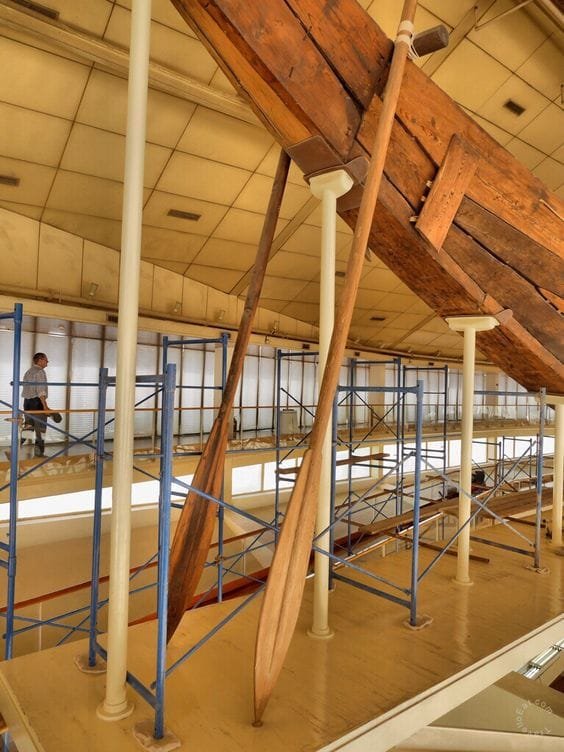
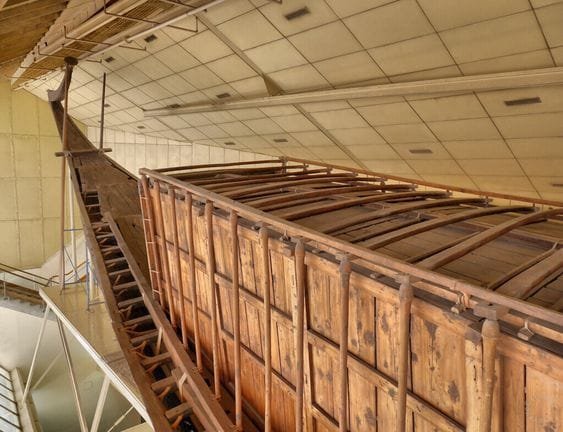
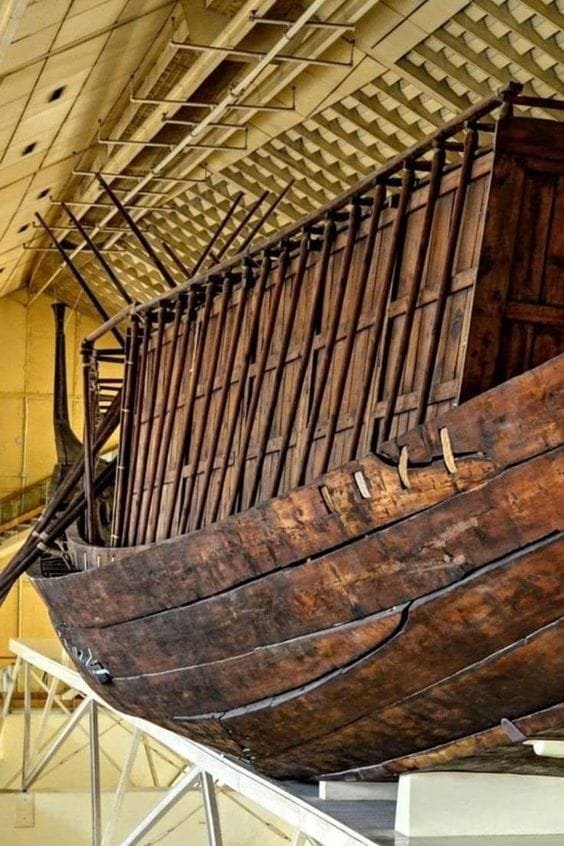
One of the most mind-boggling aspects of the Solar Boat of Khufu is its construction method. To the surprise of modern maritime engineers, the boat was built entirely without the use of metal nails or wooden pegs to join the planks. Instead, the ancient Egyptian shipbuilders utilized a sophisticated "sewn" or "lashed" technique. The planks of Lebanese cedar were carved with internal U-shaped channels through which thousands of meters of halfa-grass and papyrus rope were threaded. This allowed the hull to be held together by tension. This was not a primitive design but a highly advanced one; when the wood was placed in water, it would swell, causing the ropes to tighten and creating a completely watertight seal. This ancient maritime engineering allowed the ship to be flexible yet incredibly strong. The boat features a flat-bottomed hull with no keel, a design perfectly suited for the calm but shallow waters of the Nile. However, the sheer size of the vessel—43.4 meters long and 5.9 meters wide—suggests that it was capable of significant voyages. For the technical traveler, seeing the cross-section of the boat reveals the genius of the 4th Dynasty craftsmen who understood the properties of wood and water long before the birth of modern naval science. The "sewn" technique is a hallmark of Pharaonic technology, showing that the builders of the pyramids were just as masterful on the water as they were on land.
3: The Cedar of Lebanon – Sourcing Materials for a King
The Khufu Solar Boat is a testament to the extensive trade networks of the Old Kingdom. The vessel is primarily constructed from high-quality cedar of Lebanon (Cedrus libani), a wood prized in antiquity for its straight grain, pleasant aroma, and resistance to rot and insects. Since Egypt lacked large forests of such sturdy timber, the Pharaohs had to commission massive expeditions to the Levant (modern-day Lebanon) to acquire it. Ancient inscriptions, such as the Palermo Stone, record that King Sneferu, Khufu’s father, sent a fleet of 40 ships to bring back cedar. This highlights the immense wealth and logistical power of the Egyptian state during the Pyramid Age; they were capable of organizing international trade routes just to source the materials for a single royal ritual. The use of imported cedar was a powerful status symbol. In the eyes of the ancient Egyptians, using wood from a distant, mountainous land for the king's boat added to its divine and exotic nature. Along with cedar, the boat also utilized Egyptian sycamore for certain internal components and local halfa grass for the ropes. For the cultural tourist, the boat represents a bridge between Egypt and the wider Mediterranean world. It reminds us that Giza was not an isolated desert site, but the heart of a global empire that commanded resources from across the known world. Standing beside the boat, one can still catch a faint, sweet scent of the cedar—a 4,500-year-old aroma that connects the modern visitor directly to the lush forests of Lebanon and the ambitious trade missions of Pharaoh Khufu.
4: The Symbolic Journey – The Boat in Egyptian Mythology
In the spiritual landscape of Ancient Egypt, the Khufu Solar Boat was far more than a mere physical vessel; it was a metaphysical tool designed to ensure the King's survival in the afterlife. The Egyptians believed that the deceased Pharaoh needed a way to traverse the celestial Nile, mirroring the journey of the sun god, Ra. There are two primary theories regarding the boat's purpose: some see it as a "funerary barge" used to transport Khufu’s body from Memphis to Giza, while the more widely accepted view is that it was a Solar Barque. In this role, the ship was a religious icon intended to carry the King’s soul through the daily cycle of rebirth—sailing across the sky during the day and navigating the perils of the underworld at night. This mythological concept makes the boat an essential component of the Great Pyramid complex, functioning as part of a giant spiritual machine. Its presence beside the pyramid represents the balance between the elements; while the pyramid anchored the King to the earth, the boat provided him with the mobility of the gods. For the spiritual traveler, viewing the boat offers a profound window into the Pharaonic psyche, where death was not an end, but the beginning of a grand, cosmic voyage that required the same level of engineering precision as the construction of the pyramids themselves.
5: The Restoration Challenge – Reassembling the World’s Largest Puzzle
When the pieces of the Khufu Solar Boat were first extracted from their limestone pit, restorers faced a task unprecedented in archaeological history. While the cedar planks were remarkably preserved, they were extremely fragile and sensitive to environmental changes after 4,500 years of isolation. There were no "instruction manuals" or diagrams to explain how the 1,224 individual pieces fit together. The scientific team had to study every single fragment, matching the stitch holes and identifying the pressure points of the original ropes. The process was akin to solving the world’s most complex three-dimensional jigsaw puzzle, with some individual planks reaching lengths of over 20 meters. The reconstruction of the vessel took nearly two decades of painstaking labor. It required immense patience and a deep understanding of ancient chemistry, as the wood had to be treated with specialized consolidants to prevent it from warping or crumbling upon contact with the air. This feat was not merely an act of repair, but a process of "reverse engineering" that allowed us to understand exactly how the ancients mastered naval buoyancy. The success of this project remains a point of pride for Egyptian conservators, proving to the international community that they possess the elite expertise required to handle the most delicate and rare artifacts of human history.
6: Hag Ahmed Youssef – The Mastermind of Restoration
No history of the Khufu Boat is complete without honoring the genius of Hag Ahmed Youssef, the chief restorer who dedicated his life to bringing this vessel back to its former glory. Hag Ahmed was not just a technician; he was a visionary researcher who realized that to rebuild the boat, he had to think like an ancient Egyptian shipwright. He spent years visiting traditional boat-building yards along the Nile, studying the fishing boats of Marsa Matrouh, and observing how modern sailors used ropes to lash their timber. He understood that the secret to the boat's integrity lay in the "living traditions" of Egyptian craftsmanship that had survived for millennia. Under his expert guidance, the boat was reassembled without a single metal nail, exactly as it had been built during the Old Kingdom. He oversaw every detail, from the treatment of the Lebanese cedar to the precise tension of the halfa-grass ropes that held the hull together. Hag Ahmed Youssef remains an unsung hero to many, but his work on the Solar Barque stands as a testament to his brilliance. For visitors to the Grand Egyptian Museum, his story adds an inspiring human dimension to the artifact, showcasing a bridge of knowledge that connects a master engineer from the 4th Dynasty with a master restorer from the 20th century.
7: Design Features – Oars, Cabin, and Deck House
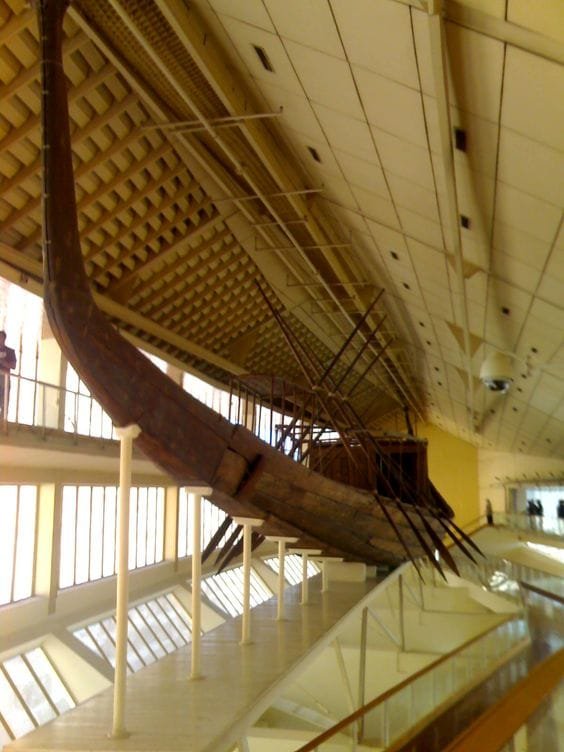
The Khufu Solar Boat is a masterpiece of functional elegance, boasting features that reveal the sophisticated lifestyle of the Old Kingdom elite. The vessel is equipped with twelve massive oars: ten intended for rowing and two larger ones at the stern to serve as rudders for steering. At the center of the deck stands a 9-meter-long main cabin, or "deck house," which is enclosed by a framework of wooden pillars. This cabin was likely covered with linen or papyrus mats to provide shade for the Pharaoh or his high priests during ritualistic use. At the bow, there is a smaller, separate canopy that may have served as a lookout station for the navigator. What is most striking about the design is the artistic finish. Both the prow and the stern are adorned with tall, elegant wooden posts shaped like papyrus stalks, a signature motif of Ancient Egyptian art. These decorative elements symbolize the marshes of the Nile from which Egyptian civilization sprang. The internal structure is equally impressive, featuring a complex system of cross-beams that provided stability to the hull. For the architectural traveler, the boat is a lesson in proportions; despite its massive size, it maintains a sleek, aerodynamic silhouette that suggests it was built for speed as much as for ceremony. Every oar and every plank was carved with an intimate understanding of hydrodynamics, proving that Khufu’s engineers were masters of both the desert and the river.
8: The Scientific Marvel – Why Did the Wood Survive?
One of the most frequent questions from visitors is how organic material like wood could survive for over 4,500 years without rotting into dust. The answer lies in the incredible engineering of the limestone pits. When the 1,224 pieces of the boat were placed in the pit, the ancient workers sealed the chamber with 41 massive limestone slabs. These slabs were then hermetically sealed with a special mortar made of lime and gypsum, creating an airtight, vacuum-like environment. This prevented the entry of oxygen and moisture, which are the primary catalysts for the growth of fungi and bacteria that cause wood rot. Furthermore, the natural environment of the Giza Plateau played a role. The dry, stable temperature of the limestone bedrock acted as a natural preservative. When Kamal el-Mallakh first breached the pit in 1954, he famously reported smelling the distinct, fresh aroma of Lebanese cedar, as if the wood had been cut only yesterday. This level of preservation is a scientific anomaly and has allowed modern researchers to study the cellular structure of the wood and the chemical composition of the ancient ropes. For the science-minded tourist, the solar boat is a miracle of "passive preservation," showing that the ancient Egyptians were masters of environmental control long before the invention of modern climate-controlled museum cases.
9: The First Museum – The Giza Solar Boat Museum
For decades, the vessel was housed in a specially constructed facility known as the Giza Solar Boat Museum, located precisely over the spot where the boat was discovered, just south of the Great Pyramid. This glass-and-concrete structure was a landmark of the plateau for over 50 years. While it allowed millions of people to see the boat in its historical context, the building eventually presented conservation challenges. The large glass windows, while beautiful, made it difficult to regulate the internal temperature and humidity, and the vibration from the thousands of tourists visiting the pyramids daily was a constant concern for the fragile cedar wood. The decision to eventually move the boat was driven by a need for a more secure and technologically advanced environment. However, the original museum served a vital role in educating the world about Old Kingdom maritime history. It allowed visitors to look down from balconies at the hull, giving them a bird's-eye view of the "sewn" planks and the intricate rope work of the deck house. While that building has now been dismantled to restore the original aesthetic of the Great Pyramid's southern face, the memories of seeing the boat "floating" beside the pyramid remain a highlight for many travelers. This original site was the starting point for the boat's modern journey, leading up to its historic move to the Grand Egyptian Museum.
10: The Historic Move – Transporting the Boat to the GEM
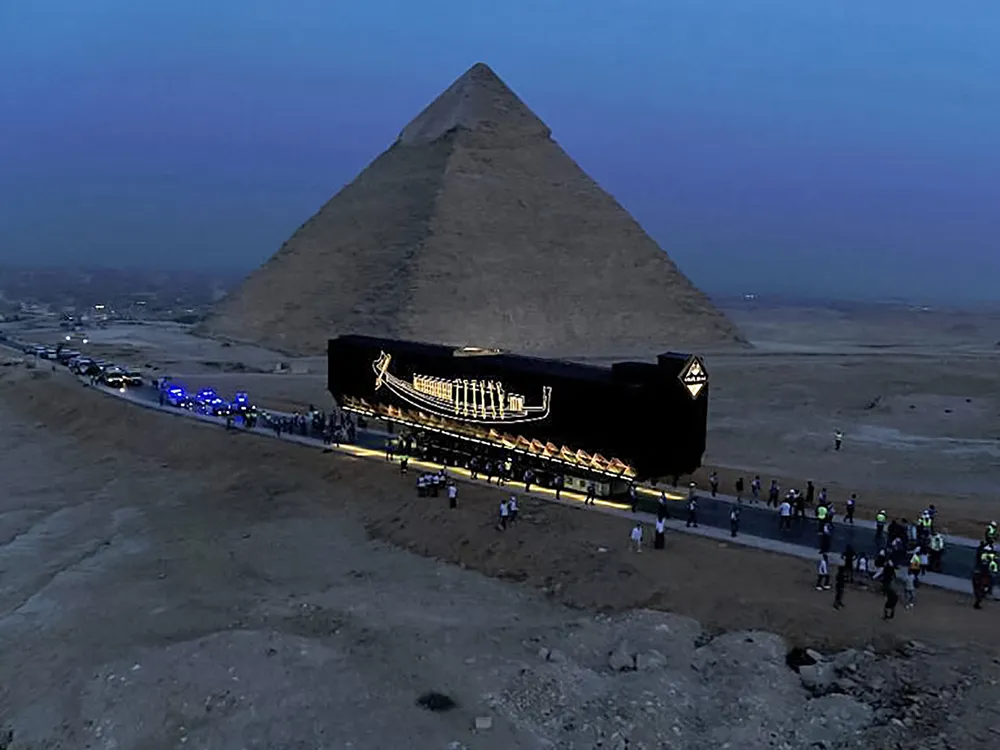
In August 2021, the Khufu Solar Boat embarked on its final journey, a 7.5-kilometer trip from its original site to the newly built Grand Egyptian Museum. This was not merely a move; it was a global engineering event. The "Solar Boat’s Last Voyage" was designed to protect the 4,500-year-old cedar wood from the slightest vibration, heat, or humidity change. The operation took approximately 48 hours, with a self-propelled modular transporter moving at a walking pace of less than 1 kilometer per hour. This precision ensured that the vessel, which survived the vacuum-sealed pits of the Old Kingdom, would not be compromised by the modern urban environment of Giza. The move was a moment of national pride, broadcast live to the world as the illuminated transport vehicle moved through the desert night. For cultural tourists, this relocation symbolizes Egypt's commitment to the future of its heritage. By moving the boat to the GEM, the Ministry of Antiquities has ensured that the artifact is no longer housed in a deteriorating 20th-century building but in a 21st-century sanctuary. This historic event serves as a bridge between the ancient tradition of transporting the Pharaoh’s bark and the cutting-edge technology of the modern age.
11: Modern Engineering – The Smart Shock-Absorbing Container
To facilitate the move, engineers developed a "smart" protective container—a massive metal cage designed to house the boat like a high-tech cocoon. This container was equipped with sophisticated shock-absorbing systems to eliminate any micro-vibrations from the road. Inside the box, a controlled environment was maintained to ensure that the moisture levels in the cedar wood remained constant. Sensors monitored the temperature and structural integrity in real-time, transmitting data to a command center throughout the journey. This was the first time in history that an organic artifact of this size and age had been moved with such a high degree of technical oversight. The engineering of the container was a masterclass in heritage preservation. It had to be rigid enough to support the weight of the boat yet flexible enough to handle the slight inclines of the Giza Plateau. For those interested in the intersection of science and archaeology, the container represents the ultimate "safety net" for the past. It demonstrated that even the most fragile artifacts can be safely navigated through a modern world if the right technology is applied. This container now serves as a model for how other massive, delicate antiquities might be moved in the future, proving that Egypt is a world leader in archaeological logistics.
12: The New Display at the GEM – A Multi-Level Experience
At the Grand Egyptian Museum, the Khufu Solar Boat is housed in a dedicated building that is a marvel of contemporary museum design. Unlike the cramped quarters of its previous home, the new display area offers a breathtaking, multi-level viewing experience. Visitors can walk around the vessel on three different tiers: the ground level allows for an intimate look at the hull and the "sewn" construction, while the upper galleries provide a bird's-eye view of the deck house, the oars, and the overall aerodynamic shape of the ship. This perspective allows travelers to appreciate the boat's massive scale—longer than many modern yachts—and its elegant proportions. The display is also equipped with interactive digital screens and augmented reality features that explain the boat’s mythology and its arduous reconstruction process. The lighting is carefully calibrated to highlight the natural grain of the Lebanese cedar without causing UV damage. For the luxury traveler, the GEM’s boat exhibit is a centerpiece of the museum experience, offering a quiet, reverent space to contemplate the nautical genius of the Pharaohs. Standing on the top balcony, looking down at the vessel that was meant to sail the stars, one truly understands the ambition of the 4th Dynasty and the eternal legacy of King Khufu.
13: The Second Boat Pit – A Modern Discovery
While the world marvels at the first reconstructed vessel, a significant part of the story remains hidden in the "Second Boat Pit." When Kamal el-Mallakh discovered the first boat in 1954, he also identified a second rectangular pit adjacent to it. However, this second chamber remained sealed for decades to ensure its preservation until technology caught up. It wasn't until 1987 that a team from the National Geographic Society used a borescope to confirm that a second, smaller vessel was indeed inside. This second ship was found in a much more deteriorated state than its famous sibling, largely due to a slight breach in the pit’s seal that allowed air and moisture to seep in over the centuries. In 2011, a joint Egyptian-Japanese team from Waseda University began the delicate process of excavating this second boat. Using specialized cranes and climate-controlled tents, they have spent years lifting the fragile cedar fragments. The Second Solar Boat offers a unique scientific opportunity to study ancient wood that hasn't been subjected to previous restoration attempts. For the archaeological enthusiast, the existence of this "twin" boat suggests that the solar journey of the King required a fleet, perhaps one for the day and one for the night. As the restoration of this second vessel continues, it promises to yield even more data about Old Kingdom naval technology and the ritualistic life of the Giza Plateau.
14: Maritime Archaeology – Impact on Ancient Trade History
The Khufu Solar Boat has fundamentally rewritten the history books regarding ancient maritime capabilities. Before its discovery, many historians believed that Old Kingdom ships were primitive river craft. However, the sheer size, sophisticated hull design, and the use of imported Lebanese cedar prove that the Egyptians were capable of deep-water navigation and international trade as early as 2500 BC. The boat's "sewn" construction provided the necessary flexibility to withstand the stresses of the open sea, suggesting that the Pharaohs had a reach that extended far beyond the banks of the Nile. This discovery shifted the focus of maritime archaeology, highlighting Egypt as a pioneer of global naval engineering. Furthermore, the boat provides physical evidence of the logistical complexity of the 4th Dynasty. To build such a vessel, the state had to coordinate wood shipments from the Levant, rope production from local farmers, and the labor of master shipwrights. It represents a "prestige project" that rivaled the pyramids in its consumption of resources. For economic historians, the boat serves as a proxy for the wealth of the Egyptian state; only a highly organized and affluent society could afford to bury such a functional and expensive masterpiece in the sand. This vessel proves that the Egyptians were not just masters of stone, but also masters of the wind and the waves, paving the way for the later maritime expansions of the Middle and New Kingdoms.
15: The Boat in Modern Media – Documentaries and Global Fame
Because of its spectacular preservation and the high-tech nature of its recent move, the Khufu Solar Boat has become a superstar of modern media. It has been the subject of numerous high-budget documentaries by National Geographic, the BBC, and the Discovery Channel, which have used CGI to "virtually" sail the boat across the Nile and the heavens. These films have helped demystify the complex "sewn" construction for a global audience, making the boat one of the most recognizable artifacts of the ancient world. In the digital age, the boat has also found a home in educational apps and VR experiences, allowing students to explore the deck of the King’s ship from anywhere in the world. The global fame of the solar boat peaked during its 2021 relocation, which was live-streamed to millions of viewers. This event transformed a piece of ancient wood into a symbol of modern Egyptian engineering and cultural pride. For the tech-savvy traveler, the boat is a perfect example of how archaeology can be made exciting through storytelling and cinematography. It isn't just a relic in a museum; it is a "media icon" that represents the mystery of the pyramids and the eternal human desire for exploration. Whether through a 4K documentary or a social media reel, the image of the solar boat continues to inspire wonder, inviting the world to participate in the ancient Pharaoh’s journey toward the stars.
16: Visiting Tips – Navigating the Solar Boat Experience
To witness the Khufu Solar Boat in its new glory, travelers should head to the Grand Egyptian Museum (GEM), as it is no longer located on the Giza Plateau. Because the boat is housed in a separate, specialized wing of the museum, it is highly recommended to check if your general museum ticket includes the boat exhibit or if a separate supplement is required. To avoid the peak crowds, the best time to visit is during the early morning hours on weekdays. The exhibit is designed for high capacity, but the quietest moments offer a more reverent atmosphere to appreciate the ancient cedar’s aroma and the scale of the hull. For the international traveler, the museum provides professional guided tours in multiple languages that dive deep into the maritime history of the Old Kingdom. Photography is generally permitted, but the use of flash is strictly forbidden to protect the light-sensitive wood. Accessibility is excellent; the multi-level viewing platforms are equipped with elevators, ensuring that everyone can see the boat from every angle. After visiting the boat, many tourists find it helpful to visit the museum’s gift shop, which offers high-quality replicas and scholarly books on the boat's discovery. Planning for at least 60 to 90 minutes for the boat wing alone will ensure you don't miss the intricate details of the 4,500-year-old joinery.
17: The Preservation Future – Safeguarding Wood for the Next Millennium
Maintaining the Solar Boat of Khufu is a never-ending scientific challenge. Unlike stone, ancient wood is a "living" material that reacts to the slightest change in its environment. The GEM’s new boat facility is essentially a giant, high-tech climate chamber. It utilizes advanced HVAC systems to maintain a constant relative humidity of approximately 50-55% and a stable temperature to prevent the cedar from expanding or contracting, which could snap the ancient papyrus ropes. Sophisticated air filtration systems also ensure that dust and pollutants are kept away from the delicate surfaces of the hull. Future conservation efforts are looking toward nanotechnology and non-invasive chemical stabilizers to further strengthen the wood fibers. The boat is also monitored by a network of laser sensors that detect any structural shifting in real-time. This level of modern conservation science is what makes the GEM one of the leading heritage institutions in the world. For the eco-conscious and science-oriented visitor, knowing that the museum uses sustainable, energy-efficient systems to power these vital conservation tools adds another layer of appreciation. The goal is simple but ambitious: to ensure that the boat remains in the same pristine condition for the next thousand years as it was when Kamal el-Mallakh first peered into the limestone pit in 1954.
18: Conclusion – The Boat as a Vessel of Human Ingenuity
As we look back at the 18-paragraph saga of the Khufu Solar Boat, it stands as more than just an archaeological find; it is a monument to the limitless reach of human ambition. It represents a time when humanity looked at the desert and saw a plateau of pyramids, and looked at the sky and saw a river of stars. The boat is the physical manifestation of the Pharaoh’s desire to conquer not just the land, but time and death themselves. It is a masterpiece of nautical engineering that proves our ancestors possessed a sophisticated understanding of the natural world that still commands our respect today. For every visitor who stands before its towering prow, the boat serves as a reminder of our shared human journey. It is a vessel that has successfully sailed across four and a half millennia to tell us its story. By preserving it within the Grand Egyptian Museum, Egypt has given the world a gift of continuity—a bridge made of cedar and rope that connects the modern age to the dawn of civilization. The solar boat remains, quite literally, a vessel of eternity, inviting us all to imagine our own voyage across the horizon of history.