

- Excursions in Egypt
- Egypt Tour Packages
- Cairo Tours and Excursions
- Hurghada Tours and Excursions
- Soma Bay Tours and Excursions
- Makadi Bay Tours and Excursions
- Sahl Hasheesh Tours and Excursions
- El Gouna Tours and Excursions
- Marsa Alam Tours and Excursions
- Port Ghalib Tours and Excursions
- El Quseir Tours and Excursions
- Dendera and Abydos Day Tours
- Aswan Tours and Excursions
- Luxor Tours and Excursions
- Alexandria Egypt Tours and Excursions
- Sharm El Sheikh Tours and Excursions
- Top Rated Egypt Tours in 2026
- Optional Excursions in Egypt
- Private Transfer
- Blogs About egypt
- Ancient Egypt
- Why Egypt Is One of the Safest Countries to Visit in the Middle East
- What You Need To know Before Your First Trip To Egypt
- Egypt Travel Costs in 2026 Full Budget Guide
- Top 10 Tourist Activities in Egypt
- Top 50 Activities You Can’t Miss in Egypt in 2026
- The Guide to Guided Tours in Egypt
- Egypt’s Ancient and Modern History
- The Nile River
- The Deserts of Egypt
- Historical Sites in Egypt
- Cairo
- Alexandria
- Luxor
- Aswan
- The Red Sea
- Dendera Temple
- El Fayoum Oasis
- Bahariya Oasis
- Siwa Oasis
- Al Alamein
- Marsa Matruh
- Ancient Egyptian gods
- famous Egyptian dishes
- UNESCO World Heritage sites
- About Us
- Egypt Hotels and Resorts
- Excursions in Egypt
- Egypt Tour Packages
- Cairo Tours and Excursions
- Hurghada Tours and Excursions
- Soma Bay Tours and Excursions
- Makadi Bay Tours and Excursions
- Sahl Hasheesh Tours and Excursions
- El Gouna Tours and Excursions
- Marsa Alam Tours and Excursions
- Port Ghalib Tours and Excursions
- El Quseir Tours and Excursions
- Dendera and Abydos Day Tours
- Aswan Tours and Excursions
- Luxor Tours and Excursions
- Alexandria Egypt Tours and Excursions
- Sharm El Sheikh Tours and Excursions
- Top Rated Egypt Tours in 2026
- Optional Excursions in Egypt
- Private Transfer
- Blogs About egypt
- Ancient Egypt
- Why Egypt Is One of the Safest Countries to Visit in the Middle East
- What You Need To know Before Your First Trip To Egypt
- Egypt Travel Costs in 2026 Full Budget Guide
- Top 10 Tourist Activities in Egypt
- Top 50 Activities You Can’t Miss in Egypt in 2026
- The Guide to Guided Tours in Egypt
- Egypt’s Ancient and Modern History
- The Nile River
- The Deserts of Egypt
- Historical Sites in Egypt
- Cairo
- Alexandria
- Luxor
- Aswan
- The Red Sea
- Dendera Temple
- El Fayoum Oasis
- Bahariya Oasis
- Siwa Oasis
- Al Alamein
- Marsa Matruh
- Ancient Egyptian gods
- famous Egyptian dishes
- UNESCO World Heritage sites
- About Us
- Egypt Hotels and Resorts
Welcome to
The Architectural Sovereignty of the Ancient World: An Introduction to Human Ingenuity
The Seven Wonders of the Ancient World represent the ultimate canon of human achievement, serving as a breathtaking testament to the boundless creativity, engineering brilliance, and artistic ambition of early civilizations across the Mediterranean and Mesopotamia. These iconic monuments were not merely physical structures; they were the “visual signatures” of the empires that produced them—Egypt, Greece, Iraq, and Turkey—reflecting their religious devotion, political power, and scientific mastery. The traditional list of wonders, primarily compiled by ancient Greek travelers and historians like Herodotus and Callimachus of Cyrene, sought to document the most awe-inspiring sights that a traveler of the classical era could behold. From the staggering verticality of the Great Pyramid of Giza to the technical complexity of the Lighthouse of Alexandria, these wonders pushed the limits of what was thought possible in an age without modern machinery. They bridged the gap between the earthly and the divine, manifesting as colossal statues of gods, lush gardens in arid deserts, and towering beacons that guided sailors across treacherous seas. Although only one of these original marvels—the Great Pyramid—stands today as a silent sentinel of history, the legacy of the Seven Wonders endures in our collective imagination. They remind us that the human spirit has always sought to defy the limitations of nature and time, creating monuments that inspire wonder thousands of years after their initial conception. To study these wonders is to explore the very foundations of global architecture and the enduring desire of mankind to leave an indelible mark upon the world, ensuring that their names and accomplishments would echo through the corridors of eternity.
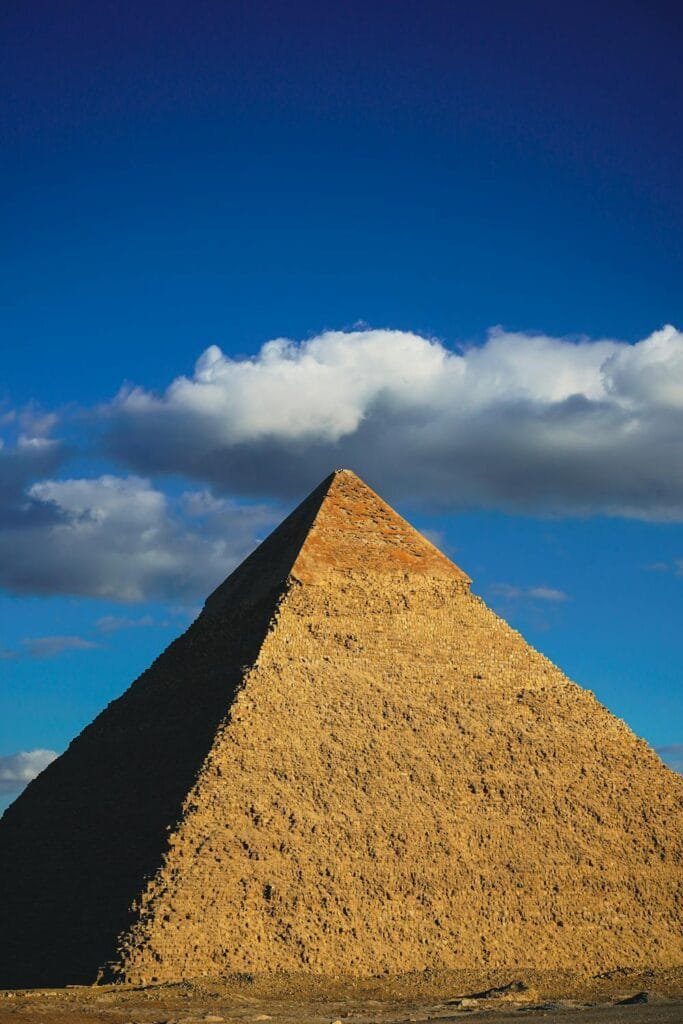
1. The Great Pyramid of Giza: The Eternal Sentinel of Stone
Shutterstock The Great Pyramid of Giza, the oldest and only surviving member of the original Seven Wonders, remains the ultimate symbol of ancient Egyptian engineering and royal ambition. Constructed around 2580 BC for the Pharaoh Khufu, this colossal structure was the tallest man-made building in the world for over 3,800 years, a record that was only broken by the Lincoln Cathedral in the 14th century. The pyramid is a mathematical marvel; its base is aligned almost perfectly to the four cardinal points of the compass, and its dimensions involve advanced geometric ratios that suggest a deep understanding of the relationship between the earth and the stars. It is estimated that approximately 2.3 million blocks of limestone and granite were used, with some stones weighing as much as 70 tons. The sheer scale of the logistics—quarrying the stone, transporting it across the Nile, and lifting it to a height of 146 meters—defies modern imagination. Contrary to popular myths of slave labor, archaeological evidence suggests the pyramid was built by a highly organized workforce of skilled laborers and seasonal farmers who were well-fed and provided with medical care. Originally, the pyramid was encased in polished white Tura limestone, which would have made the structure gleam like a brilliant diamond under the scorching Egyptian sun. Inside, the pyramid contains a complex system of ascending and descending passages, the grand gallery, and the King’s Chamber, which still houses a red granite sarcophagus. The Great Pyramid is more than a tomb; it is a profound expression of the Egyptian belief in the divinity of the King and the permanence of the soul, standing as a physical bridge between the mortal world and the eternal heavens.
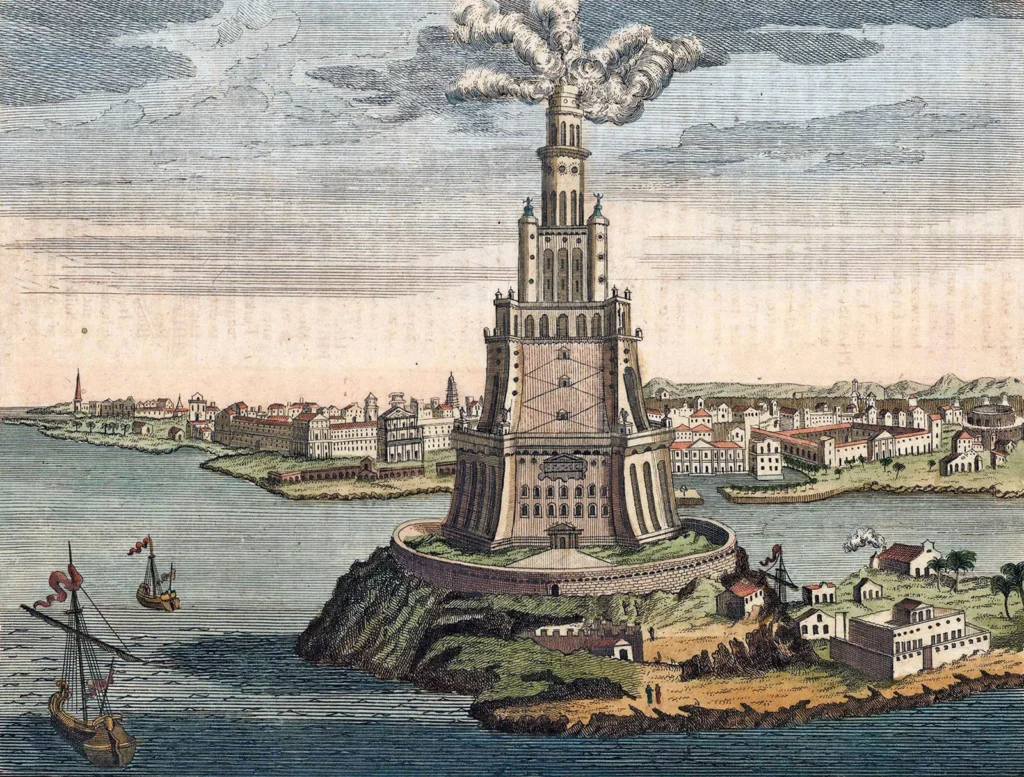
2. The Lighthouse of Alexandria: The Beacon of the Mediterranean
Standing as a monumental achievement of the Hellenistic age, the Lighthouse of Alexandria—also known as the Pharos—was the first structure of its kind and the blueprint for all future lighthouses. Built on the island of Pharos in the 3rd century BC during the reigns of Ptolemy I and II, it served as both a practical navigational aid for the bustling harbor of Alexandria and a propaganda tool showcasing the city’s scientific and economic supremacy. Designed by the architect Sostratus of Cnidus, the lighthouse rose to a staggering height of roughly 120 meters, divided into three distinct tiers: a square base, an octagonal middle section, and a circular top. At its summit, a massive bonfire was maintained, and its light was amplified by sophisticated bronze mirrors, making the beacon visible to sailors up to 50 miles away. This was a technological breakthrough of the ancient world, essentially a massive optical instrument. The Pharos was so famous that its name became the root for the word "lighthouse" in many Romance languages, such as the French phare and Spanish faro. Despite its robust construction of limestone and granite blocks leaded together, the lighthouse was eventually brought down by a series of devastating earthquakes between the 10th and 14th centuries. Its ruins eventually slipped into the Mediterranean or were repurposed for the construction of the Citadel of Qaitbay. Today, underwater archaeology continues to recover massive fragments of the lighthouse, providing a tangible link to a structure that once symbolized the union of Greek architectural beauty and Egyptian monumentalism, acting as a literal light in the dark for the ancient maritime world.
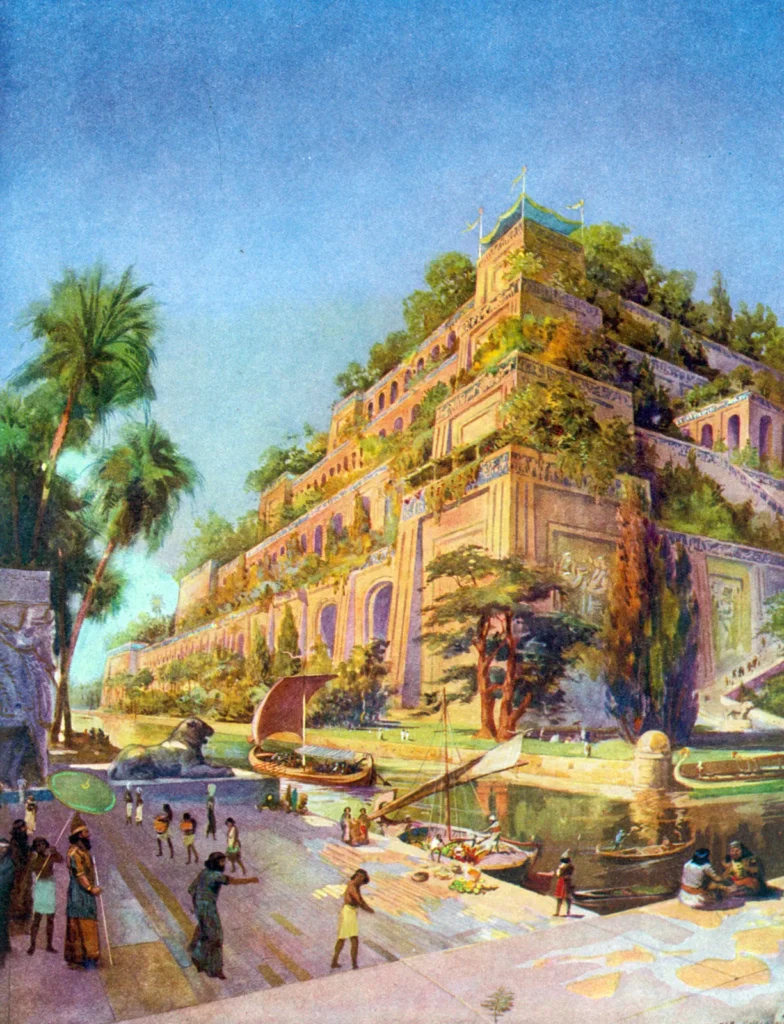
3. The Hanging Gardens of Babylon: The Mythical Verdant Paradise
The Hanging Gardens of Babylon represent the most enigmatic of all the Seven Wonders, as they are the only ones for which no definitive archaeological evidence has been found. According to ancient historians like Diodorus Siculus, the gardens were built by King Nebuchadnezzar II in the 6th century BC as a gift for his wife, Amytis of Media, who missed the green mountains of her homeland in the flat, dusty plains of Mesopotamia. The gardens were described as a series of ascending, terraced gardens that resembled a green mountain, supported by massive stone columns and vaulted ceilings. To sustain such a lush environment in the arid climate of Iraq, the Babylonians reportedly utilized a groundbreaking irrigation system, likely involving a series of water screws or chain pumps that lifted water from the Euphrates River to the highest levels of the terraces. The "hanging" aspect of the gardens actually referred to the plants overhanging the balconies, creating a lush, vertical forest that seemed to float in the air. However, the mystery remains: why do contemporary Babylonian records make no mention of such a marvel? Some modern scholars, such as Stephanie Dalley, suggest that the gardens were actually located 300 miles north in Nineveh, built by the Assyrian king Sennacherib. Others believe the gardens were a poetic exaggeration, a literary symbol of the "perfect city." Regardless of their physical location, the myth of the Hanging Gardens has endured as a powerful image of human power over nature, representing the ancient desire to create a paradise on earth through the marriage of engineering and horticulture.
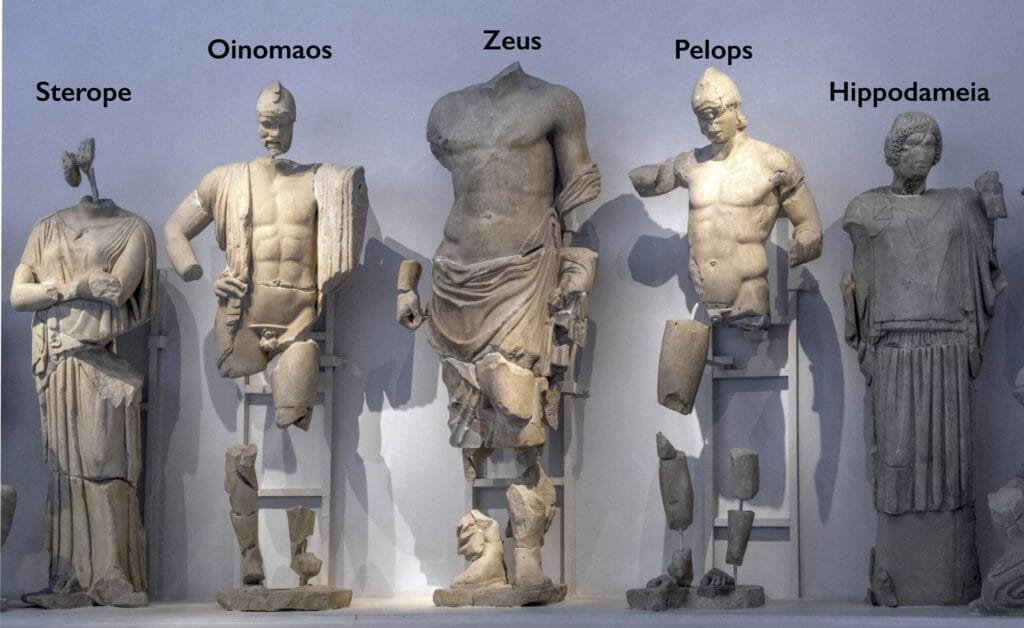
4. The Statue of Zeus at Olympia: The Divine Presence in Gold and Ivory
The Statue of Zeus at Olympia was the most celebrated religious sculpture of the ancient world, representing the absolute pinnacle of chryselephantine (gold and ivory) artistry. Created around 435 BC by the master sculptor Phidias, who also oversaw the Parthenon's construction, the statue sat within the massive Temple of Zeus in the Peloponnese region of Greece. Standing roughly 12 meters tall, the seated figure of Zeus was so large that if he had stood up, he would have unroofed the temple. The sculpture's "skin" was made of plates of polished ivory, while his robes, sandals, and beard were crafted from hammered gold. Zeus sat upon a throne of cedarwood inlaid with ebony, precious stones, and intricate carvings of mythological scenes. In his right hand, he held a figure of Nike (the goddess of victory), and in his left, a scepter topped with an eagle. The statue was not merely a work of art; it was a physical manifestation of the god's power intended to inspire religious awe in the athletes and spectators of the ancient Olympic Games. To keep the ivory from cracking in the humid climate, priests regularly anointed the statue with olive oil, which also pooled on the floor to reflect the god’s image. For eight centuries, it was considered a tragedy to die without having seen this masterpiece. The statue’s fate remains a mystery, with theories suggesting it was destroyed in a fire in the 5th century AD or moved to Constantinople and lost during a riot. Today, all that remains are the foundations of the temple and Phidias’s workshop, where molds and tools used to create this divine wonder were found, proving that even the gods depended on the genius of human craftsmen.
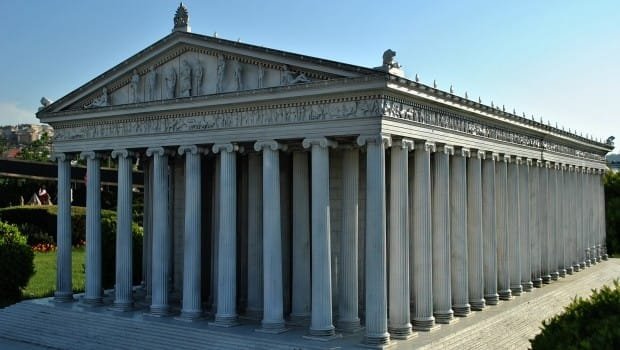
5. The Temple of Artemis at Ephesus: A Monument to Divine Grandeur
The Temple of Artemis at Ephesus was widely considered the most beautiful of all the wonders, a structure so vast and opulent that it dwarfed the contemporary Parthenon in Athens. Located in modern-day Turkey, this "Ionian" masterpiece was dedicated to Artemis, the goddess of the wilderness and hunt, but in Ephesus, she was worshipped as a unique, multi-breasted fertility deity. The temple was built almost entirely of marble, supported by 127 massive columns, each standing 18 meters high. What set this wonder apart was that many of these columns were decorated at their bases with life-sized reliefs, an unprecedented architectural luxury. The temple functioned not only as a place of worship but also as a marketplace and a sanctuary where criminals could find refuge. It was a site of immense wealth, housing masterpieces by the greatest sculptors of the age, such as Polyclitus and Pheidias. The history of the temple is one of repeated destruction and rebirth. In 356 BC, a man named Herostratus deliberately set fire to the temple, seeking to immortalize his name through an act of supreme infamy; legend says he succeeded, for the temple burned on the very night Alexander the Great was born. It was rebuilt even more grandly, only to be destroyed again by Goths in 262 AD. Today, the site is a quiet marsh where a single reconstructed column stands as a lonely reminder of its former glory. Yet, its influence persists; the temple’s massive scale and use of marble set the standard for classical architecture, symbolizing the city’s role as the commercial and spiritual gateway between the East and the West.
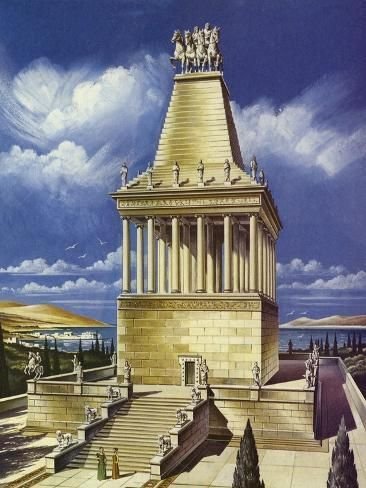
6. The Mausoleum at Halicarnassus: The Architecture of Eternal Grief
The Mausoleum at Halicarnassus was a tomb so magnificent that its name became the root for the word "mausoleum," used today to describe any grand burial structure. Built between 353 and 350 BC in modern-day Bodrum, Turkey, it was commissioned for Mausolus, a provincial governor of the Persian Empire, and his wife Artemisia II, who was also his sister. Following Mausolus’s death, Artemisia spared no expense to create a monument that would elevate his memory to the level of a god. The structure was a unique blend of three distinct architectural styles: the square base was Egyptian, the colonnade of 36 columns was Greek, and the pyramid-shaped roof was Lycian. At the very top stood a massive marble four-horse chariot carrying the statues of the royal couple. Standing 45 meters high, the Mausoleum was famous for its rich sculptural decorations; four of Greece’s greatest sculptors—Scopas, Bryaxis, Leochares, and Timotheus—each took responsibility for decorating one side of the building. This resulted in a frieze that was a masterclass in movement and emotion. The building was so sturdy that it stood for over 1,600 years until a series of earthquakes shattered it in the Middle Ages. In the 15th century, the Knights of St. John used its stones to build Bodrum Castle, and they reported finding the burial chamber, though it was looted shortly thereafter. Fragments of the colossal statues and the chariot wheels are now housed in the British Museum, providing a tactile connection to a tomb that redefined how the ancient world celebrated the transition from life to the afterlife, turning private grief into a public and permanent landmark of stone.
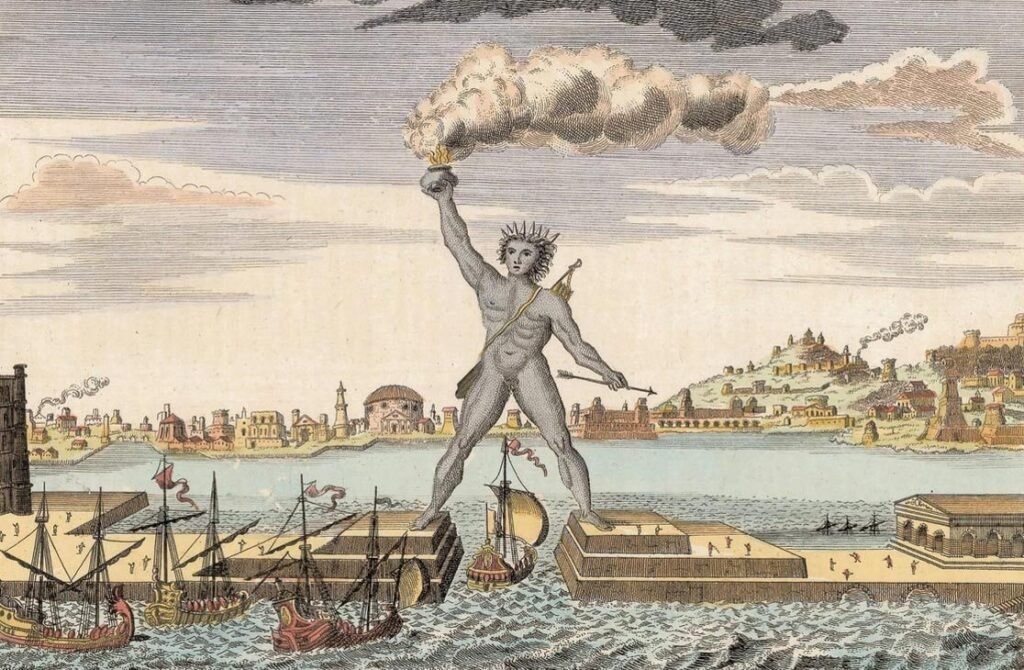
7. The Colossus of Rhodes: The Bronze Giant of the Harbor
The Colossus of Rhodes was a triumph of Hellenistic engineering and a massive symbol of freedom, built to celebrate the island's successful defense against a year-long siege by the Macedonian general Demetrius Poliorcetes. Constructed between 292 and 280 BC by the sculptor Chares of Lindos, the statue depicted the sun god Helios and stood approximately 33 meters tall—roughly the same height as the Statue of Liberty from feet to crown. It was fashioned from bronze plates over an iron framework, weighted down with stones in its hollow interior. Contrary to the popular medieval myth that the statue straddled the harbor entrance, it likely stood on a high pedestal overlooking the sea. The construction process was an ordeal in itself; as the statue rose, workers built massive earthen ramps to reach the higher sections. When it was finally completed, the bronze skin would have reflected the Mediterranean sun with a blinding brilliance, serving as a landmark for every ship entering the Aegean. Remarkably, this wonder stood for only 54 years before a violent earthquake in 226 BC snapped the giant at its knees. Even in its fallen state, the statue remained a marvel; travelers for centuries wrote about the sheer size of its broken limbs, noting that a man could barely wrap his arms around one of the thumbs. It remained on the ground for nearly 800 years until it was eventually sold for scrap metal, but its legacy as a symbol of defiance and technological scale continues to inspire the creation of massive public monuments to this day.
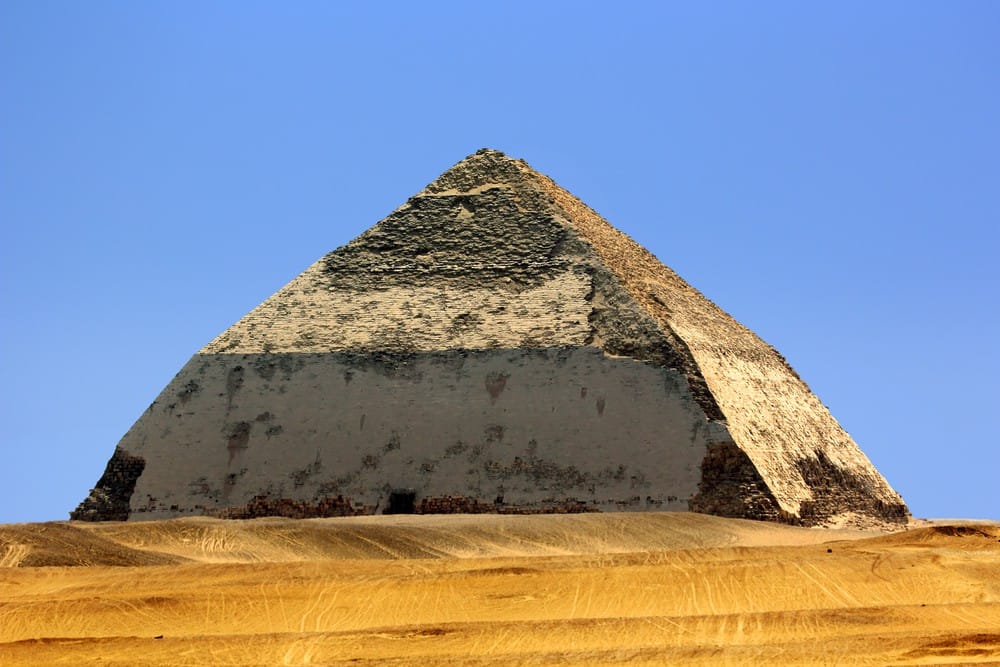
8. The Bent Pyramid at Dahshur: An Architectural Experiment
While the Great Pyramid represents the perfection of a form, the Bent Pyramid at Dahshur represents the daring and sometimes dangerous "trial and error" that made such perfection possible. Built around 2600 BC for Pharaoh Sneferu, the father of Khufu, this structure is a unique witness to the evolution of the true pyramid. It is famous for its distinct, two-stage silhouette: the lower half rises at a steep 54-degree angle, but midway up, the angle abruptly changes to a gentler 43 degrees. Most Egyptologists believe this was a desperate mid-construction adjustment; as the massive weight of the stone began to settle, cracks likely appeared in the internal chambers, threatening a catastrophic collapse. By reducing the angle, the architects lessened the vertical pressure, successfully completing the structure but leaving it with its characteristic "bent" appearance. Beyond its shape, the Bent Pyramid is significant because it still retains much of its original, smooth limestone casing—the best-preserved of any pyramid in Egypt—giving us a rare look at how these monuments appeared in antiquity. It also features two separate entrances, a unique internal design that deviates from the standard single-entry system. Though it was likely abandoned as a primary burial site in favor of the nearby Red Pyramid, the Bent Pyramid stands as a monument to human persistence, showing that even the greatest builders in history had to learn through failure and adaptation to reach the heights of the Giza plateau.
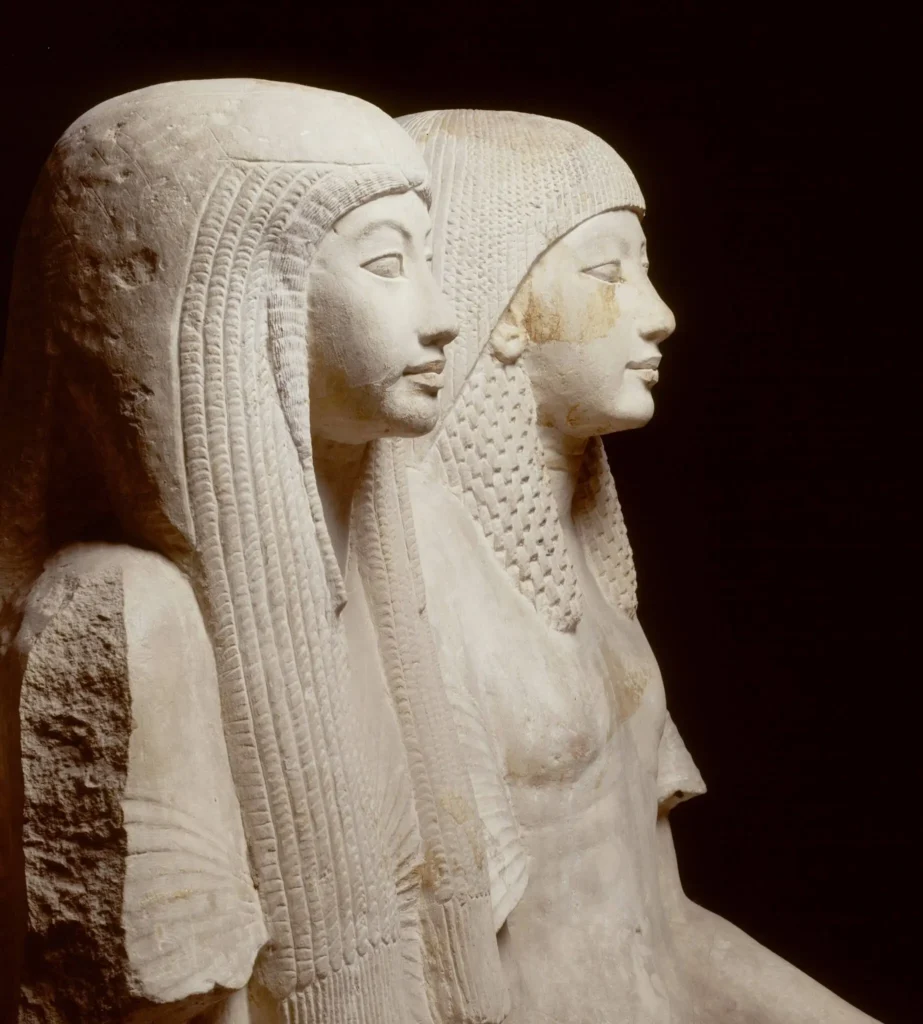
9. The Tomb of Queen Maya: A Masterpiece of New Kingdom Art
The Tomb of Queen Maya (not to be confused with the Old Kingdom Maya) is a vital archaeological treasure located in the Saqqara necropolis, offering an intimate look at the transition into the late 18th Dynasty. Maya was likely a figure of high status, possibly associated with the court of Tutankhamun or Horemheb, and her tomb is celebrated not for its external size, but for the breathtaking quality of its subterranean reliefs. The walls are adorned with some of the most refined and elegant carvings in Egyptian history, showcasing a style that blends the naturalism of the Amarna period with the formal traditionalism of the New Kingdom. These scenes depict Maya in various religious rituals, as well as daily life scenes—banquets, agricultural work, and offerings—that provide a vivid social history of the era. The preservation of the pigments is particularly remarkable, with blues, yellows, and reds still clinging to the stone, allowing us to see the world as the ancients did. The discovery of this tomb provided crucial context for the "Memphite" style of art, which flourished when the capital moved back toward the north. Unlike the royal tombs of the Valley of the Kings, which were hidden and vertical, Maya’s tomb followed a more complex architectural plan with an open courtyard and decorated chapels above ground. It remains a "wonder" of artistry, proving that the grandeur of Egypt was not found only in its massive stones, but in the delicate, masterfully carved details that sought to ensure the deceased would live forever in a world of beauty and abundance.
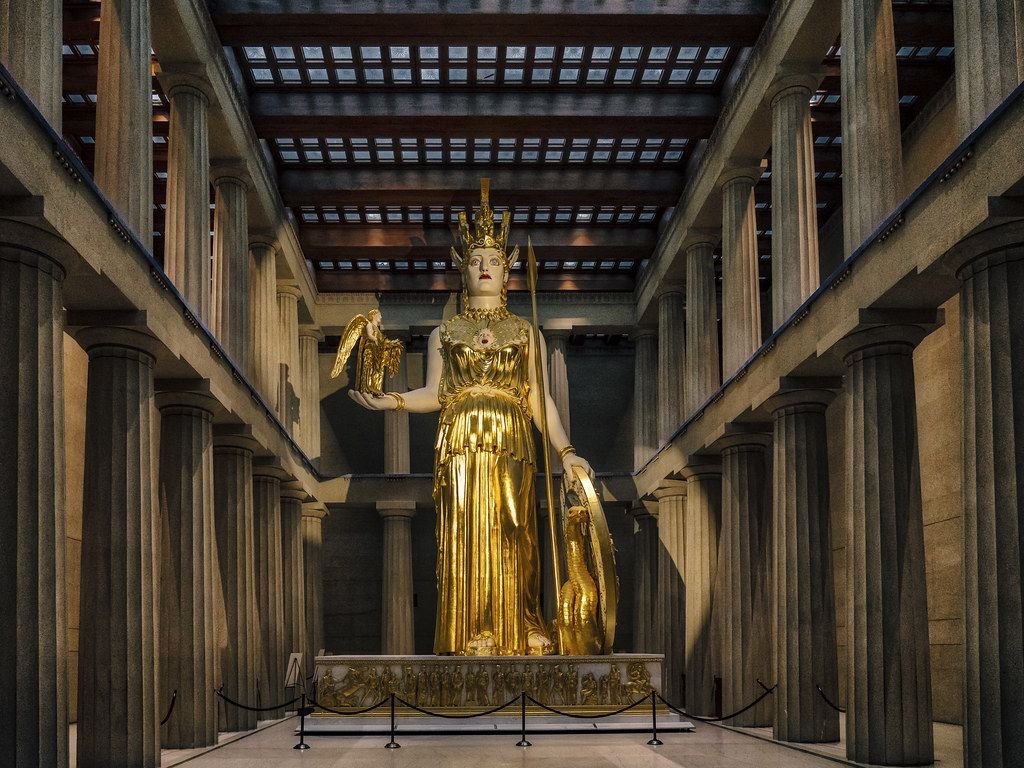
10. The Statue of Athena Parthenos: The Golden Heart of Athens
While the Statue of Zeus was the wonder of Olympia, the Statue of Athena Parthenos was the crowning jewel of the Athenian Acropolis. Designed by the legendary sculptor Phidias and dedicated in 438 BC, this colossal chryselephantine (gold and ivory) statue stood approximately 12 meters tall inside the Parthenon. Athena was depicted as a victorious warrior goddess, clad in an aegis with the head of Medusa, holding a six-foot-tall statue of Nike in her right hand and a spear in her left. At her feet rested a massive shield intricately carved with the battle between the Greeks and the Amazons. The sheer wealth invested in this monument was staggering; the gold used for her garments weighed over 1,100 kilograms and was designed to be removable so it could be weighed or even melted down during times of financial crisis. This made the statue not only a religious icon but also a literal gold reserve for the city of Athens. The ivory plates used for her skin required a high degree of craftsmanship to create seamless curves on such a massive scale. Though the statue was eventually lost—likely destroyed in a fire or dismantled during the Byzantine era—detailed descriptions and Roman-era copies have allowed historians to reconstruct its appearance. It remains a "wonder" of classical antiquity, symbolizing the peak of Athenian power, the perfection of Greek artistic proportions, and the fusion of religious devotion with immense state wealth.
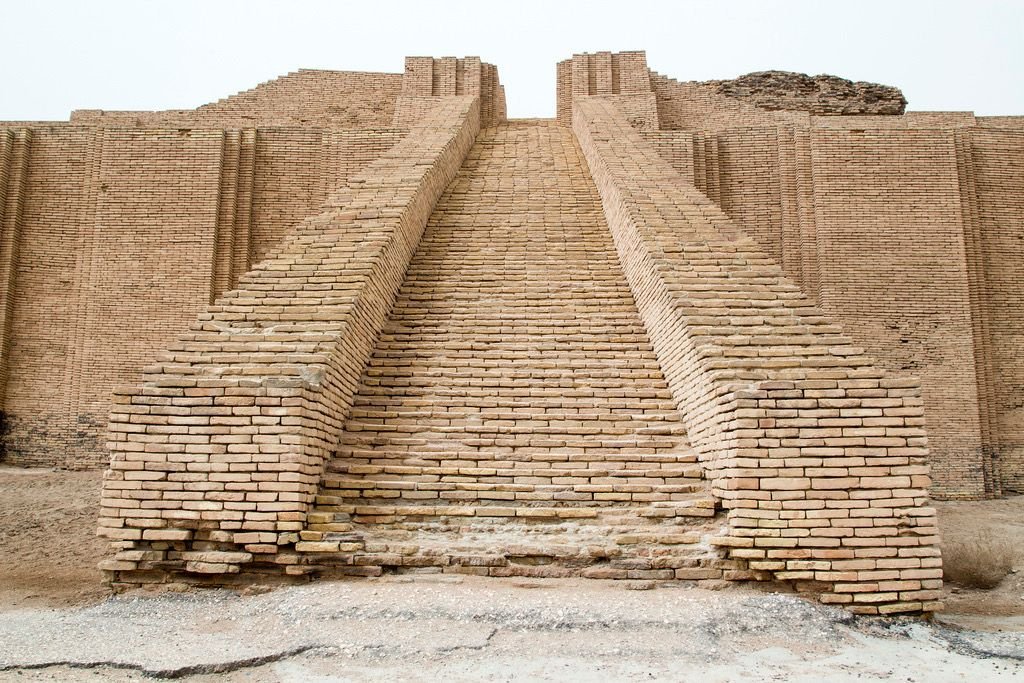
11. The Ziggurat of Ur: The Stairway to the Heavens
To understand the engineering foundations that led to the Seven Wonders, one must look to the Ziggurat of Ur in modern-day Iraq. Built during the Early Bronze Age (approximately 2100 BC) by King Ur-Nammu, this massive stepped pyramid served as a temple to the moon god Nanna. While not on the traditional Greek list of wonders, its architectural influence was profound. The ziggurat was a masterpiece of mud-brick construction, featuring three levels of terraces connected by a magnificent system of monumental staircases. To prevent the structure from collapsing due to moisture, the Sumerian engineers incorporated "weeper holes" to allow water to drain from the core, and they used layers of woven reeds and bitumen (natural asphalt) as an early form of mortar and waterproofing. The sheer precision of the outward-sloping walls was a clever optical illusion designed to make the structure appear more stable and imposing. Standing over 30 meters high in its prime, it functioned as the spiritual and administrative heart of one of the world's first true cities. The Ziggurat of Ur represents the dawn of monumental architecture; it was the precursor to the hanging gardens and the pyramids, proving that as early as the third millennium BC, human civilizations possessed the organizational and mathematical skills to build structures that aimed to touch the sky and bridge the gap between man and the divine.
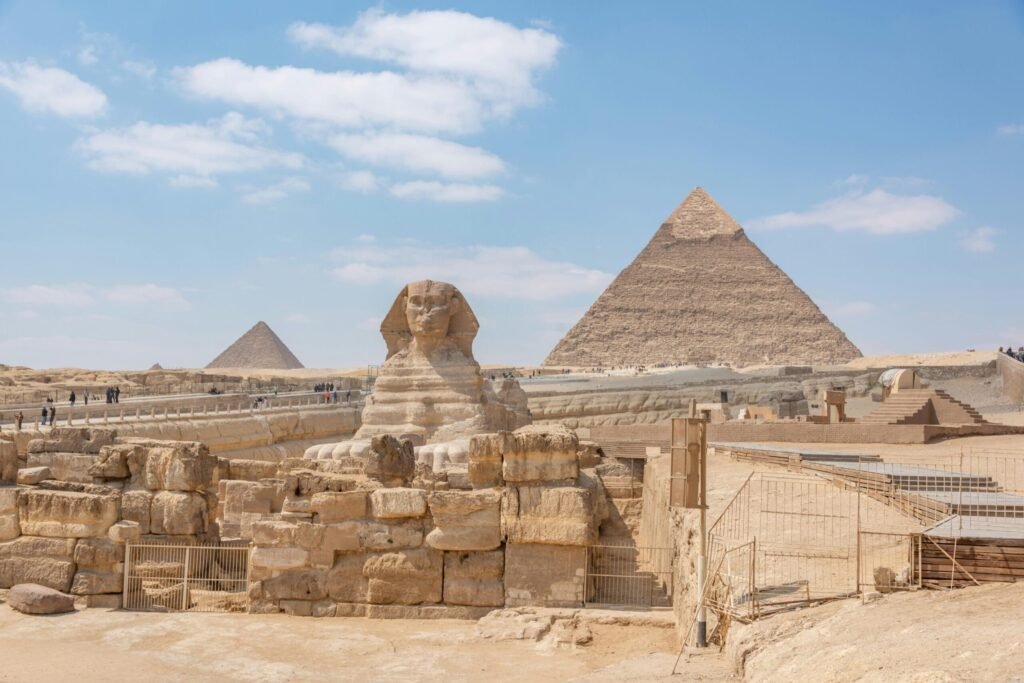
12. The Legacy of Ancient Engineering: A Reflection on Human Creativity
The story of the Seven Wonders of the Ancient World is ultimately a story of the human spirit’s refusal to accept the impossible. Whether it was the precise astronomical alignment of the Great Pyramid, the innovative hydraulics of the Hanging Gardens, or the massive bronze casting of the Colossus, these monuments represent a level of sophistication that challenges our modern assumptions about the past. They were built in an era without electricity, steel, or computers, yet they achieved a level of durability and aesthetic beauty that continues to inspire modern architects and engineers. The legacy of these wonders is found in the way they shaped the identities of their respective nations—Egypt’s eternal stability, Greece’s intellectual harmony, and Mesopotamia’s urban innovation. While time, war, and nature have reclaimed most of these structures, their influence is woven into the fabric of global culture. They taught us that architecture is the most powerful form of storytelling, capable of preserving the memory of a culture long after its language has fallen silent. As we look back at these twelve chapters of ancient history, we see that the true "wonder" is not just the stone and gold itself, but the collective human will to dream on a colossal scale and to build something that might, against all odds, survive to tell our story to future generations.