- Excursions in Egypt
- Egypt Tour Packages
- Cairo Tours and Excursions
- Hurghada Tours and Excursions
- Soma Bay Tours and Excursions
- Makadi Bay Tours and Excursions
- Sahl Hasheesh Tours and Excursions
- El Gouna Tours and Excursions
- Marsa Alam Tours and Excursions
- Port Ghalib Tours and Excursions
- El Quseir Tours and Excursions
- Dendera and Abydos Day Tours
- Aswan Tours and Excursions
- Luxor Tours and Excursions
- Sharm El Sheikh Tours and Excursions
- Top Rated Egypt Tours in 2026
- Optional Excursions in Egypt
- Private Transfer
- Blogs About egypt
- Ancient Egypt
- Historical Sites in Egypt
- Cairo
- Alexandria
- Luxor
- Aswan
- The Red Sea
- Dendera Temple
- El Fayoum Oasis
- Bahariya Oasis
- Siwa Oasis
- Al Alamein
- Marsa Matruh
- Why Egypt Is One of the Safest Countries to Visit in the Middle East
- What You Need To know Before Your First Trip To Egypt
- Egypt Travel Costs in 2026 Full Budget Guide
- Top 10 Tourist Activities in Egypt
- Top 50 Activities You Can’t Miss in Egypt in 2026
- The Guide to Guided Tours in Egypt
- Egypt’s Ancient and Modern History
- The Nile River
- The Deserts of Egypt
- Ancient Egyptian gods
- famous Egyptian dishes
- UNESCO World Heritage sites
- About Us
- Egypt Hotels and Resorts
- Excursions in Egypt
- Egypt Tour Packages
- Cairo Tours and Excursions
- Hurghada Tours and Excursions
- Soma Bay Tours and Excursions
- Makadi Bay Tours and Excursions
- Sahl Hasheesh Tours and Excursions
- El Gouna Tours and Excursions
- Marsa Alam Tours and Excursions
- Port Ghalib Tours and Excursions
- El Quseir Tours and Excursions
- Dendera and Abydos Day Tours
- Aswan Tours and Excursions
- Luxor Tours and Excursions
- Sharm El Sheikh Tours and Excursions
- Top Rated Egypt Tours in 2026
- Optional Excursions in Egypt
- Private Transfer
- Blogs About egypt
- Ancient Egypt
- Historical Sites in Egypt
- Cairo
- Alexandria
- Luxor
- Aswan
- The Red Sea
- Dendera Temple
- El Fayoum Oasis
- Bahariya Oasis
- Siwa Oasis
- Al Alamein
- Marsa Matruh
- Why Egypt Is One of the Safest Countries to Visit in the Middle East
- What You Need To know Before Your First Trip To Egypt
- Egypt Travel Costs in 2026 Full Budget Guide
- Top 10 Tourist Activities in Egypt
- Top 50 Activities You Can’t Miss in Egypt in 2026
- The Guide to Guided Tours in Egypt
- Egypt’s Ancient and Modern History
- The Nile River
- The Deserts of Egypt
- Ancient Egyptian gods
- famous Egyptian dishes
- UNESCO World Heritage sites
- About Us
- Egypt Hotels and Resorts
Welcome to
The Pyramid of Khafre: The Majestic Sentinel of Giza
While the Great Pyramid of Khufu claims the title of the largest, the Pyramid of Khafre is often regarded as the most visually striking and aesthetically preserved monument on the Giza Plateau. Built for the son of Khufu during the Fourth Dynasty, Khafre’s pyramid stands on a slightly higher bedrock, creating a clever optical illusion that makes it appear taller than its predecessor. It is most famous for the distinct “cap” of original white Tura limestone that still clings to its apex, offering a rare glimpse into the gleaming, polished splendor that once characterized the entire necropolis. For the traveler, Khafre’s complex provides a more complete understanding of the royal funerary ritual, as it is connected to the best-preserved Valley Temple in Egypt and the enigmatic Great Sphinx itself. The architecture of Khafre’s monument reflects a shift toward a more robust and rugged style; its lower courses are encased in massive blocks of pink granite, and its interior, while simpler than Khufu’s, possesses a raw, subterranean power. Standing before this second giant, one can feel the continuity of a divine dynasty that sought to anchor itself in the eternal sands. The pyramid is not just a tomb, but a focal point of a massive sacred landscape where the Pharaoh was celebrated as the “Living Horus.” To explore Khafre’s pyramid is to witness the peak of Old Kingdom confidence—a structure that balances sheer scale with a refined sense of proportion. It remains a sentinel of history, a mountain of stone that bridges the gap between the monumentalism of the past and the enduring mystery of the Sphinx, inviting every visitor to contemplate the legacy of a King who commanded the very horizon.
1. Khafre the Restorer: The Legacy of a Divine Son
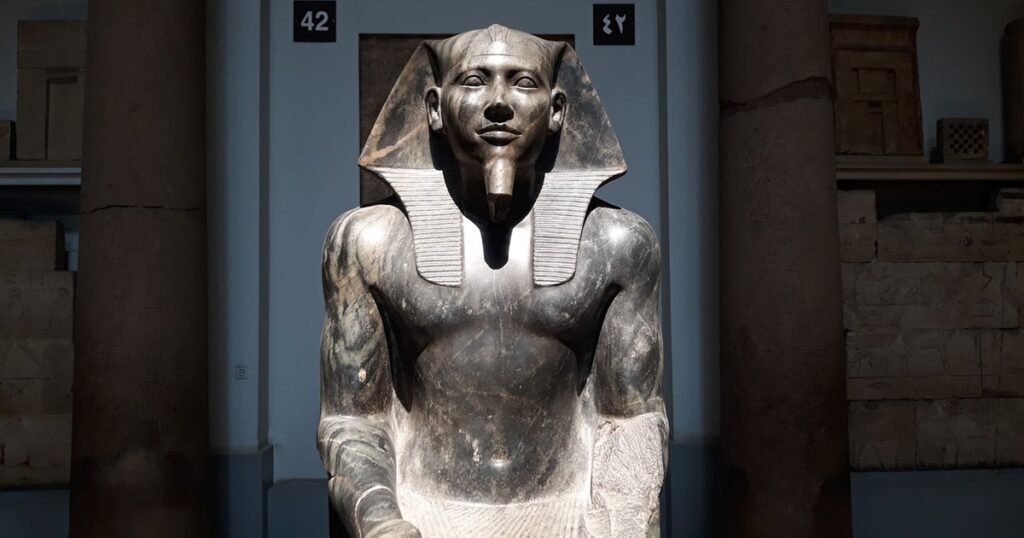
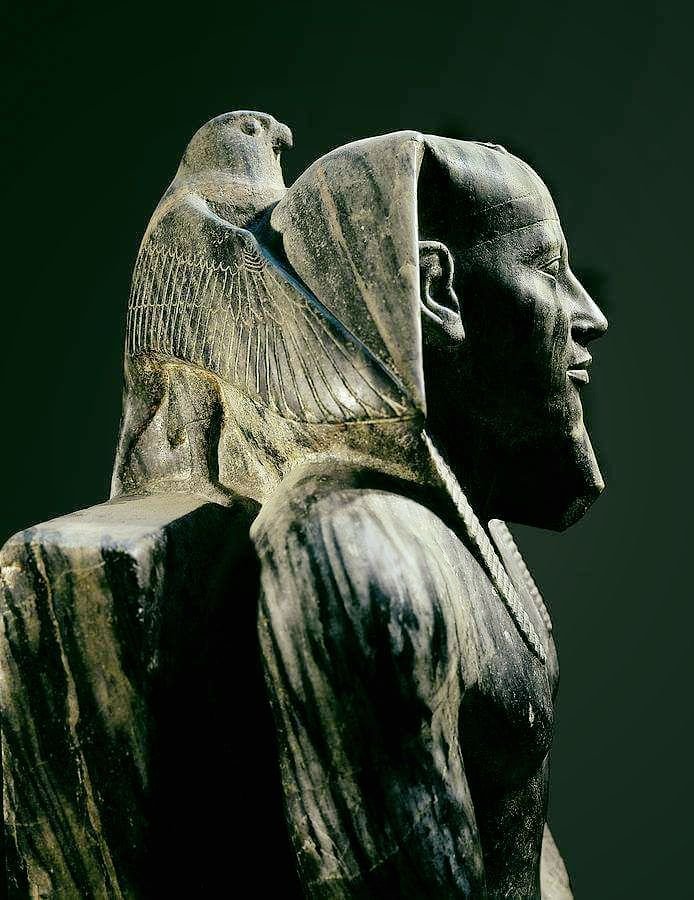
Pharaoh Khafre, the son of Khufu and the builder of the second-largest pyramid at Giza, remains one of the most powerful and enigmatic figures of the Fourth Dynasty. Known to the Greeks as Chephren, his reign was marked by a desire to continue the monumental legacy of his father while carving out his own distinct place in eternity. Unlike the controversial image of Khufu, Khafre is often depicted in sculpture as the quintessential divine king—serene, powerful, and eternally youthful. The most famous likeness of him, carved from dark diorite and now housed in the Cairo Museum, shows the Horus falcon wrapping its wings around the King’s head, symbolizing his divine protection and authority. For the traveler, understanding Khafre is key to appreciating the symmetry of the Giza Plateau. He did not seek to surpass his father in sheer volume, but rather in strategic positioning and artistic harmony. His decision to build on a higher elevation was a masterstroke of psychological architecture, ensuring his monument would dominate the skyline. Khafre’s reign represented a period of stability and artistic flourishing, where the funerary cult reached its highest level of ritualistic complexity. To walk through his complex is to encounter the spirit of a King who understood that true immortality lay in the balance between power and beauty. He was not just a successor; he was the architect of a unified sacred vision that successfully linked the heavens, the pyramid, and the watchful gaze of the Sphinx into a single, eternal kingdom of stone.
2. The Optical Illusion: Architecture and Elevation
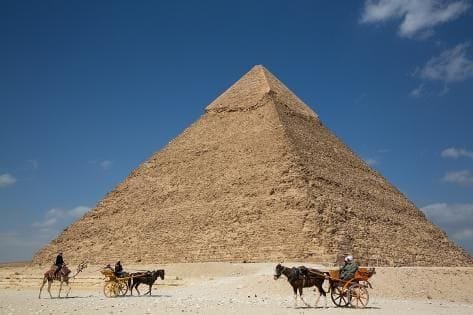
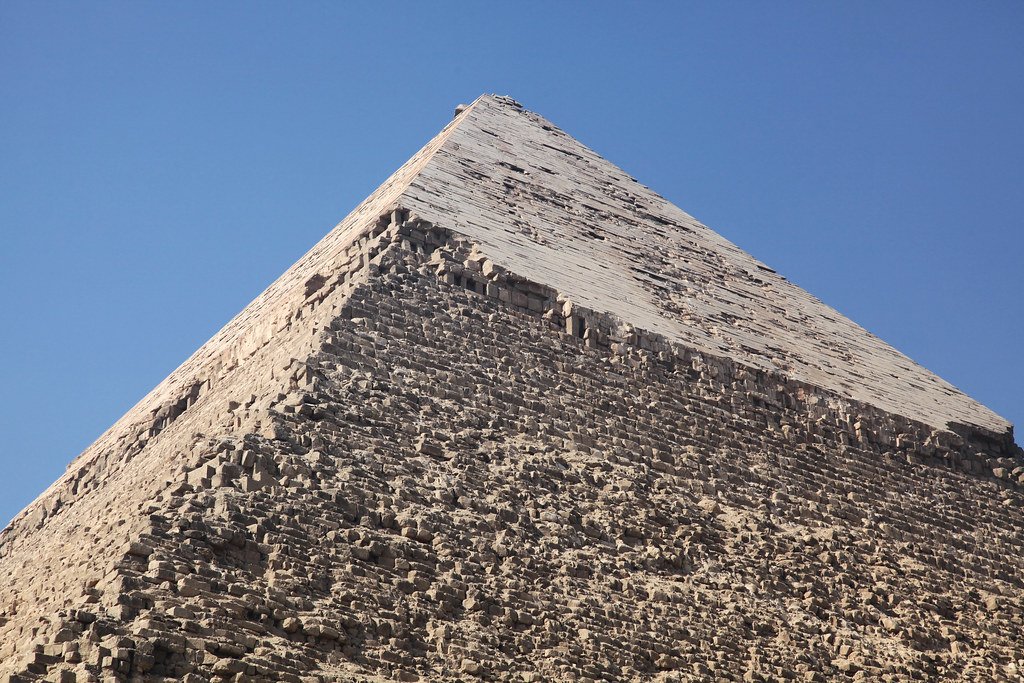
One of the most fascinating aspects of the Pyramid of Khafre is the "architectural trickery" that makes it the most photographed monument at Giza. Although it is physically smaller than the Great Pyramid of Khufu—standing at roughly 136.4 meters compared to Khufu’s 146—Khafre’s pyramid appears taller from almost every vantage point on the plateau. This is because Khafre’s architects chose a site on a natural limestone pedestal that sits 10 meters higher than his father’s base. Additionally, the pyramid’s steeper angle of inclination (about 53 degrees) gives it a more pointed, soaring appearance. For the modern visitor, this design is a lesson in ancient perspective and ego. It shows that the Egyptians were masters of the landscape, capable of manipulating the viewer's perception to enhance the majesty of the King. The structure itself is incredibly dense and rugged, built with massive limestone blocks that give it a sense of indestructible weight. Near the top, you can still see the famous "casing cap," a remnant of the smooth limestone that once covered the entire surface. This cap serves as a visual bridge between the ruined past and the polished perfection of the original construction. Looking up at Khafre’s pyramid, one realizes that its beauty lies in this tension between the raw core and the refined apex. It is a monument that commands the eye, proving that in the hands of the right architect, height is not just a matter of measurement, but a matter of vision and the clever use of the earth itself.
3. The Interior Realm: A Descent into Simplicity
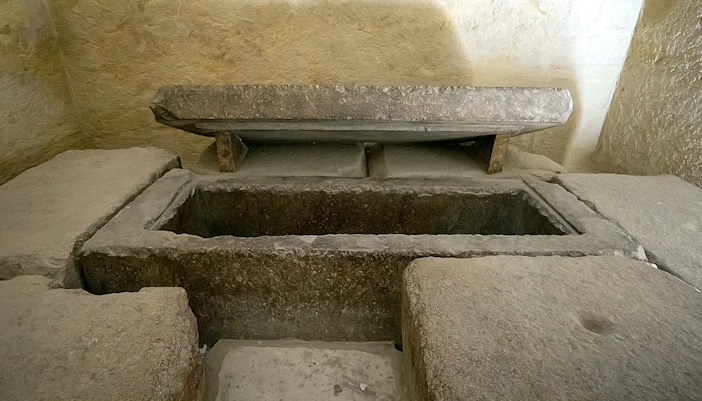
Unlike the complex, multi-level passages of the Great Pyramid, the interior of Khafre’s pyramid is characterized by a stark, subterranean simplicity that evokes a profound sense of ancient mystery. There are two entrances on the northern side—one located about 11 meters up the face and another at ground level—both of which lead to a single, massive burial chamber carved directly into the bedrock. For the traveler, the descent into Khafre’s tomb feels more raw and elemental than the climb inside Khufu’s. The burial chamber is a large, rectangular room with a gabled ceiling of limestone beams, designed to withstand the colossal pressure of the pyramid above. The only decoration is the silence and the empty, black granite sarcophagus sunk into the floor, inscribed with the name of the Italian explorer Giovanni Belzoni, who rediscovered the entrance in 1818. There are no grand galleries or hidden air shafts here; instead, the focus is entirely on the King’s final resting place within the earth. This design reflects a different theological focus, perhaps emphasizing the King’s connection to the chthonic powers of the underworld. Walking through these passages, you feel the cool, damp breath of the plateau and the absolute weight of the stone mountain surrounding you. It is a humble yet powerful space that reminds us that even for a god-king, the journey eventually leads back to the heart of the earth. The simplicity of Khafre’s interior makes the experience more intimate, allowing the visitor to stand in the quiet dark and contemplate the eternal rest of a Pharaoh.

4. The Valley Temple: A Masterpiece of Megalithic Masonry
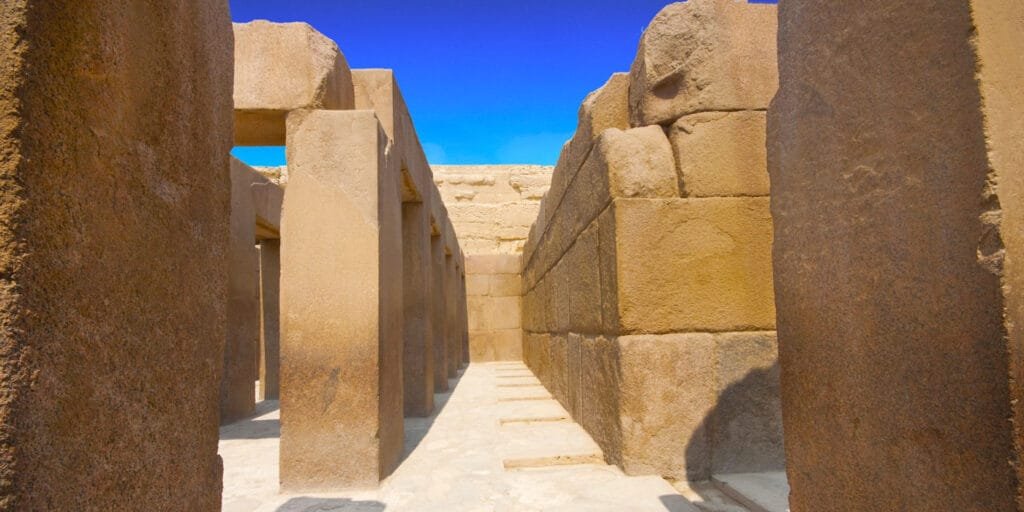
The Valley Temple of Khafre is arguably the most impressive and best-preserved structure of its kind from the Old Kingdom. Located at the end of the long causeway, this temple was constructed using massive blocks of local limestone encased in polished red Aswan granite. Its architectural style is one of "severe elegance," characterized by sharp angles, colossal T-shaped pillars, and floors of creamy white alabaster. For the traveler, walking through this temple is a sensory revelation; the contrast between the deep red granite and the white floors creates a timeless, modern aesthetic that feels strangely contemporary. This was the sacred place where the "Opening of the Mouth" ritual was likely performed—a ceremony designed to reanimate the Pharaoh's senses for the afterlife. The precision of the stonework is so absolute that the joints are nearly invisible, a feat of engineering that remains unexplained by modern technology. Unlike the pyramids, which are experienced from the outside, the Valley Temple offers an immersive interior experience of ancient Egyptian power. Standing in its main hall, you are surrounded by the sheer weight of history, feeling the coolness of the granite and the hushed atmosphere of a space that was built to exist for millions of years. It serves as the majestic gateway to the pyramid complex, proving that Khafre’s builders were as skilled at creating sophisticated interior spaces as they were at stacking mountains of stone.
5. The Diorite Statue: The King Protected by Horus
Within the shadows of the Valley Temple, archaeologists discovered one of the greatest masterpieces of world art: the seated diorite statue of Khafre. This sculpture is more than just a likeness; it is a profound theological statement in stone. The King sits on a throne decorated with the sema-tawy symbol (the union of Upper and Lower Egypt), while the falcon god Horus perches behind his head, spreading his wings in a gesture of divine protection. For the visitor, this statue—now the centerpiece of the Cairo Museum—explains the spiritual confidence behind the pyramid itself. Diorite is one of the hardest stones on earth, yet the ancient sculptors carved it with such fluid grace that the King’s skin appears soft and his gaze eternal. The statue was designed to serve as a Ka vessel, a permanent home for the Pharaoh’s soul should his body be disturbed. When you visit the site, you can still see the pits where several such statues were originally placed. This artistic legacy proves that under Khafre, the Egyptian state reached a peak of craftsmanship where the most difficult materials were bent to the King’s will. It reminds us that the pyramid was not an isolated project, but part of a grand artistic program aimed at immortalizing the King as the earthly embodiment of the divine. The diorite Khafre remains the ultimate icon of the Old Kingdom, a symbol of serenity and absolute power that has outlasted the rise and fall of countless empires.
6. The Great Sphinx: The Guardian of the Horizon
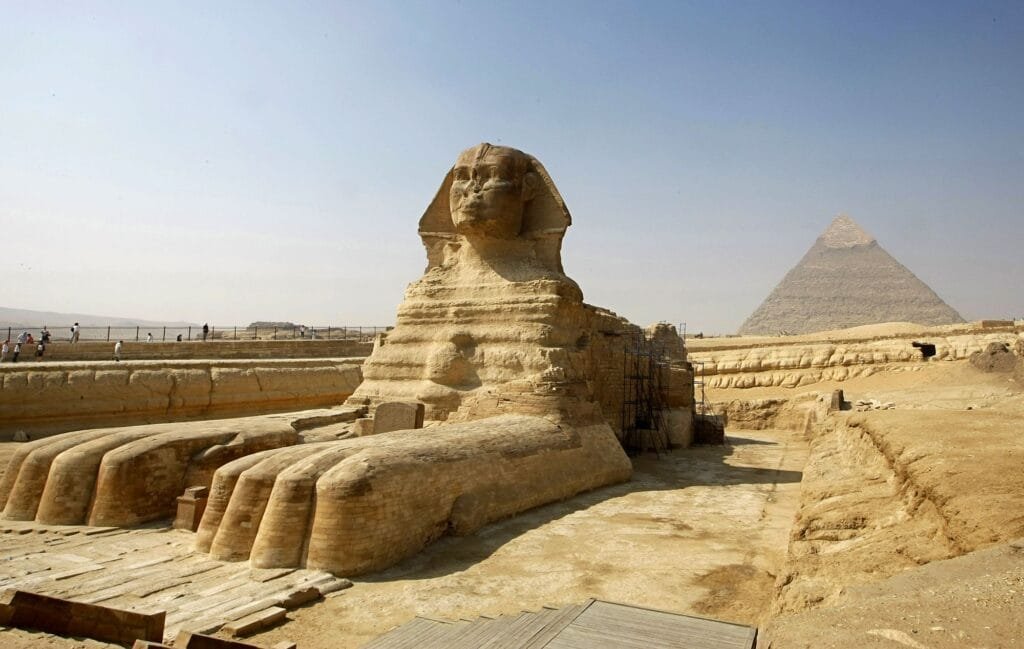
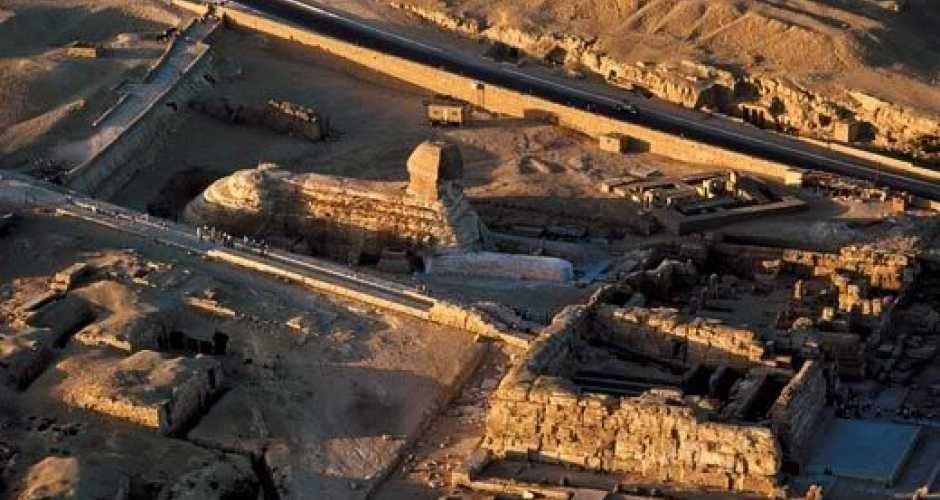
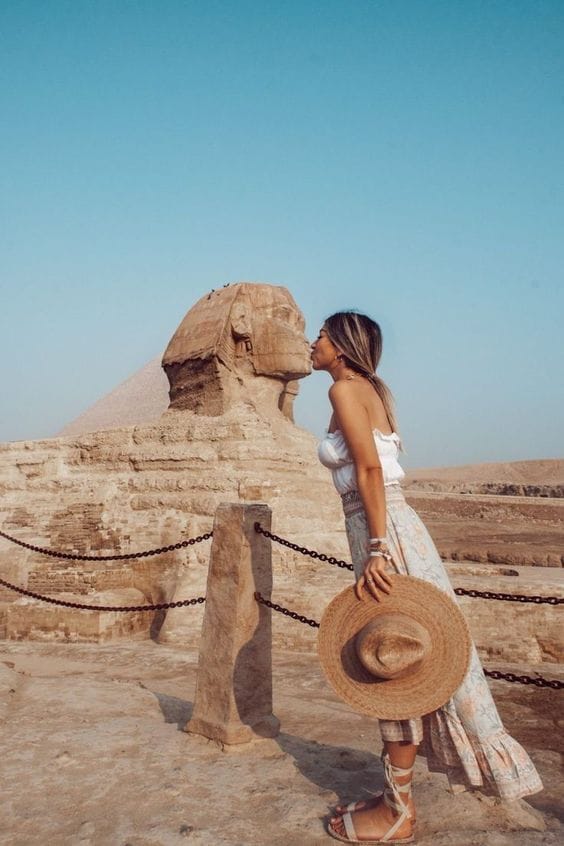
No discussion of Khafre’s pyramid is complete without the Great Sphinx, the colossal limestone guardian that rests at the base of his causeway. Carved directly from the bedrock of the plateau, the Sphinx features the body of a lion and the head of a king, widely believed to be Khafre himself. This monumental sculpture acts as the "Guardian of the Horizon," positioned to protect the pyramid complex and greet the rising sun. For the traveler, the relationship between the Sphinx and the pyramid is the most iconic visual in Egypt. It represents the perfect synthesis of architecture and landscape, where the living rock is transformed into a divine symbol. The Sphinx’s face, though weathered by time and sand, still carries the regal features of the Fourth Dynasty, staring eternally toward the east. This proximity suggests that the entire Giza Plateau was a unified sacred map, with the Sphinx serving as the solar sentinel for Khafre’s eternal dwelling. Standing at the Sphinx’s paws and looking up at the towering pyramid behind it, one realizes the sheer scale of Khafre’s vision. He did not just build a tomb; he redefined the landscape of Egypt, placing a divine protector at its gate. The Sphinx is the bridge between the human world and the afterlife, a silent witness to the greatness of a King who successfully merged the power of the beast with the wisdom of the divine, creating a legacy that continues to haunt and inspire the modern imagination.

7. The Sacred Causeway: A Path for the Soul
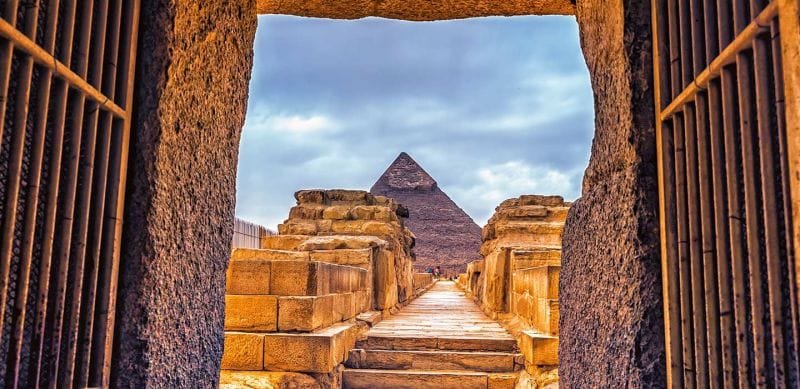
Connecting the Valley Temple to the Pyramid itself is the grand causeway, a monumental stone ramp that spans nearly 500 meters across the desert floor. In antiquity, this was a fully enclosed corridor, its walls likely decorated with vibrant reliefs depicting the King’s life and his transition into the divine realm. Today, the roof is gone, but the massive limestone floor remains, offering the traveler a dramatic, guided approach to the pyramid's base. Walking this path is a highlight of any visit, as it provides a shifting perspective of the monument, with the pyramid growing in stature and majesty with every step. To the ancient Egyptians, the causeway was more than just a road; it was a symbolic umbilical cord connecting the world of the living (near the Nile) to the world of the dead (on the high plateau). It served as the processional route for the royal funeral, where the King’s mummy was carried from the embalming temple toward his eternal resting place. For the modern visitor, the causeway is the best place to appreciate the logistical scale of the complex. You can see how the architects integrated the natural slope of the land into the sacred design, creating a seamless ascent that feels both physical and spiritual. It is a place of transition, where the heat of the desert and the weight of the stones combine to remind you that you are following in the footsteps of priests and kings, moving toward the heart of the Giza mystery.
8. The Girdle of Granite: A Foundation of Power
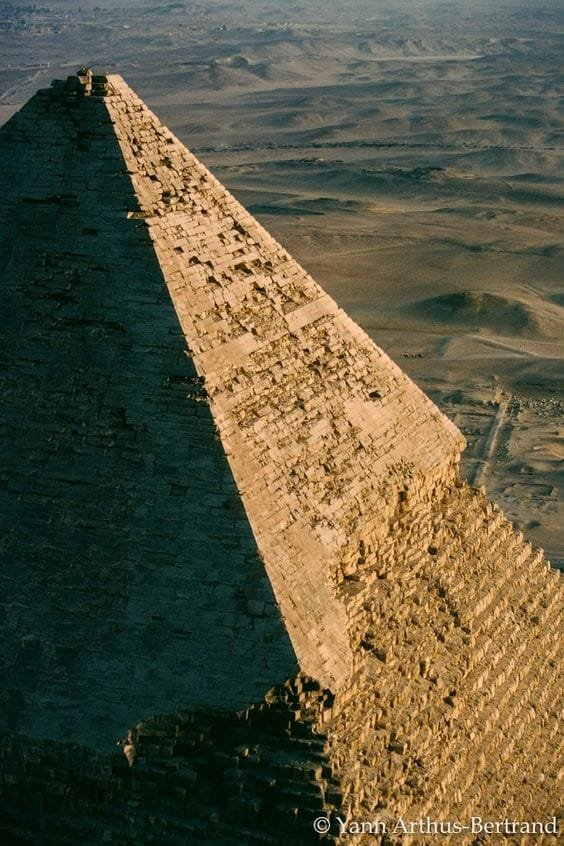
While most of Khafre’s pyramid is built from yellow limestone, its lowest courses were once encased in massive blocks of pink Aswan granite, some of which still remain in place today. This "granite girdle" served both a structural and a symbolic purpose. Structurally, the density of the granite provided a solid foundation for the millions of tons of stone above. Symbolically, the red hue of the granite was associated with the sun and rebirth, creating a vibrant visual contrast with the white limestone that covered the upper sections. For the traveler, these lower blocks are a testament to the sheer physical effort required to build at Giza. Each granite block, weighing several tons, had to be floated down the Nile from 800 kilometers away and then precisely fitted without the use of mortar. Touching these smooth, weathered stones allows you to feel the raw power of the Fourth Dynasty. They represent a time when the Pharaoh had absolute command over the most difficult materials the earth could offer. Over the millennia, much of this granite was stripped away to be reused in later buildings, but the surviving fragments at the base remain as scars of honor. They remind us that the pyramid was not just a pile of rock, but a carefully engineered composite of the earth's finest minerals, designed to withstand the erosion of wind and sand for millions of years, ensuring that the King’s "house of eternity" would never crumble.
9. The Casing Cap: A Glimpse of Original Splendor
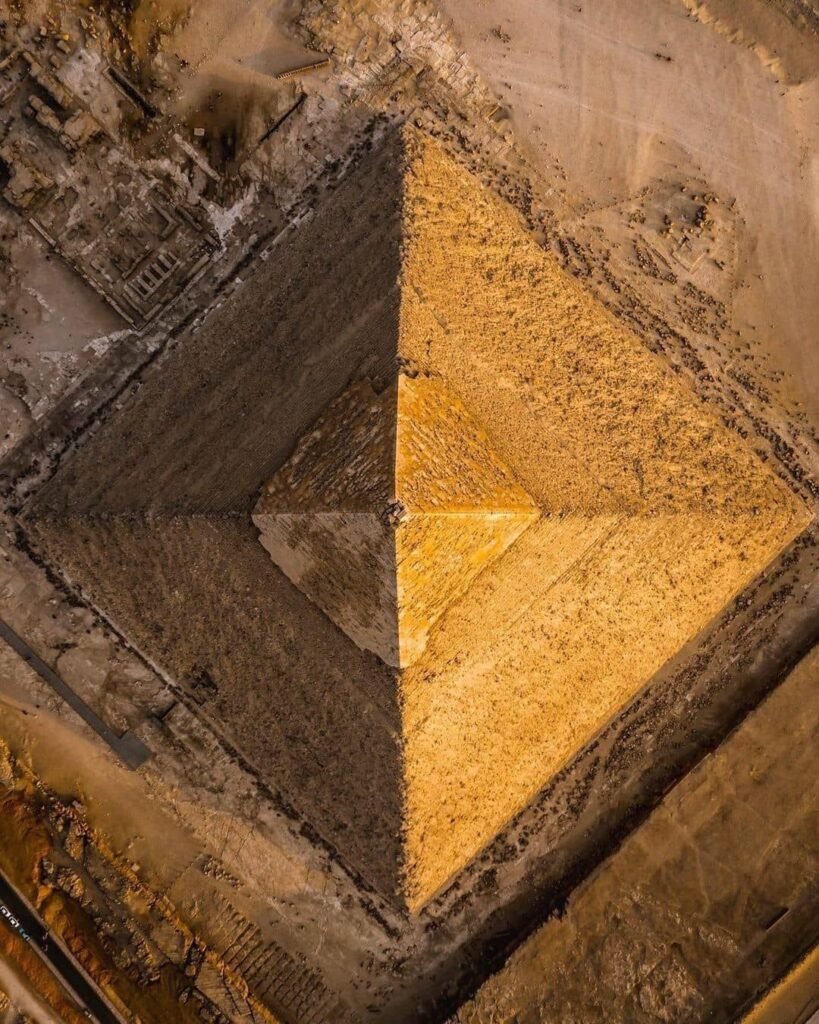
The most defining feature of the Pyramid of Khafre is the "cap" of original casing stones that still clings to its summit. This remnant of white Tura limestone is the only significant piece of original pyramid exterior left in the Giza necropolis, giving us a vital clue as to how these monuments appeared 4,500 years ago. In antiquity, the entire pyramid was smooth and polished, reflecting the sun’s rays so brightly that it would have been visible from many miles away, appearing like a solid, glowing crystal. For the visitor looking up from the base, the cap provides a fascinating contrast to the rugged, stepped core below. It shows the incredible precision of the ancient masons, who joined these outer stones so tightly that a hair could not pass between them. The cap also reveals why Khafre’s pyramid feels more "complete" than its neighbors; it preserves the original silhouette and the sharp, clean lines intended by the architects. This surviving fragment has witnessed the rise and fall of every Egyptian dynasty, the arrival of Greek travelers, Roman soldiers, and modern explorers. It stands as a silent witness to the passage of time, a hauntingly beautiful reminder of the perfection that once was. Seeing the cap against a clear blue sky is a moment of pure wonder, as it allows the imagination to rebuild the pyramid in its full, gleaming glory, transforming a ruin back into the radiant "Stairway to Heaven" that Khafre envisioned for his soul.

10. The Subterranean Secret: A Bedrock Foundation
One of the most remarkable but least discussed features of the Pyramid of Khafre is its profound connection to the very bedrock of the Giza Plateau. While the Great Pyramid is built almost entirely on top of the plateau, a significant portion of Khafre’s interior and its base was carved directly into the natural limestone. This was a deliberate engineering choice that provided the monument with an unshakable foundation. For the visitor, this is most evident when examining the "trench" that surrounds the pyramid on its north and west sides. The builders had to slice through the solid rock to create a level platform for the massive structure. This subterranean effort highlights the dual nature of Egyptian architecture: it was as much about "carving" the earth as it was about "building" upon it. Standing in the shadow of the pyramid, you can see the natural strata of the limestone, realizing that the monument is literally an extension of the Egyptian soil. This integration with the bedrock was believed to anchor the King’s soul to the land of Egypt forever. It serves as a reminder that the pyramid was not just an object placed on the sand, but a permanent transformation of the earth itself. Understanding this hidden foundation allows the traveler to appreciate the sheer volume of material removed—not just added—to achieve the perfect symmetry of Khafre’s eternal home, showcasing a mastery over the physical world that is both terrestrial and divine.
11. Belzoni’s Mark: The Rediscovery of the Interior
The history of Khafre’s pyramid is not only a story of ancient kings but also of daring explorers. In March 1818, the Italian explorer Giovanni Belzoni became the first person in modern times to find the entrance to the burial chamber. Upon entering, he found the space empty, save for a few bones and a large granite sarcophagus. In a moment of bold triumph, Belzoni painted his name and the date of his discovery in large black letters on the chamber’s wall—an inscription that remains clearly visible to this day. For the modern traveler, seeing Belzoni’s "graffiti" adds a fascinating layer of 19th-century adventure to the ancient site. It marks the beginning of the era of modern Egyptology, a time when the pyramids were shifting from mysterious myths into studied archaeological treasures. While some might see the inscription as a defacement, it has become part of the pyramid's long history, representing the bridge between the ancient world and the modern curiosity that drives us to explore it. Standing in the chamber and reading those letters, you feel a connection to the explorers who risked their lives in the dark, dusty tunnels to unlock the secrets of the Pharaohs. Belzoni’s mark is a reminder that the Pyramid of Khafre is a living monument, a place where the stories of the Fourth Dynasty and the seekers of the 1800s converge, creating a narrative of human persistence that spans over four thousand years.
12. The Traveler’s Ritual: Navigating the Descent
Entering the Pyramid of Khafre is a physical experience that demands a sense of adventure and a willingness to embrace the unknown. The journey begins at the ground-level entrance, leading the visitor through a descending passage that is narrow and low, requiring a steady crouch. The air inside is still and warm, carrying the distinct, earthy scent of ancient limestone. For the traveler, this descent is a visceral reminder of the pyramid's purpose as a passage between worlds. Unlike the grand, soaring spaces of Khufu, the tunnels of Khafre feel more like a direct burrow into the heart of the mountain. It is a quiet, meditative crawl that strips away the distractions of the outside world. As you reach the horizontal passage and finally emerge into the burial chamber, the sudden expansion of space is both a relief and a wonder. The chamber’s simplicity—the bare stone walls and the sunken sarcophagus—invites a moment of deep reflection. To visit the interior of Khafre’s pyramid is to participate in a 4,500-year-old ritual of transition. It is a challenge that rewards the visitor with a profound sense of accomplishment and an intimate connection to the King who once lay at the center of this stone universe. Emerging back into the bright Egyptian sunlight, you carry with you the silence of the bedrock and a newfound respect for the ancient architects who could turn a dark, subterranean space into a portal for eternity.
13. The Spiritual Engine: The Pyramid as a Solar Tool
To the ancient Egyptians, the Pyramid of Khafre was more than a passive tomb; it was a sophisticated "spiritual engine" designed to facilitate the King’s transformation into a solar deity. The entire layout of the complex was meticulously aligned with the sun's path, symbolizing the eternal cycle of birth, death, and resurrection. For the traveler, understanding this solar connection changes the way you view the stones. The pyramid was the "Benben," the primordial mound that rose from the waters of chaos at the beginning of time. Every sunrise hitting the limestone cap was a reenactment of creation, recharging the Pharaoh’s spirit for his journey across the celestial Nile. This theological depth is what gives the monument its haunting power; it wasn't just built for the eyes of men, but for the mechanics of the universe. Standing on the eastern side of the pyramid at dawn, one can feel the immense intentionality behind every angle. The structure acted as a bridge between the physical earth and the divine sky, ensuring that Khafre would forever rise with the sun god, Ra. This cosmic purpose is why the pyramid remains so resonant today—it is a physical manifestation of the human desire to overcome mortality and find a permanent place in the grand design of the cosmos. It is a monument to the light, a stone-carved prayer for eternity that continues to capture the imagination of every soul who stands in its long, morning shadow.
14. Modern Echoes: Khafre in the Global Mind
The Pyramid of Khafre has left an indelible mark on the global cultural consciousness, often serving as the "face" of ancient Egypt in cinema, literature, and art. Because of its iconic limestone cap and its association with the Sphinx, it is frequently the primary image used to represent the mystery of the East. For the modern traveler, seeing it in person is a moment of profound recognition—it is the reality behind a thousand postcards and documentaries. Beyond its visual fame, Khafre’s legacy is a symbol of resilience. While the Great Pyramid is often analyzed for its internal complexity, Khafre’s is admired for its external endurance and the way it harmonizes with the natural landscape. In a world that is constantly changing and digitizing, the pyramid stands as a solid, tactile anchor of human achievement. It challenges us to think in terms of millennia rather than minutes. For visitors, this cultural resonance creates a bridge across time, making the distant world of the Fourth Dynasty feel strangely accessible. The pyramid reminds us that the pursuit of beauty, order, and legacy is a universal human trait. It has inspired everyone from Napoléon’s scholars to contemporary architects, proving that Khafre’s vision of majesty was truly universal. It remains a global icon of stability, a mountain of stone that continues to whisper the story of a civilization that built not for the next decade, but for the end of time itself.
15. The Final Gaze: A Farewell to the Second Giant
As you prepare to leave the shadow of the Pyramid of Khafre, the image that stays with you is one of perfect, quiet strength. It is a monument that does not need to shout to be heard; its presence is felt in the weight of the air and the stillness of the desert. To say goodbye to Khafre is to acknowledge the end of the most ambitious era of construction in human history. The second pyramid represents the peak of Giza’s development—a moment when the Egyptian state had mastered the logistics, the art, and the spiritual architecture of the afterlife. For the traveler, the final look at the pyramid, with its white cap glowing against the deepening blue of the sky, is a moment of rare clarity. You carry away a sense of the immense scale of human potential and the sobering reality of the passage of time. The pyramid is a silent teacher, reminding us that while we are small in the face of history, our dreams can be monumental. It remains a sentinel of the horizon, guarding the secrets of the Pharaohs and the questions of the modern world with equal grace. As the desert winds continue to smooth its stones, the Pyramid of Khafre stands as a testament to the fact that some things are truly timeless. It is the heart of Giza, a dark and golden peak that connects our mortal curiosity with the infinite laws of the universe. Leaving the sands, you realize that you don’t just visit Khafre; you experience a standard of greatness that remains unsurpassed, forever etched into the bedrock of human history.
16. The Quarry’s Tale: The Birth of a Giant
To understand the Pyramid of Khafre, one must look at the ground beneath it. The construction of this massive monument was a masterclass in local resource management. Most of the limestone blocks were quarried from the immediate area surrounding the pyramid, creating a deep trench that highlights the sheer volume of stone removed from the plateau. This process was not merely destructive; it was a surgical extraction that allowed the architects to use the natural landscape as part of the building’s foundation. For the traveler, exploring the quarry areas around Khafre’s pyramid offers a behind-the-scenes look at the ancient construction site. You can see the tool marks left by copper chisels and wooden wedges, and the veins of rock that match the blocks used in the pyramid’s core. This connection to the "living rock" gives the monument an organic feel, as if it grew directly out of the Earth. It reminds us that the pyramid was not just transported to Giza; it was born from Giza. The logistical genius required to coordinate thousands of workers in these quarries, ensuring a steady flow of stone while maintaining the precise geometry of the rising structure, is a feat that rivals the final product. Understanding the quarry’s tale allows the visitor to appreciate the sweat, ingenuity, and physical reality of the Old Kingdom, turning the silent stone back into a vibrant, echoing site of human labor and divine ambition.

17. Architectural Harmony: The Symmetry of the Necropolis
The Pyramid of Khafre is the cornerstone of the Giza Plateau’s visual harmony. Its placement was not accidental; it was carefully calculated to create a balanced, aesthetic relationship with the pyramids of Khufu and Menkaure. When viewed from the south, the three pyramids align in a perfect diagonal, mirroring the stars of Orion’s Belt. This spatial intelligence shows that Khafre’s architects were concerned with more than just a single tomb—they were designing a unified sacred city. For the modern visitor, this symmetry is best appreciated from the "Panorama" viewpoint, where the pyramids appear as a synchronized dance of geometry against the desert horizon. Khafre’s monument acts as the visual anchor of the trio, its steeper angle and remaining casing cap drawing the eye to the center of the complex. This sense of order and proportion is what makes Giza feel like a singular, coherent masterpiece rather than a collection of separate ruins. It reflects the Egyptian concept of Ma'at—the balance and order that held the universe together. Walking between the monuments, you can feel the rhythm of the architecture, where every gap, angle, and temple was placed to create a sense of cosmic peace. Khafre’s pyramid is the heartbeat of this arrangement, a testament to a civilization that understood that true beauty lies in how we relate to the space around us and the infinite patterns of the cosmos.
18. The Eternal Echo: A Final Farewell to Khafre
As the final rays of the Egyptian sun strike the limestone cap of Khafre’s pyramid, the monument seems to glow with an inner light, a silent echo of its former glory. This final farewell to the second giant is a moment of deep reflection for any traveler. You have walked the causeway, touched the granite base, and descended into the quiet heart of the bedrock. What remains is a profound sense of the pyramid’s "immovability"—not just in a physical sense, but in its place in the human spirit. Khafre’s pyramid is a victory over the temporary; it has survived the erosion of time, the greed of treasure hunters, and the weight of millennia to stand as a beacon of what humanity can achieve. It challenges us to build our own lives with the same precision, integrity, and long-term vision. Leaving the plateau, you realize that the pyramid is no longer just a historical site; it is a mental landmark, a symbol of the peak of human capability. It stands as a silent guardian of the Egyptian soul, a mountain of stone that will continue to inspire awe long after modern cities have turned to dust. The legacy of Khafre is not found in the empty sarcophagus or the broken temples, but in the enduring wonder it ignites in every heart that experiences its shadow. It is the second wonder, the middle giant, and the eternal sentinel of the horizon—a masterpiece that remains, now and forever, a bridge between the dust of the earth and the light of the stars.